
Kichijoji is the town Tokyo keeps voting for. Every year some magazine runs the "where do you want to live" poll and every year Kichijoji is at or near the top, and the annoying thing is that it earns it: Inokashira Park with its swan boats and its dying-and-replanted cherry trees, the Ghibli Museum one stop down in Mitaka, a used-bookstore density that shouldn't be economically possible, Harmonica Yokocho — a warren of postwar black-market stalls that turned into standing bars — and two rail lines, the JR Chuo running east into Shinjuku and the Keio Inokashira running southeast into Shibuya.
What Kichijoji is not is a red-light district. There's no soap street, no scout on the corner, no wall of pink signage. It's a place people live, which creates a very specific commercial problem for a shop like this one: your customer is usually going home, not to a hotel. Hold onto that, because the entire operating design here follows from it.
The shop
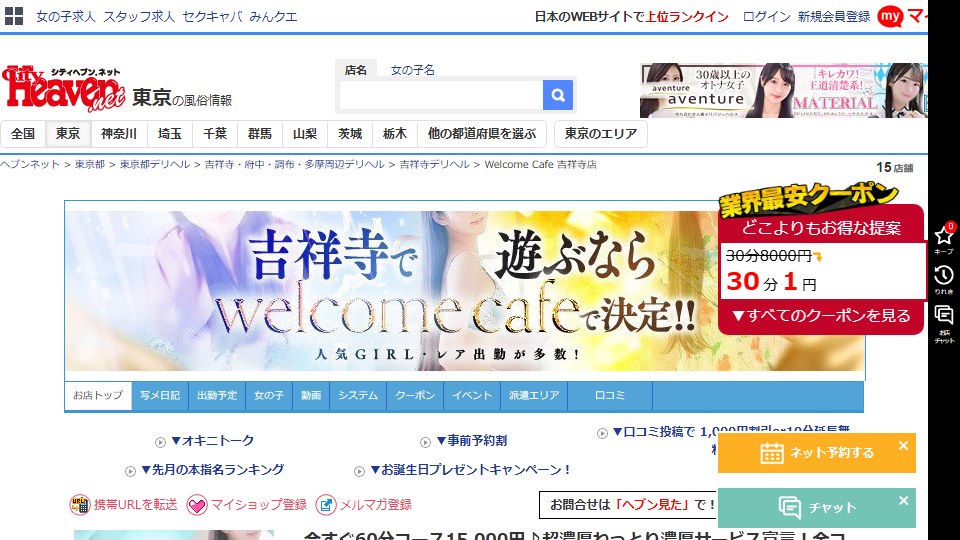
Welcome Cafe 吉祥寺店 — Welcome Cafe Kichijoji — a deriheru (delivery health, outcall) in Musashino City, filed on Cityheaven under the standard classification. Phone is 0422-28-5228. Official site is welcomecafe.net. It's a branch of a fifteen-store chain whose flagship is Welcome Cafe Hachioji, and the chain-wide roster Cityheaven counts runs to 1,311 women — that's all fifteen stores together, not this one, and anybody quoting that number at you as a Kichijoji figure is selling something.
Hours are 10:00 to 05:30, 年中無休, no closed days. Reception runs 09:45 to 04:00.
Look at those two windows next to each other, because they're not the same window. The shop stops answering the phone at four in the morning and stops operating at five-thirty. That's a ninety-minute tail — exactly one 90-minute course. The last call you can make buys you the 90 and nothing longer. Whether that's deliberate or arithmetic accident, it tells you which course this shop builds its clock around, and as we'll see, the price board says the same thing.
The house line: 昼は待ち合わせ&デリバリー、夜はデリバリーと、お客様のライフスタイルに合わせてご利用下さい — by day, meetup and delivery; by night, delivery. Cast described as 18~30代, spanning スレンダー美女、癒し系、グラマー系. The catchphrase is 超濃厚ねっとり濃厚サービス宣言!, which manages to say "rich" twice in six characters and is exactly as informative as it sounds.
Two maps, and they're different shapes
Here's the thing I actually went out there to look at.
The meetup map is a rail line. Station pickup: Kichijoji free. Musashisakai, Ogikubo, Mitaka — ¥1,000, and only until 20:00. Pull up a Chuo Line map and read those in order: Ogikubo, (Nishi-Ogikubo), Kichijoji, Mitaka, Musashisakai. Four stations, one line, walking-distance-from-the-platform logistics. That's not a service area, that's a commute.
The delivery map is a road network. Kichijoji-area hotels free; Musashino ¥2,000→¥1,000; Mitaka, Chofu, Fuchu and neighbors ¥3,000→¥2,000; Kiyose, Higashiyamato, Musashimurayama, Higashimurayama, Inagi ¥4,000→¥3,000. Those are municipalities, not stations, and they fan out north and south into places the Chuo Line does not go. Inagi is down by the Tama River near Kawasaki. Higashiyamato is up past Tachikawa. You do not get to either one on foot from a platform.
So the shop runs a train product until eight and a car product after, and the small print says so outright: 夜間は車でのデリバリーのみとなり、お待ち合わせは出来ません — at night it's car delivery only, no meetups. That's a real constraint, published, and it is the single most important sentence on the page for anyone who was planning to meet at Ogikubo at nine.
While we're in the transport table: every discounted ring is discounted by exactly ¥1,000. Two becomes one, three becomes two, four becomes three. The crossed-out numbers are decoration. The actual board is free / ¥1,000 / ¥2,000 / ¥3,000, and I'd rather a shop just print that — but I'll take a published transport fee over the industry-standard "please ask by phone" any day of the week. This one tells you what the ride costs before you dial. That's rarer than it should be.
The board
| Course | Price | Per minute |
|---|---|---|
| 60 min | ¥15,000 | ¥250.00 |
| 90 min | ¥20,000 | ¥222.22 |
| 120 min | ¥28,000 | ¥233.33 |
| 180 min | ¥39,000 | ¥216.67 |
| 270 min | ¥58,000 | ¥214.81 |
| 9 hours (540 min) | ¥110,000 | ¥203.70 |
Extension: 30 minutes, ¥8,000. No entry fee and no nomination fee — 入会金、指名料は一切なし! — which on a board this shape is worth actual money, because a ¥2,000 nomination charge would wipe out most of what follows.
Now read that per-minute column again. It goes down, then up, then down. The 120 is more expensive per minute than the 90 and more expensive per minute than the 180. On a volume ladder, that's a pothole, and potholes are always caused by something.
Read the steps, not the rungs
| Step | Extra minutes | Cost | Per minute |
|---|---|---|---|
| 60 → 90 | +30 | ¥5,000 | ¥166.67 |
| 90 → 120 | +30 | ¥8,000 | ¥266.67 |
| 120 → 180 | +60 | ¥11,000 | ¥183.33 |
| 180 → 270 | +90 | ¥19,000 | ¥211.11 |
| 270 → 540 | +270 | ¥52,000 | ¥192.59 |
| (extension) | +30 | ¥8,000 | ¥266.67 |
Three findings fall straight out of that table, and they're the whole article.
One: the cheapest thirty minutes at this shop cost ¥5,000, and they're the ones between the 60 and the 90. ¥166.67 a minute against a house average north of ¥210. Buy the 60 and extend once and you've paid ¥23,000 for ninety minutes that cost ¥20,000 if you'd said "90" on the phone. Three thousand yen, for a word. If there is any chance you want ninety minutes, the 60 is a mistake, and it's the most common mistake available on this board.
Two: the 90 → 120 step costs ¥8,000, which is exactly the extension price. Not approximately. Exactly. Which means the 120 is not a course, it's the 90 with an extension pre-attached at list price — and booking it in advance buys you nothing you cannot buy later for the same money. That's the pothole in the per-minute column, and it has a clean practical consequence:
Book the 90. It's the only rung on this board that comes with a free option. If you want thirty more, extend — same ¥8,000 you'd have paid up front. If you don't, you've saved ¥8,000 that a 120 booking would have committed. There is no scenario in which booking the 120 beats booking the 90 and deciding in the room.
Three: above the 120, the commitment discount comes back. The 180 costs ¥11,000 more than the 120 for a full extra hour; assembling that same hour out of two extensions costs ¥16,000. So if you already know you want three hours, say three hours — that's ¥5,000 you don't leave on the nightstand. The board's shape, end to end: discount, no discount, discount. Cheap to step up to the 90, free to defer past it, expensive to improvise past the 120.
The coupons, ranked honestly
Four are posted. They are not equally good, and the best one is not the one with "new customer" on it.
ヒメ割 — 100 minutes for ¥20,000. Ten free minutes bolted onto the 90. Say 「シティヘブンのヒメ割希望」 when you call. Restricted to women flagged as immediately available. Do the division: ¥200.00 a minute — the cheapest per-minute cell on the entire board, undercutting even the nine-hour stay at ¥203.70. You give up free choice of partner to get it. That's the trade, and it's a real one, but nothing else on this page reaches ¥200.
Birthday, route A — 30-minute extension for ¥1. Within three days either side, members only, once a year, ID required, not stackable.
Birthday, route B — ¥8,000 off, taking the 120 to ¥20,000. Same window, same conditions, applies to the 120 and 180.
Notice that those two are the same coupon wearing different clothes. Route A hands you a ¥8,000 extension for one yen. Route B hands you ¥8,000 off. Apply route A to the 90 and you get 120 minutes for ¥20,001; take route B and you get 120 minutes for ¥20,000. This shop values your birthday at exactly ¥8,000 and offers two roads to the identical number, which is presumably why they're not combinable. Fair enough. Just take route B on the 180, where the discount lands on a rung that was already the second-cheapest per minute on the board.
New customer benefit — 90 minutes, ¥20,000, plus a pink rotor and ¥1,000 in points toward your next visit. Look closely: ¥20,000 for the 90 is the printed list price. Cityheaven renders this as "9% off," but the course price it names is the same course price the board already names. So the first-timer offer is not a discount on the hour; it's a toy and a thousand yen you can only spend by coming back. Which makes it, on pure arithmetic, the weakest of the four — a new customer who asks for the ヒメ割 instead gets ten extra minutes for the same ¥20,000. Whether the two can run together is a phone question, and it's the one I'd ask first.
Member ID isn't issued at the door, either: ご利用日翌日に電話もしくはメールにて当店にご連絡を頂ければ会員IDとパスワードをお知らせいたします — call or email the day after and they'll send credentials. The points are real; the paperwork is on you.
What's included, and what costs extra
The free list is long, and the length is the point: Dキス、玉舐め、生フェラ、素股、69、口内発射、指入れ、オナニー鑑賞、パイズリ、言葉攻め、アナル舐め、全身リップ、ソフトM、ソフトS、障害者対応. That last item — accommodation for customers with disabilities, listed among the free options rather than buried or priced — is not something I see on most boards, and a shop that puts it in the standard column has made a decision about who it's willing to serve.
Paid options run ¥1,000 to ¥5,000: ノーパン ¥1,000, ノーブラ ¥1,000, 放尿 ¥1,000; ローター ¥2,000, 電マ ¥2,000, ウーマナイザー ¥2,000; バイブ ¥3,000, 撮影5枚 ¥3,000; ゴックン ¥5,000, AF ¥5,000. Standard shape for a standard shop, and note that the new-customer rotor is a ¥2,000 option handed over free — the one part of that offer with a printed price attached.
On hygiene: 全コンパニオンに月に1度のSTD検査を義務付けておりますので衛生面も万全です — monthly STD screening required of all companions. It's a claim on a web page and you should weigh it as one, but it's a specific, falsifiable, dated-cadence claim rather than the usual vague reassurance, and specificity is the only signal available here.
What the page doesn't tell you
Payment method isn't published. Nowhere on the listing does it say whether cards are taken or it's cash only. In a town full of people going back to their own apartments, that's the second thing I'd ask on the call.
The prohibited-conduct list isn't on the listing either. Every standard shop has one; this one just isn't printed where I could read it. Assume the usual — no filming outside the paid option, no coercion, no intoxication — and confirm.
The 20:00 pickup cutoff has an edge nobody explains. If you book at 19:40 for a Mitaka meetup, does the cutoff apply to the booking or the meeting? Ten minutes of ambiguity, one question, worth asking rather than discovering on a platform.
"Advance reservation required" is doing quiet work on the nine-hour. ¥110,000 for 540 minutes at ¥203.70 a minute is the best raw rate on the standard board, but it isn't something you call up and get. Plan it or forget it.
What it costs, all in
A first-timer at a Kichijoji-area hotel, 90 minutes, no options, no transport: ¥20,000. Nothing added at the door — no entry fee, no nomination fee, free delivery inside the free ring. That's an unusually clean number for this industry, where the printed price and the paid price are usually two different quantities.
Push out one ring to Mitaka or Chofu and it's ¥22,000. Out to Inagi or Higashiyamato, ¥23,000. Meet at Ogikubo before eight and it's ¥21,000, and after eight it isn't available at any price.
The number I'd actually pay: ¥20,000 for the ヒメ割 100, before 20:00, meeting at Kichijoji Station, having asked on the phone whether the first-visit points ride along. It's ten free minutes and the best per-minute rate on the page, and the cost is that the shop picks from whoever's free — which, on a Tuesday afternoon in a fifteen-store chain, is a bet I'll take.
Verdict
- Transport disclosure: ★★★★★ — four published rings with published prices, in a business where "ask by phone" is the norm. The theatrical ¥1,000 "discount" on every ring is silly, but the numbers are there before you dial.
- The 90: ★★★★★ — the load-bearing rung. Cheapest step up on the board, and the only course where deferring the next decision is free.
- The 120: ★☆☆☆☆ — do not book this. It is the 90 plus an extension at exactly extension price, and the per-minute column has a visible dent where it sits.
- Coupon honesty: ★★★☆☆ — the ヒメ割 is genuinely the best value on the page, and the offer with "new customer" on it is the worst. Nothing here is dishonest; the labels just don't rank the way the labels suggest.
- Day/night design: ★★★★☆ — a rail-line meetup product and a road-network delivery product under one phone number is a smart read of a residential town. Marked down because the switchover is disclosed in a subordinate clause rather than at the top of the page.
- Going back: ○ — daytime, Kichijoji gate, the 100.
What stays with me about this board is how much of it is legible if you subtract instead of read. The rungs look like a normal descending ladder until you difference them, and then a structure appears: a bargain step at the bottom, a deliberately flat step in the middle that quietly gives you a free option, and a real discount again at the top for people who already know what they want. Layered on top is a shop that changes shape at eight at night because the town it serves changes shape at eight at night — trains until then, cars after, and a price sheet that never bothers to make a slogan out of either. Kichijoji is a place people choose to live in rather than pass through. The shop is built for residents, priced for residents, and honest enough about the ride to the outer rings that you can do the whole calculation on the Chuo Line before you get off.