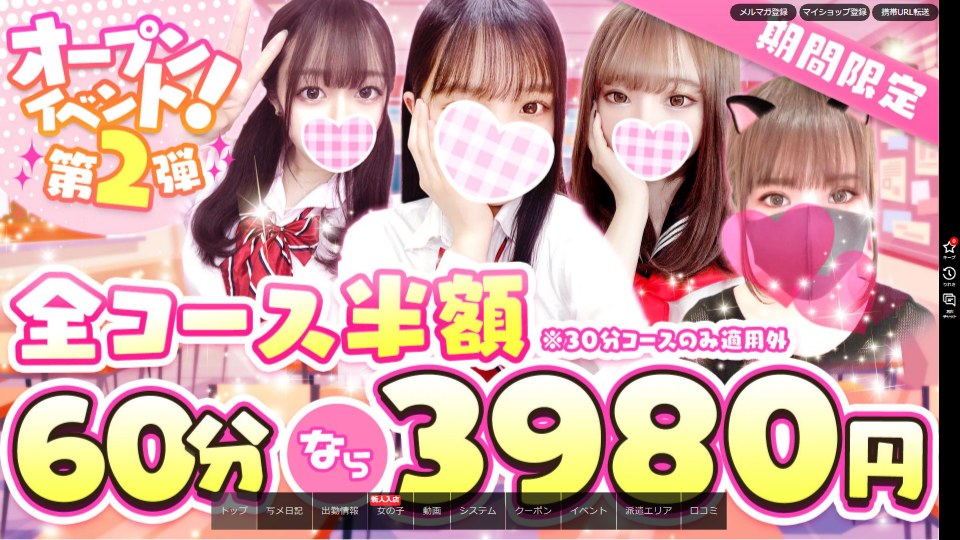

Akihabara sells proximity without contact. That's the district in four words, and it has been for twenty years. The radio-parts stalls under the Sobu Line viaduct gave way to PC shops, the PC shops gave way to anime retail, and somewhere in the mid-2000s the ground floors along Chuo-dori filled up with maid cafés — an industry whose entire product is a woman being warm at you across a table she will not come around. No touching, no leaving. You buy an omelet with ketchup drawn on it and you buy forty-five minutes of someone acting delighted you exist.
Refre is what happens when that transaction gets into a car and goes to a hotel room. Same product — attention, banter, closeness — different room, longer clock, and a legal envelope that has to be drawn a great deal more carefully. Which is what makes this shop worth an afternoon with a calculator, because the envelope and the arithmetic turn out to be the same document.
The shop
リフレ東京秋葉原本店 — Refre Tokyo Akihabara Honten, the flagship branch — is a dispatch refre based in Taito-ku, filed on Cityheaven under the Akihabara / Kanda / Suidobashi area block. Phone is 03-3876-6276. Hours are 10:00 to 24:00, no closed days. Official site is jk-refre.tokyo.
The dispatch map is small and published: 秋葉原・錦糸町のシティホテルかラブホテルへ派遣可能 — city hotels or love hotels in Akihabara and Kinshicho. Two districts, four stops apart on the Sobu Line, and nothing else. That is a genuinely tight service area by Tokyo standards, and a shop that publishes a tight map is telling you something honest about its logistics rather than something flattering about its reach.
It belongs to a 24-store chain carrying 1,607 women on the combined roster. Hold that number. It comes back at the end, and it isn't a boast — it's a consequence.
What it is, and what it says it isn't
Cityheaven files this shop under エステ・アロマ(出張エステ) — dispatch esthetic. The shop's own description, on the same page, says:
マッサージなし、添い寝なし、おしゃべりとイチャイチャのみ(オプション可)
No massage. No lying down together. Talking and flirting only, with paid options available. So the category at the top of the page says massage, and the shop says, in its own words, that there is no massage. I don't think anyone is being deceptive — Cityheaven's taxonomy has no refre bucket, so refre falls into the nearest available box. But it does mean the genre label is the least accurate line on the listing, and anyone who booked off the category booked the wrong thing.
The age policy is stated flatly, and in two halves on two different sites. On Cityheaven: 18歳未満(高校生を含む)の方の利用はお断りいたします。当店には18歳未満のコンパニオンは在籍しておりません。 No customers under 18, no companions under 18. On the official site, the other half: 当店は20歳になった女の子は自動的に卒業するシステムのため、10代の女の子とだけ遊ぶことが可能です — women automatically graduate at twenty.
A floor of eighteen and a ceiling of twenty. Every worker here is a legal adult, and the entire staffing model lives inside a 24-month window. Nearly every structural oddity in this business follows from that fact. We'll get there.
The board is one equation
| Course | Price | Per minute |
|---|---|---|
| 30 min | ¥3,980 | ¥132.67 |
| 60 min | ¥7,980 | ¥133.00 |
| 75 min | ¥9,980 | ¥133.07 |
| 90 min | ¥11,980 | ¥133.11 |
| 120 min | ¥15,980 | ¥133.17 |
Nomination ¥1,000, repeat nomination (本指名) ¥2,000, extension 30 minutes for ¥5,000.
Read the right-hand column top to bottom. It goes up. Not dramatically — half a yen across the whole board — but it never once goes down, and on a price sheet that is a structural statement. There is no volume discount here. There is a small volume penalty.
Here's the mechanism. Every one of those five prices is the same equation:
price = ¥4,000 × (minutes ÷ 30) − ¥20
Check it. Thirty: 4,000 − 20 = 3,980. Sixty: 8,000 − 20 = 7,980. Seventy-five: 10,000 − 20 = 9,980. Ninety: 12,000 − 20 = 11,980. A hundred and twenty: 16,000 − 20 = 15,980. Five for five, no exceptions, no rounding fudge.
So the board is ¥4,000 per half hour, flat — ¥2,000 per quarter hour — with a single twenty-yen shave applied once at the end so every number lands on 80. That twenty yen is the only discount anywhere in the structure, it's a constant rather than a rate, and a constant divided by a growing number shrinks. That is the complete explanation for the rising per-minute column. The longer you book, the less that twenty yen is worth to you.
To be fair to the shop: a flat board is not a scam. It's honest in its own way — ¥2,000 a quarter hour, all day, no games, nothing hidden in the curve because there is no curve. But it does mean the usual method for reading a Japanese price sheet is inert here. There's no sweet spot to hunt. No rung is secretly cheap. Differencing the table hands you ¥133.33 five times and then stops talking.
The one place the line breaks
| Step | Extra minutes | Cost | Per minute |
|---|---|---|---|
| 30 → 60 | +30 | ¥4,000 | ¥133.33 |
| 60 → 75 | +15 | ¥2,000 | ¥133.33 |
| 75 → 90 | +15 | ¥2,000 | ¥133.33 |
| 90 → 120 | +30 | ¥4,000 | ¥133.33 |
| extension | +30 | ¥5,000 | ¥166.67 |
There it is. The extension is the only number in the system that isn't on the line, and it sits 25% above it. Thirty minutes bought in advance costs ¥4,000. The identical thirty minutes bought from inside the room costs ¥5,000.
Which inverts the standard advice. At most shops the courses carry a volume discount and the extension is priced near the top rung, so booking short and extending is roughly neutral and occasionally clever. Here it's a flat ¥1,000 tax on changing your mind, and it is the only pricing decision on this board that can actually go wrong.
Book the length you want. If there's a real chance you want ninety minutes, say ninety — ¥11,980. Booking the sixty and extending buys the same ninety for ¥12,980. Nothing on this board rewards deferring, because deferring is the one thing it charges for.
The fee that isn't on the board
The coupon spells the real number out, and it's the most useful line on the site:
通常 60分 ¥10,980(入会金 ¥2,000 + 指名料 ¥1,000 + コース ¥7,980)→ クーポン 60分 ¥3,980(入会金 ¥0 + 指名料 ¥0 + コース ¥3,980)
So the honest first-visit price of the advertised ¥7,980 hour is ¥10,980 — thirty-seven percent above the board — and that comes to ¥183.00 a minute, which is more expensive than the extension rate we just flagged as the worst deal in the system. The genuinely priciest minutes at this shop are a new customer's ordinary, un-couponed sixty.
And then the coupon takes all of it away. Entry waived, nomination waived, course halved to ¥3,980. That's ¥66.33 a minute, and it is the cheapest per-minute cell on any page of this listing by a distance.
The spread between the most and least expensive minute you can buy here — ¥183.00 against ¥66.33 — is 2.76 to one, on a board whose five headline courses are identical to two decimal places. All of the variance in this business is in the fees and the coupon. None of it is in the menu.
Terms on the coupon, as published: say 「ヘブンクーポン見た!」 when you call; 30分コース対象外 (thirty-minute course excluded); リピーターの方は120分まで有効 (for repeat customers, valid up to 120 minutes); no combining with other discounts; walking course excluded.
"Limited time," since October 2021
The coupon's headline is 真・半額イベント開催!期間限定で全コース半額です☆ — a true half-price event, limited time, all courses half off.
Its validity period is printed directly underneath: 2021/10/10(日)〜無期限. From October 2021, with no expiry.
That's a limited-time offer that has been running for four years and ten months, and which by its own terms cannot end. The other two coupons on the page are dated 2021/09/02 and are also 無期限, so they've been running a month longer than that.
There's only one honest conclusion. The half price is the price. The ¥7,980 hour on the board has not meaningfully been the transacted price of an hour since autumn 2021; the board is a reference number whose function is to make ¥3,980 read as sixty-four percent off. If you ever pay the board price here, it's because you didn't know the coupon existed — and it is permanently available to anyone who says one sentence on the phone.
The thirty-minute course is the trap
Look again at the exclusion: 30分コース対象外.
The thirty-minute course costs ¥3,980. The coupon price of the sixty-minute course is also ¥3,980. The single course excluded from the discount is the one whose full sticker price exactly equals the discounted price of the course above it — twice the time, same money.
It gets worse for a first-timer, because the ¥2,000 membership fee doesn't scale with the course. Thirty minutes, first visit, with a nomination: ¥3,980 + ¥2,000 + ¥1,000 = ¥6,980 for half an hour, or ¥232.67 a minute. That is three and a half times the coupon rate, and it's the worst purchase available anywhere on this listing.
There is no configuration in which the thirty is correct. If you want the shortest possible visit, book the coupon sixty and leave early. You'll pay less.
The rotation course, which is a different business
| Rotation course | Price | Per minute |
|---|---|---|
| 60 min — 20 min × 3 women | ¥4,980 | ¥83.00 |
| 80 min — 20 min × 4 women | ¥6,980 | ¥87.25 |
| 100 min — 20 min × 5 women | ¥8,980 | ¥89.80 |
Same shape as the standard board — linear, rising per-minute — but on a completely different line. This one is ¥2,000 per additional twenty-minute woman, less a flat ¥1,020: 2,000 × 3 − 1,020 = 4,980, and it holds for four and five.
That's ¥100 a minute at the margin against ¥133.33 on the standard board, and ¥83.00 all-in for the sixty. Outside of the coupon, the rotation course is the cheapest time in the building — and it makes sense that it would be, because it's the product that doesn't require the shop to hold any one woman's schedule for an hour. You're buying whoever is between bookings. The discount is a scheduling discount.
One coincidence worth having in your head at the door: a standard sixty with a nomination is ¥7,980 + ¥1,000 = ¥8,980, and the hundred-minute rotation with five women is also ¥8,980. Identical money buys you an hour with somebody you chose, or a hundred minutes with five people you didn't. Whether the half-price coupon can be applied to a rotation course isn't stated either way on the page — it excludes the thirty and the walking course and says nothing about rotation — so that's the first thing I'd ask on the phone, because the answer moves this number a long way.
A second tier that isn't on the board at all
Two more coupons advertise courses that never appear in the price table:
- 混浴マイクロコース — 60 min, regular ¥15,000 (¥2,000 entry + ¥1,000 nomination + ¥12,000 course) → ¥9,000 with coupon (entry ¥0, nomination ¥1,000, course ¥8,000)
- アロマイクロコース — 60 min, same numbers exactly
So there's a premium tier at ¥12,000 an hour — fifty percent above the standard sixty — that a customer reading the price board would never learn about. And note the difference in what gets waived: the half-price coupon kills both the entry fee and the nomination fee, while these two kill only the entry fee. The ¥1,000 nomination survives.
The page doesn't explain what either course involves beyond the names, and I'm not going to invent a description. If they matter to you, they're a phone call.
The option set costs more than the course
The official site advertises an option bundle: 「お好きなオプション3つまでし放題」 — up to three options of your choice, unlimited — for ¥10,000.
Put that next to the board. Ten thousand yen is more than the sixty (¥7,980) and more than the seventy-five (¥9,980). Against the coupon sixty at ¥3,980, the add-ons cost two and a half times the thing they're added to.
That isn't necessarily a bad deal — three unlimited options may well be worth more than an extra half hour of talking, and the shop is clearly signalling where its real margin lives. But it does reframe the ¥3,980 headline. The advertised price is the price of the room and the clock. The menu inside the room is where this shop actually makes its money, and it's priced accordingly.
The twenty-four-month roster
Back to that 1,607 across 24 stores — roughly 67 women per branch.
Now apply the graduation rule. Nobody can work here past their twentieth birthday, and nobody can start before eighteen. Maximum possible tenure is 24 months, and the realistic average is well under that, because not everyone joins the week they turn eighteen and not everyone stays two years.
Run the arithmetic on a roster of 1,607 with a hard two-year ceiling: the chain has to replace its entire staff every two years. That's on the order of 800 hires a year, fifteen a week, indefinitely, just to stand still. The recruiting operation isn't a department here — it's the load-bearing wall.
Which recasts a line from the official site that reads at first as a selling point: リアルな制服を着た、業界経験がない10代の女の子と遊べるお店です — women in real uniforms with no industry experience. That inexperience isn't curated. It's arithmetic. A roster that turns over completely every twenty-four months structurally cannot accumulate experience; there is no mechanism by which anyone becomes a veteran. The shop is describing the inevitable output of its own age policy and framing it as the product.
I'll say the quiet part once and move on, because it's the honest thing to note and then leave alone: every worker here is a legal adult, the shop states its eighteen-year floor more explicitly than most shops state anything, and Tokyo's 2016 ordinance regulating JK businesses is presumably why that floor is stated so loudly and so often. The published design — hard 18+ line, no massage, no co-sleeping, conversation and flirtation only — reads end to end as a compliance envelope, drawn carefully and disclosed openly. That's the shop operating inside the rules. It's also a business model whose core promise requires that nobody in it stays long enough to get good at it, or to gain any leverage from having stayed. Both of those things are true at once and the second one doesn't stop being true because the first one is.
The uniform contradiction
Two sources, same shop, two weeks of reading apart:
- Official site: リアルな制服を着た — wearing real uniforms.
- Cityheaven listing: 制服には着替えません — they do not change into uniforms.
Those look flatly opposed and I don't think they are. My reading — and I'll flag it as a reading, not a fact — is that "real" is doing the work: the women arrive in their own clothes rather than changing into a rental costume in your room. The official site is selling authenticity; the Cityheaven line is managing the expectation that somebody will show up with a garment bag. But it's the kind of detail two people can read two ways, and if it's material to your booking, ask.
What the page doesn't tell you
Payment method is unpublished. Nowhere on the listing does it say cards or cash. With a ¥2,000 entry fee that's itself only disclosed inside a coupon, I'd want this answered before I was standing in a hotel lobby.
No transport or hotel fee appears anywhere. The dispatch area is published — Akihabara and Kinshicho — but whether a delivery charge rides on top of the course is simply absent from the page. Two named districts and no stated fee usually means it's included. Usually isn't a number.
The 120-minute coupon terms are ambiguous. "全コース半額" says all courses are half off; "リピーターの方は120分まで有効" says repeat customers get it up to 120 minutes. Whether a first-timer can put the half-price coupon on the 120 is not resolved by those two sentences sitting next to each other. Worth ¥8,000 to ask.
Whether rotation qualifies for the coupon. As above. The single highest-value question on the page.
The prohibited-conduct list isn't printed where I could read it — the shopinfo page redirects to an age gate. Given the service definition here, the boundaries are the most important document the shop has, and they're the one document that isn't on the listing.
What it costs, all in
A first-time customer, coupon quoted on the phone, sixty minutes, one nominated woman, no options, Akihabara hotel: ¥3,980. Entry waived, nomination waived, course halved. That's ¥66.33 a minute and it is, by a wide margin, the number this whole shop is built around.
The same visit with nobody saying 「ヘブンクーポン見た!」: ¥10,980. Same room, same hour, same woman, ¥7,000 more — the single largest consequence of a single sentence I've found on any listing this year.
Ninety minutes at board price with the membership fee and a nomination: ¥11,980 + ¥2,000 + ¥1,000 = ¥14,980. Add the three-option set and you're at ¥24,980, at which point the options are two-thirds of the bill.
The number I'd actually pay: ¥3,980 for the coupon sixty, having asked on the call whether it stacks onto a rotation course and what the payment method is. If rotation qualifies, that's the best value in Akihabara by an embarrassing margin. If it doesn't, ¥4,980 for three women in an hour is still the cheapest clock on the board.
Verdict
- Board transparency: ★★☆☆☆ — the five course prices are clean, consistent, and generated by an equation you can verify in ten seconds. Then there's a ¥2,000 membership fee that appears only inside a coupon's strikethrough, a premium tier that appears only inside two other coupons, and an option bundle that appears only on a different website. The board isn't dishonest. It's just badly incomplete, and every omission runs the same direction.
- Pricing structure: ★★★☆☆ — perfectly linear, which is refreshingly unmanipulative and completely uninformative. Nothing to optimize. Marked down for the ¥1,000 extension penalty, the only trap in the system.
- The coupon: ★★★★★ — genuinely enormous, permanently available, and it does exactly what it says. ¥7,000 off an hour for one sentence on the phone is the best-value line I've seen this month.
- "Limited time": ★☆☆☆☆ — four years and ten months, expiry 無期限. The half price is the price and everybody involved knows it.
- The thirty-minute course: ☆☆☆☆☆ — excluded from the discount, priced identically to a discounted hour, and at ¥232.67 a minute for a first-timer it's the worst buy on the page. Constructed to be avoided.
- Category accuracy: ★★☆☆☆ — filed under esthetic by a shop that advertises no massage. Not the shop's fault; still wrong at the top of the page.
- Going back: ○ — coupon quoted before anything else, rotation question asked first.
What stays with me is how completely the interesting information has migrated off the price board. The board itself is the most honest thing here and also the least useful: one equation, five printings, no curve, nothing to find. Everything that actually determines what you pay — the membership fee, the permanent half-price event, the hidden premium tier, the option bundle that outweighs the course, the exclusion that makes the shortest course the most expensive per minute — lives somewhere else, in a coupon or on a different domain or in a subordinate clause. It's a shop built in a district that has spent two decades perfecting the sale of proximity without contact, and it has ended up applying the same principle to its own pricing: everything is right there, adjacent, visible, and not quite where you'd reach for it.