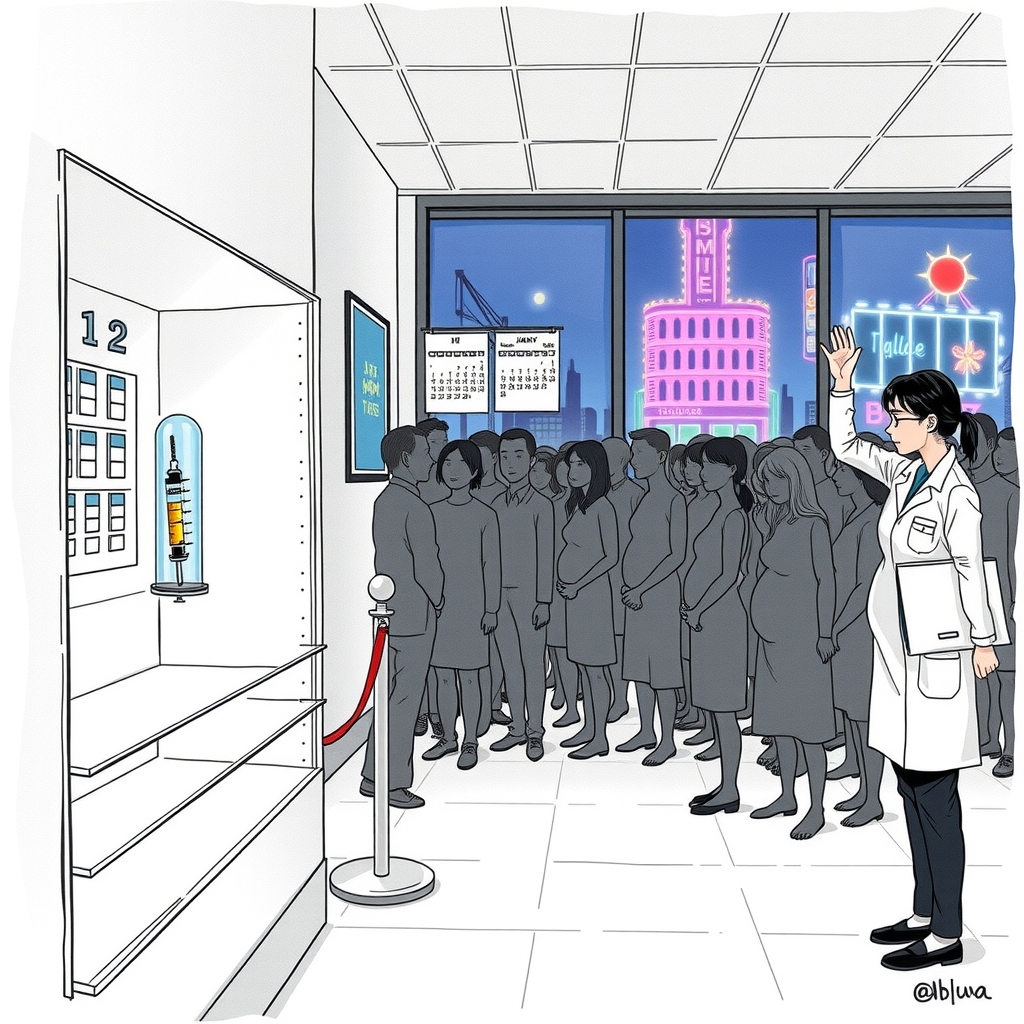
The Drug Ran Out
Japan has run out of the injection it uses to keep syphilis from crossing the placenta, and it is not getting more until the second half of 2027.
Kyodo News reported on the morning of September 9, 2026 that the shortage of penicillin — the first-line treatment for syphilis — is continuing, with production halted by an equipment failure at the manufacturer's plant. The wire moved through Yahoo! News Japan, the Kumamoto Nichinichi Shimbun and the Kitanippon Shimbun, and in English through Japan Today. Tokyo Reporter carried its own account on September 12.
The drug is Steruiz — Suteruizu, Pfizer's prefilled syringe of benzylpenicillin benzathine hydrate, the long-acting formulation known internationally as benzathine penicillin G. It is the only treatment Japanese guidelines recommend for preventing mother-to-child transmission of syphilis.
On August 24, the Japanese Society for Sexually Transmitted Infections issued a formal request to every clinician, dentist and pharmacist who handles penicillins. Its subtitle was blunt: "So that the patients who need treatment get it." The document was signed by Hiroshige Mikamo, who chairs the society's syphilis committee, and Satoshi Takahashi, its president. Its central instruction is a rationing order in everything but name.
Give the remaining doses to pregnant women first.
What Broke
The failure chain is long and entirely industrial.
| Date | Event |
|---|---|
| April 2025 | 600,000-unit Steruiz syringe stops shipping |
| July 2025 | Voluntary recall of Steruiz over foreign matter contamination |
| November 2025 | Manufacturing equipment fails at the plant |
| July 2026 | Pfizer announces the 2.4 million-unit syringe will stop shipping once inventory runs out |
| Latter half of 2027 | Earliest expected resumption |
The society's statement attributes the stoppage to equipment failure at an overseas manufacturing site and to the regulatory procedures required by the manufacturing-process changes that followed. The same production line supplies multiple countries, and the society notes that comparable shortages are occurring abroad. It warns that the constraint "may last a long time."
The 600,000-unit syringe — the small-dose presentation — has been unavailable since April 2025, with no restart date at all. Pfizer has told clinicians it does not endorse substituting the 2.4 million-unit syringe for it in treating congenital syphilis, citing differences in the formulations' viscosity. That leaves the pediatric presentation simply gone.
The Ration Card
The society's guidance reorganizes syphilis treatment around scarcity, and the hierarchy it lays out is specific.
For adults who are not pregnant and do not have neurosyphilis, the first line is now oral amoxicillin, 500 mg three times daily for 28 days, under the Society's STI Diagnosis and Treatment Guidelines 2026. If amoxicillin itself becomes hard to secure — and some manufacturers and strengths are already under limited shipping — the guidance tells doctors to actively consider minocycline, 100 mg twice daily for 28 days, as second line. Minocycline is contraindicated in pregnancy.
For pregnant patients, any remaining Steruiz should be used first. The statement is candid about the limits of even that: congenital syphilis has been reported in infants whose mothers completed benzathine penicillin treatment and were judged serologically cured. The injection is the best-evidenced option, not a guarantee. Where none is available, the instruction is not to delay — consult obstetrics, pediatrics and infectious-disease specialists, and consider the oral amoxicillin regimen at 1,500 mg per day for 28 days, which has been used in Japan, while acknowledging that its evidence base for preventing congenital transmission is thinner.
Then comes the line that matters most for the trade this site covers. After pregnant women, the society tells hospitals to prioritize the remaining injections for patients for whom completing 28 days of oral treatment would be difficult and who therefore risk losing a reliable treatment opportunity.
That is a clinical description of a shift worker. A single intramuscular injection is a treatment you can finish in one clinic visit between shifts. A 28-day oral course is a treatment you have to remember to take three times a day for a month, in a job with no sick leave, no occupational health service and every incentive not to explain your absence.
The society also tells clinicians what not to do: do not split prefilled syringes across patients, do not swap in intravenous penicillin G potassium as a like-for-like substitute, and do not place bulk orders or duplicate orders across wholesalers. Penicillin G potassium is needed for neurosyphilis, ocular and otic syphilis and for treating infected newborns, and demand for it is expected to climb.
A Third of the Epidemic Runs Through the Trade
The reason a drug shortage is a sex-industry story is in Japan's own surveillance data.
Since 2019, the national syphilis notification form has asked whether the patient worked in or paid for commercial sex within six months of diagnosis. The National Institute of Infectious Diseases, now under the Japan Institute for Health Security, publishes the answers quarterly. The most recent report covers the second quarter of 2026, as of July 1.
| Second quarter, 2026 | Men (n=1,932) | Women (n=1,018) |
|---|---|---|
| Reported paying for sex within 6 months | 704 (36%) | 15 (1%) |
| Reported selling sex within 6 months | 38 (2%) | 304 (30%) |
| Answered "no" to the relevant question | 523 (27%) | 387 (38%) |
| Unknown or left blank on that question | 705 (37%) | 327 (32%) |
Those are floors, not ceilings. Roughly a third of notifications arrive with the question unanswered. Among men whose forms recorded an answer either way, 57 percent said they had paid for sex in the six months before diagnosis. Among women with a recorded answer, 44 percent said they had sold it.
The age curve points the same direction. Of the 1,018 women notified in the quarter, 615 — 60 percent — were under 30, with the single largest band at ages 20 to 24. Male cases spread almost evenly across every decade from the twenties to the sixties. One side of this epidemic is a narrow cohort of young women; the other is a broad cross-section of the men who buy from them.
Geography reinforces it. Tokyo recorded 700 notifications in the quarter, 49.8 per million residents, more than double the national rate of 23.4. Osaka followed at 37.3 per million, Kumamoto at 35.1, Fukuoka at 34.3.
The Curve Was Already Bending Down
Here is the part that complicates the alarm, and it belongs in the story.
Japan's syphilis wave is receding. Kyodo puts national notifications at roughly 6,000 in 2020, rising to more than 13,000 in 2025. But the quarterly surveillance shows 2,950 notifications in the second quarter of 2026 against 3,748 in the same quarter of 2025 — a ratio the report prints as 0.8. Tokyo fell from 946 to 700 over the same comparison. Thirty-eight of Japan's 47 prefectures were flat or down year over year; nine rose.
Congenital syphilis, the outcome the whole rationing scheme exists to prevent, has been running at single digits to low double digits per quarter: 13 in the second quarter of 2025, 11 in the third, 6 in the fourth, 10 in the first quarter of 2026, 6 in the second.
So the accurate framing is not that an explosion has met a drug shortage. It is that Japan is losing its best tool at the precise moment the epidemic had begun to give ground — and that the babies at stake number in the dozens a year, which is small enough that a modest slippage in treatment quality would be visible in the count almost immediately.
What the Society Actually Wants
Read past the rationing table and the August 24 statement makes an argument that has nothing to do with supply chains.
The most reliable prevention of congenital syphilis is to complete syphilis treatment before pregnancy.
It then instructs clinicians to take every opportunity to push testing and completed early treatment on women of reproductive age and their partners.
In a country where 30 percent of newly diagnosed women report selling sex and 60 percent of them are under 30, that sentence has an address. It points at the women working in fūzoku and at the men buying from them — the population that generates the largest single identifiable share of Japan's syphilis notifications and is also, structurally, the hardest for a health system to reach. Many shops run or require periodic STI screening; none of that testing infrastructure controls whether a woman who tests positive can complete 28 days of antibiotics, or whether the men she saw in the interim are ever tested at all.
The injection papered over that gap. One shot, one visit, done. Until the latter half of 2027, Japan does not have it.
Sources: Kyodo News report of September 9, 2026, 8:28 a.m., distributed via Yahoo! News Japan, the Kumamoto Nichinichi Shimbun, the Kitanippon Shimbun and Livedoor News, and in English via Japan Today, for the continuing shortage, the equipment failure, the July 2025 recall over foreign matter contamination, the November 2025 equipment breakdown, the resumption timeline and the 2020 and 2025 national case figures; the Japanese Society for Sexually Transmitted Infections' statement of August 24, 2026, "Request for cooperation on appropriate use and appropriate ordering of benzylpenicillin benzathine hydrate and amoxicillin hydrate preparations under supply constraints," signed by syphilis committee chair Hiroshige Mikamo and society president Satoshi Takahashi and based on information current to August 20, 2026, for the prioritization scheme, the treatment regimens, the cause of the stoppage, the warnings against splitting syringes and bulk ordering, and the quoted guidance on pre-pregnancy treatment; Nikkei Medical's report of August 26, 2026, for the July 2026 shipment-halt announcement, the late-2027 resumption estimate and the status of the 600,000-unit syringe; Pfizer notices carried by the Japanese Society for Pediatric Infectious Diseases and Yakuji Nippo for the 600,000-unit halt from April 2025 and the viscosity-based advice against substitution; the National Institute of Infectious Diseases / Japan Institute for Health Security quarterly report "Summary of syphilis notifications in Japan," as at July 1, 2026, for all notification counts, prefectural rates, age distributions, congenital syphilis counts and the commercial-sex history tables; and Tokyo Reporter's English account of September 12, 2026. Percentages among respondents who answered the commercial-sex question, and the share of female cases under 30, are calculated from the published tables. Surveillance figures are notifications, not infections, and the most recent weeks are typically undercounted. Glossary: fūzoku = Japan's legal commercial sex sector; benzathine penicillin G = a long-acting intramuscular penicillin given as a single dose; congenital syphilis = infection passed from a pregnant woman to the fetus, which can cause stillbirth, premature birth and neurological and skeletal damage.