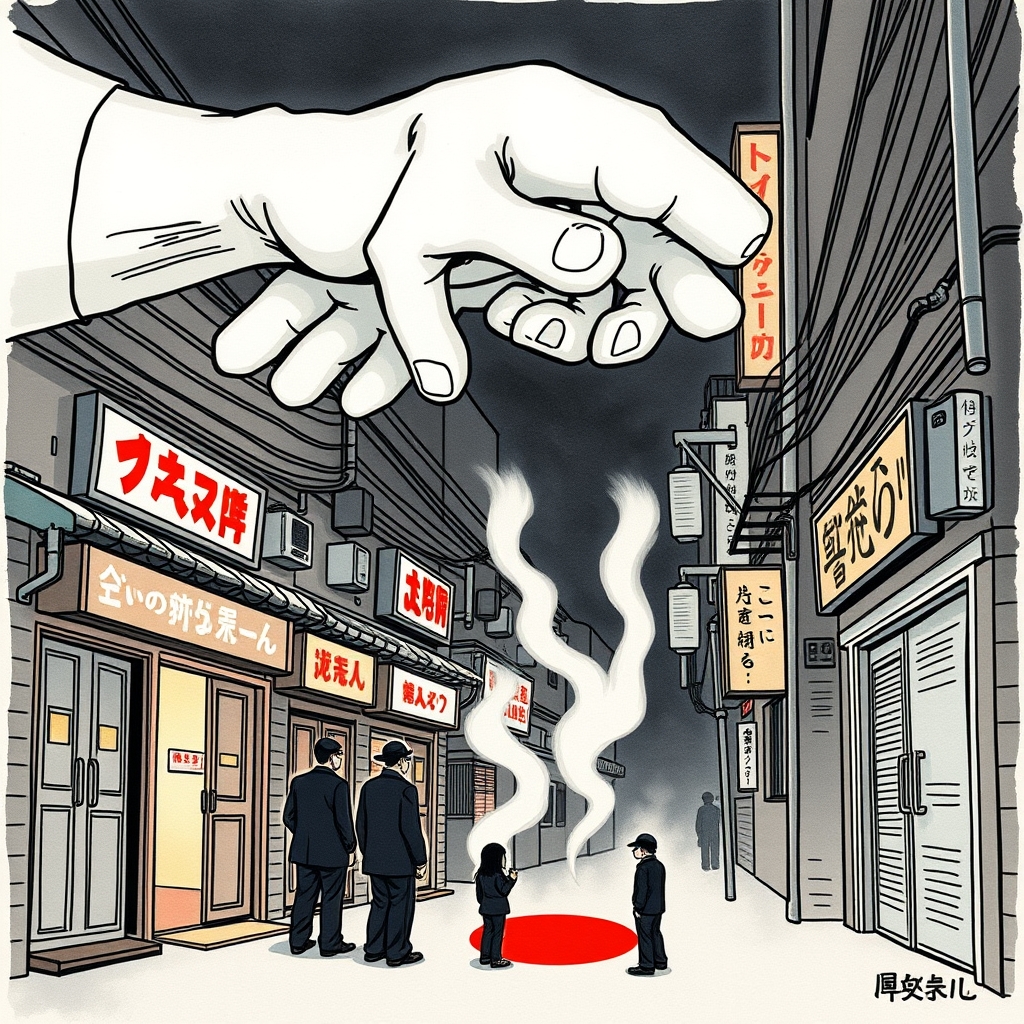
An Open Secret, Suddenly Enforced
For decades, Japan's soaplands—bathhouse-style brothels that skirt the law by framing paid sex as a private act between consenting adults—operated in plain sight, tolerated in red-light districts from Tokyo's Yoshiwara to Kobe's Fukuhara. In the first half of 2026, that tolerance broke. Police in city after city have moved against establishments under the baishun boshi-ho (Anti-Prostitution Act), and legal commentators are now asking the obvious question: why now?
The answer taking shape in Japanese and English coverage this week is that the raids are less about morality than about money—specifically, the money that flows from these shops to the illegal recruiting syndicates known as "scouts." This account is drawn from analysis published July 13–14, 2026 by the legal-news outlet Bengoshi JP News (Bengo4) and the English-language site Tokyo Reporter, among others, and from commentary by former special-investigation prosecutor Tsunehiko Maeda.
A Map of the Raids
The enforcement has been geographically broad. According to the reporting, arrests on suspicion of violating the Anti-Prostitution Act's "place-provision" clause—the provision that criminalizes knowingly furnishing a venue for prostitution rather than the paid sex itself—have been logged in Tokyo's Yoshiwara, Sendai's Aoba Ward, Niigata, and Wakayama City, among other locations. In Yoshiwara, a shop said to have operated for 43 years was among those targeted; its annual revenue was reported in the hundreds of millions of yen.
The Sendai case illustrates the scale. Prosecutors and police there moved against an operator whose group reportedly took in roughly 40 million yen in the first 28 days of January 2026 alone and employed around 200 women. When that group was dismantled, some 21 affiliated locations are reported to have shut down.
These are allegations at the investigative and prosecutorial stage; arrest does not establish guilt, and the accounts so far are the authorities' and their commentators'.
The Real Target: The Scouts' Cash Flow
What ties the raids together, in the reading offered by attorney Sho Wakabayashi of Bengoshi JP News, is a strategy aimed upstream. Illegal "scouts"—recruiters who funnel women into unlicensed sex work and collect a cut of the resulting sales as a referral fee—do not, as a rule, run the shops. They feed workers into them. Prosecuting the shops that pay those fees is a way to choke off the revenue that sustains the scout networks.
That framing fits the biggest scout cases of the past year. In April 2025, the Metropolitan Police Department dismantled "Access," a recruiting network reported to span 46 prefectures and roughly 350 affiliated shops, said to have collected an estimated 7 billion yen in referral kickbacks. A separate organization, "Natural," described in reporting as the country's largest scout group, has seen its leadership arrested and re-arrested in stages through 2026. Cutting the pipeline of paying shops, in this logic, starves the recruiters that policing the recruiters alone has failed to eliminate.
A Second Driver: The Law Under Review
There is a legislative backdrop as well. The Justice Ministry has convened a study panel in 2026 to reexamine the Anti-Prostitution Act, including whether to introduce penalties for buyers—who currently face none—and to stiffen punishment for solicitation and place-provision. Commentators suggest that by prosecuting venue operators now, authorities are demonstrating that "place-providers" are already reachable under existing law, ahead of any reform.
The Anti-Prostitution Act has long been lopsided in exactly this way: it does not punish the consensual transaction between buyer and seller, only the intermediaries and enablers around it. That structural gap is precisely what the current review, and the current raids, are pressing against.
Who Pays
The sharpest note in this week's commentary concerns the women. Both Wakabayashi and Maeda warn that the people most exposed by the crackdown are the sex workers themselves. When a group is broken up, its shops close overnight, and the women lose their income with none of the protections that ordinary labor law would provide. The Sendai closures alone are estimated to have put hundreds of workers out of work.
The paradox, as the legal writers frame it, is that a campaign justified in part by the goal of protecting women can strip those same women of their livelihoods in the process—and that criminalizing buyers, the reform most often floated, could push the trade further underground and harder to oversee, not safer.
Whether the mid-2026 wave marks a durable shift in how Japan enforces the Anti-Prostitution Act, or a pressure tactic tied to a specific fight against the scouts, will become clearer as the prosecutions proceed and the Justice Ministry panel reports. For now, an industry that spent decades as an open secret is being treated, shop by shop, as a crime scene.
This article is compiled from analysis and reporting published July 13–14, 2026 by Bengoshi JP News (Bengo4), Tokyo Reporter, and commentary by former prosecutor Tsunehiko Maeda via Yahoo! News Japan, among others. Facts and figures are attributed to those reports. Legal glosses: baishun boshi-ho = Anti-Prostitution Act; the "place-provision" offense punishes knowingly providing premises for prostitution. Points that remain unconfirmed are noted as such; no individuals are named beyond the cited commentators.