
The name is the entire business model
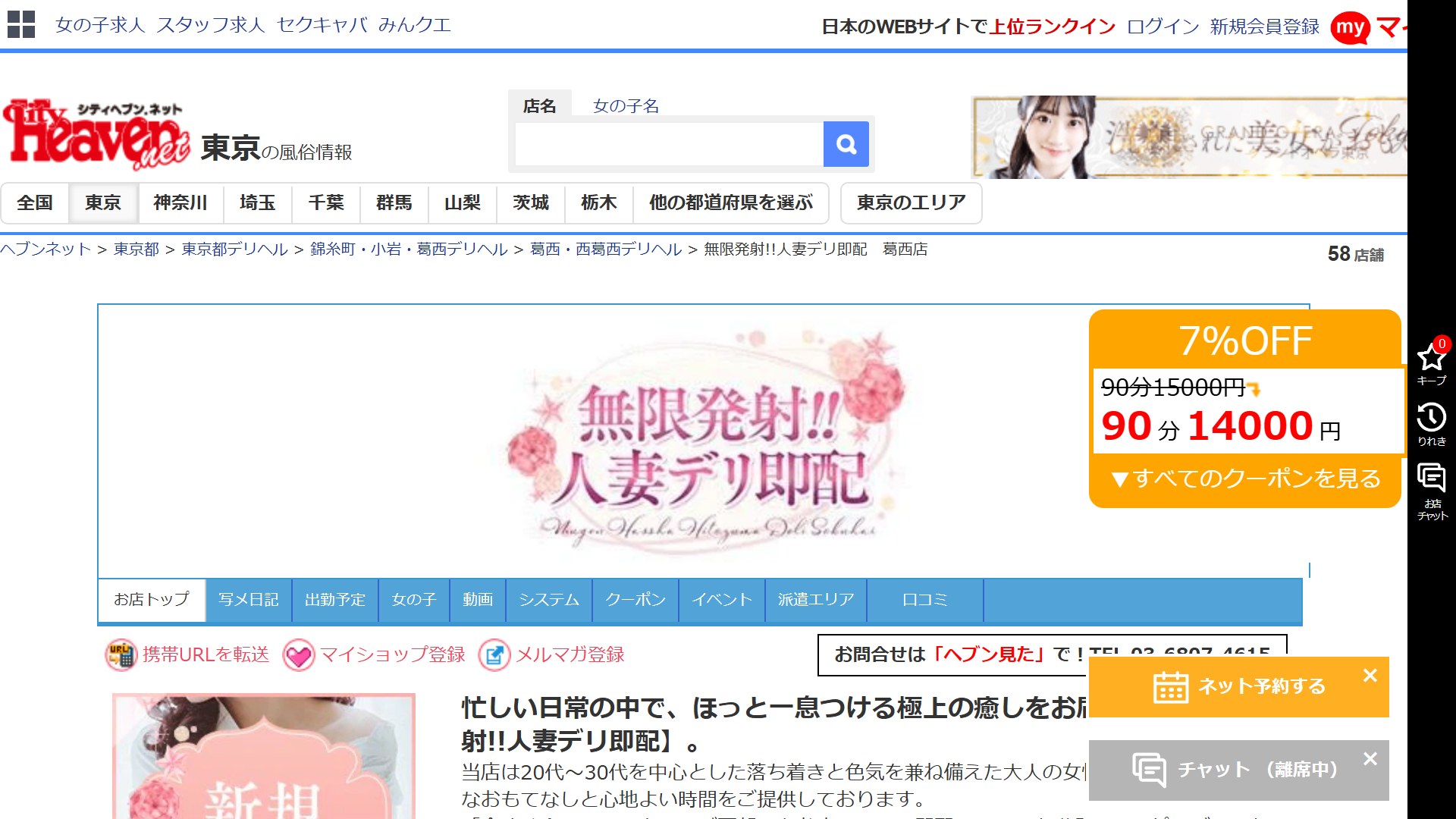
Mugen Hassha!! Hitozuma Deri Sokuhai — Kasai branch has one of those Japanese shop names that functions as a spec sheet. Break it apart and there's no mystery left.
Hitozuma — married women, the housewife genre. Deri — delivery health (deriheru), the format where the girl comes to your hotel or apartment rather than you going to a shop. Sokuhai — immediate dispatch; we send someone now, no appointment ritual. And mugen hassha, the two characters doing the heaviest lifting, claiming no cap on finishes inside your booked time.
Three promises: mature women, at your door, fast, with no counting. The copy on the page is softer than the name — "ほっと一息つける極上の癒しをお届け," delivering top-grade relief where you can breathe out, and "すぐに会える安心感", the reassurance of meeting right away. That second phrase is the honest one. The product here is right away.
So I tested right away, at the hour when it's the only thing on the menu that matters.
Three in the morning in Edogawa
The shop runs 24 hours. In Tokyo delivery health that phrase gets printed a lot and means less than you'd think — plenty of "24-hour" shops have three girls on the board after 2 a.m. and a dispatcher who sounds like you woke him up.
Kasai is in Edogawa ward, out on the Tozai line, east of the river and well past where the tourist map gives up. It is residential, wide-streeted, and profoundly quiet at 3 a.m. — the kind of neighborhood where a taxi's tires on wet asphalt is the loudest thing for two blocks. This is not Kabukicho, where you can stand on a corner and have four options within a hundred meters. Out here, at that hour, a shop that actually answers the phone is not competing with anyone. It's competing with you giving up and going to sleep.
That's the context that makes the number below matter.
Phone is 03-6807-4615, and the page asks you to say "ヘブン見た" — "saw you on Heaven" — when you call. Do it. It's the standard line at Cityheaven-listed shops, it takes a second, and it occasionally attaches you to listing-specific pricing.
The price curve has exactly one anomaly
Here's the course board as published:
| Course | Price | Per minute |
|---|---|---|
| 60 min | ¥12,000 | ¥200 |
| 90 min | ¥15,000 | ¥167 |
| 120 min | ¥23,000 | ¥192 |
| 150 min | ¥28,000 | ¥187 |
| 180 min | ¥34,000 | ¥189 |
Look at the right-hand column. Normally a course board slopes gently downward — the longer you book, the cheaper each minute gets, because the shop wants to lock up your evening. This one doesn't slope. It dips hard at 90 and then climbs back up.
The 90 at ¥15,000 is ¥167 a minute. Everything above it costs more per minute than the 90 does. The 120 is ¥25 a minute worse. That is not how course boards usually behave, and it isn't sloppiness.
There's also a coupon on the listing: the 90 at ¥14,000, a 7% cut. That drops the 90 to ¥155 a minute and widens the gap to a canyon. The shop is pointing directly at one course and it is not being subtle about it.
The ¥8,000 tell
Now put the extension fees next to it. Thirty extra minutes is ¥8,000. Sixty is ¥15,000.
Then do this bit of arithmetic:
¥15,000 (the 90) + ¥8,000 (a 30-minute extension) = ¥23,000 — which is exactly the price of the 120.
Not approximately. Exactly. The 120-minute course is not a course. It's the 90 with a paid extension already stapled to it, priced to the yen.
That single line tells you how the shop thinks. It has decided the 90 is the product, and everything longer is the 90 plus extension math. Commit to two hours upfront and you are handed precisely zero reward for the commitment — no bulk discount, no thank-you, nothing. You've simply pre-paid for a decision you could have made later, in the room, with actual information.
The longer courses do finally break the pattern, mildly. The 150 at ¥28,000 undercuts extending the 90 by an hour (¥15,000 + ¥15,000 = ¥30,000) by ¥2,000. The 180 at ¥34,000 beats stacking both extensions (¥15,000 + ¥8,000 + ¥15,000 = ¥38,000) by ¥4,000. So if you genuinely intend to be there three hours, book the three hours. But at the 120 mark — the length most people reflexively choose when they want "a bit more than an hour and a half" — booking upfront buys you nothing at all.
Book the 90. Take the coupon. Extend in the room if it's going well. At the 120 line that costs you the same money and hands you an exit you'd otherwise have paid to lose.
The ¥5,000 that nobody reads until it's too late
Here's the part I actually want you to take away, and it's the one buried at the bottom of the fee list.
Change: ¥5,000.
Change — chenji — is what you do when the girl arrives and you'd rather she didn't stay. Five thousand yen is a steep price for that door. It's 42% of the entire 60-minute course. It is more than a third of the coupon-price 90.
Now hold that against the shop's headline promise. Sokuhai. Immediate dispatch. The whole pitch is that you don't wait, don't browse, don't agonize — you call, and someone comes. Which means the customer most likely to want a change is the exact customer the shop's marketing is built to attract: the 3 a.m. caller who took whoever was available.
Set against the other fees, the shape is unmistakable:
- Nomination (shimei — requesting a specific girl): ¥1,000
- Repeat nomination (honshimei — asking for the same girl again): ¥2,000
- Change: ¥5,000
One change costs the same as five nominations. The shop has priced picking in advance at a fifth of the price of un-picking after the fact, and that spread is the actual advice hiding in the fee table. Spend the ¥1,000. Look at the board, choose someone, pay the nomination fee. It is the cheapest insurance on the page, and it costs less than the tip you didn't leave.
The cancellation term is the same lesson in a harsher register: 50% of the total. Cancel a 90 and you're out ¥7,500 for nothing. This is not a shop to phone while you're still deciding whether you want to. Decide, then phone.
None of this is dishonest — every figure is printed plainly on the listing where anyone can read it. But it is a fee structure that quietly punishes exactly the impulsive, half-committed, tell-me-what's-available behavior the shop's own name encourages. Both things are true at once, and only one of them is on the banner.
Transport: the genuinely generous number
Credit where it's earned. The transport fee is ¥1,000 for Edogawa, Taito, Koto, Katsushika, Chuo, Chiyoda, Minato, Toshima, Shinagawa, and Meguro. Everywhere else is ¥2,000.
Read that list again. A shop based in Kasai will send a girl to Minato ward — Roppongi, Akasaka, the hotel district — for a thousand yen. That's most of the way across Tokyo. Chiyoda, Toshima, Shinagawa, Meguro, all on the same flat grand. Plenty of central shops charge more than that to cross two stations.
And even the penalty tier is only ¥2,000. There's no distance-scaling scheme, no zone matrix, no surprise. For a customer in Koto or Chuo — the near-east, where good delivery options thin out fast after midnight — this is a properly cheap way to get someone to your door.
The flat structure also removes the one negotiation nobody wants at 3 a.m., which is arguing about taxi money with a dispatcher.
The real arithmetic
Total it honestly, because the course price is never the price.
The move I'd actually make: 90 minutes on the coupon at ¥14,000, plus ¥1,000 nomination, plus ¥1,000 transport inside the cheap zone = ¥16,000 out the door. Ninety minutes, a girl you chose off the board rather than drew from a hat, at three in the morning, in a part of Tokyo where the alternative is nothing.
Sixteen thousand yen is a fair number for that. It's genuinely good for that hour.
The move I'd avoid: calling cold, taking the dispatch, disliking the draw, and paying ¥5,000 to undo it. That path turns a ¥12,000 hour into ¥18,000 before transport, and you'll have spent more than the coupon 90 to get less than it.
Same shop. Same night. A ¥1,000 decision separates them.
The verdict
| Item | Rating |
|---|---|
| 24-hour coverage where it's genuinely scarce | ★★★★★ |
| Transport pricing (Kasai to Minato for ¥1,000) | ★★★★★ |
| The 90-minute course as value, with coupon | ★★★★★ |
| Flat, legible fee table — no hidden zones | ★★★★☆ |
| Longer courses as real courses | ★★☆☆☆ |
| Change fee vs. the shop's own "just send someone" pitch | ★★☆☆☆ |
| Would I go again | ◎ — on the 90, with a nomination, never cold |
Mugen Hassha Hitozuma Deri Sokuhai Kasai is a competent late-night operation with one course worth booking and one fee worth fearing. The 90 with the coupon is priced better than anything else on its own board, the transport terms are quietly among the more generous I've seen from an outer-ward shop, and being awake and reachable at 3 a.m. in Edogawa is a real service, not a slogan.
But the shop sells impulse and then charges ¥5,000 to correct an impulse. That tension is the whole review. Resolve it by refusing the premise: don't use the sokuhai. Spend the thousand yen, pick someone yourself, book ninety minutes, and let the shop's best number do the work while you sidestep its worst one.
Speed is worth paying for. Just don't let it pick for you.