
There is no shop in Ginza
Start with the thing hiding in plain sight on the listing.
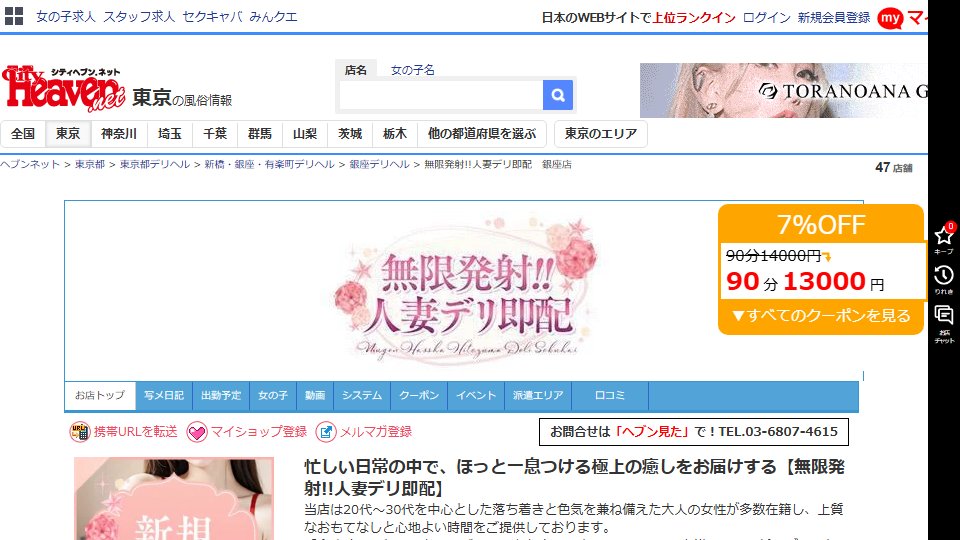
Mugen Hassha!! Hitozuma Deri Sokuhai — Ginza publishes the phone number 03-6807-4615. That is the identical number printed on the same chain's Kasai listing, out in Edogawa ward on the far side of the Sumida. One dispatch desk, two storefronts on Cityheaven, thirteen kilometers apart.
This is not a scandal. It's how a large share of deriheru actually works, and anyone telling you otherwise is selling something. Delivery health has no premises you visit — legally and practically, the "shop" is a phone line, a roster, and a taxi budget. A branch is a coverage area with its own listing page, priced for the neighborhood it points at.
But it reframes the whole transaction, and it's worth understanding before you dial. You are not calling a Ginza establishment. You are calling a dispatcher and asking them to point a woman at Ginza. Everything else about this booking follows from that.
The transport tiers are a map
Here's where the listing quietly tells the truth about its own customers.
Transport is ¥1,000 for the Hatchobori / Nihonbashi / Ginza area, and ¥2,000 everywhere else. That's the entire zone scheme — two tiers, no distance matrix, no surprises.
Look at the cheap tier again. Not "Ginza." Hatchobori, Nihonbashi, Ginza. A shop that genuinely believed its customers were sitting in Ginza proper would have written Ginza and stopped. Instead it drew a small ring across the eastern edge of Chuo ward and put three names in it.
That ring is the answer to the question I opened with. Ginza itself is department stores, flagship boutiques, hostess clubs, and sushi counters where the omakase costs more than the 180-minute course. What Ginza does not have, in any meaningful quantity, is the accommodation this industry runs on. The love hotel districts are elsewhere — Uguisudani, Ueno, Shinjuku, Gotanda. In Chuo ward you are looking at business hotels, and a business hotel is a very different proposition: single rooms, a front desk with sightlines, and a corridor where nobody is anonymous.
So the honest version of a "Ginza" booking is usually a business hotel room in Kyobashi or Hatchobori, five to ten minutes' walk east of the actual Ginza crossing, or your own apartment if you're lucky enough to live in Chuo. The fee tier isn't a marketing zone. It's a description of where the rooms are.
I took a business hotel near Hatchobori. Booked it in the afternoon, walked in with a bag like everyone else, and had the desk done in ninety seconds.
The numbers, plainly
Courses run 60 minutes ¥12,000, 90 minutes ¥15,000, 120 minutes ¥23,000, 150 minutes ¥28,000, and 180 minutes ¥34,000. Nomination (shimei, requesting a specific woman off the board) is ¥1,000; repeat nomination (honshimei) is ¥2,000. Extensions are ¥8,000 for thirty minutes, ¥15,000 for sixty. Cancellation is 50% of the total and a change is ¥5,000, so decide before you dial rather than after. The shop runs 24 hours with no closing days, and there was a coupon on the listing taking the 90 down to ¥13,000.
I called just after seven on a Friday evening, took the coupon 90, and spent ¥1,000 on a nomination and ¥1,000 on transport. ¥15,000 out the door.
Say "ヘブン見た" — heaven mita, "saw you on Heaven" — when you call. The listing asks for it twice, which is a hint that the coupon pricing is attached to it.
One caveat on the name, because it's doing a lot of work on the banner. Mugen hassha means unlimited discharge, and the page does not lay out any terms for it — no stated conditions, no explanation, no system section spelling out what it does or doesn't cover. I'm not going to tell you what it includes, because the shop doesn't. If it matters to you, ask on the phone before you book, not in the room afterward. The dispatcher answered every direct question I put to him without any theater about it.
Ninety minutes with someone in her thirties
She was thirty-two. I'm not using her board name.
The featured roster on this listing sits between twenty-nine and thirty-four, and that consistency is the actual product — this is a hitozuma and jukujo shop, married and mature women, and the copy leans into it hard. "熟れた果実のような濃厚な色気" is the line: a rich sensuality like ripened fruit, for the adult man who wants that rather than youth. Florid, but not inaccurate as a description of who turns up.
What a woman in her thirties does differently, in my experience across a lot of these rooms, is that she arrives already calibrated. She came in, put her bag down once and left it there, and read the room in about four seconds — business hotel, single guy, weekday-adjacent Friday, no drama wanted. There was no audition phase. Twenty-somethings in this industry often spend the first ten minutes establishing what kind of encounter this is going to be, and half of that is nerves and half is a script. She skipped it entirely and started talking to me like we'd already met.
The conversation was about the hotel, then the heat, then — because I asked — about the commute. She'd come in from the eastern side of the river, which lines up with a dispatch desk that also serves Kasai. Twenty-five minutes door to door, she said, which is roughly what the shop implied on the phone and roughly what it was.
What you're buying at a jukujo shop, stripped of the marketing, is the absence of friction. Nobody was nervous. Nobody needed managing. There was no moment where I had to decide whether to be reassuring. For ninety minutes on a Friday evening after a long week, the value of that is genuinely hard to overstate, and it is not something a shop can train into a twenty-two-year-old — it only comes with the years.
The honest limit of it: this is competence, not chemistry. It was warm, unhurried, attentive, and entirely professional, and if what you're chasing is the electricity of someone slightly out of their depth, you will not find it here and shouldn't book here. That's a filter, not a fault. The shop is not pretending to sell that.
She left on time and told me to drink water, in the tone of someone who has told a lot of men to drink water.
Who this is actually for
The Ginza listing makes sense for a specific person, and it's worth being blunt about who.
It's for someone who is already in eastern Chuo ward at the end of the day — a salaryman staying over in a Kyobashi business hotel, someone who lives in Nihonbashi or Hatchobori, someone with an evening in the district and a room already sorted. For that person the ¥1,000 transport is genuinely cheap, the 24-hour line means the timing is yours, and ¥15,000 all-in for ninety minutes is a fair price anywhere in central Tokyo, let alone this postcode.
It is not for someone who wants a Ginza experience. There isn't one here. The neighborhood contributes nothing to this booking except a name on a listing page and a short walk to a hotel that could be in any ward in Japan. If the district is the appeal, that money buys a lot more atmosphere in a Ginza bar.
And if you're coming from outside the cheap ring, the ¥2,000 tier is still reasonable, but at that point you're just using a chain dispatcher who happens to have a Ginza page, and you may as well book against whichever of their listings covers where you actually are.
The verdict
| Category | Rating |
|---|---|
| Value at ¥15,000 all-in for 90 minutes | ★★★★★ |
| Consistency of the roster with the concept | ★★★★★ |
| Front-desk handling and straight answers | ★★★★☆ |
| Transport pricing for eastern Chuo | ★★★★☆ |
| Clarity of the headline "unlimited" claim | ★★☆☆☆ |
| Anything specifically Ginza about it | ★☆☆☆☆ |
| Would I book again | ◎ — but only when I'm already sleeping in the ward |
Mugen Hassha Hitozuma Deri Sokuhai Ginza does the thing it can actually control very well. The women match the advertised genre, the desk answers questions without spin, the price for ninety minutes is honest by central Tokyo standards, and the line is open whenever you are.
What it can't control is Ginza, a district that offers this industry a name and almost nothing else. Take the branch as a delivery radius rather than a destination, get your room in Hatchobori before you pick up the phone, and it's a solid, unfussy evening for fifteen thousand yen.
Just don't expect the address on the listing to show up in the room.