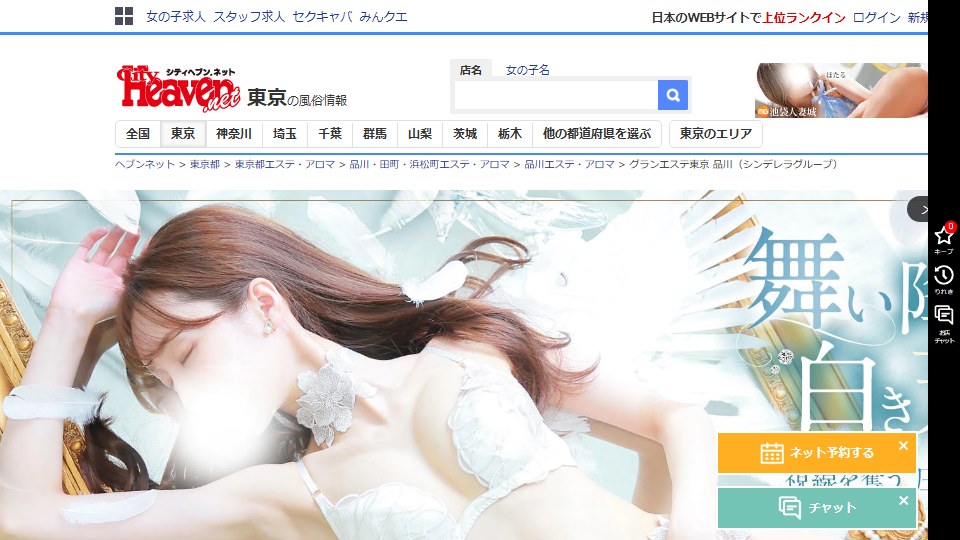

I booked Gran Esthe Tokyo Shinagawa on a Monday afternoon in September, which is the deadest slot in the week and therefore the honest one. This is an outcall house — shutchō esute, dispatch only — so there's no shopfront to walk into and no waiting room to judge. It runs out of the Shinagawa–Gotanda corridor and sends therapists to all twenty-three wards of Tokyo. Business hotels, city hotels, love hotels, and your own apartment, with one condition worth knowing before you plan around it: home visits start at the 100-minute course. Book seventy minutes and you are booking a hotel room, whether or not anyone says so out loud.
The phone number is 03-5422-6607, the hours are 9:00 AM to 4:00 AM, year-round, and you're asked to say you saw it on Heaven. That last part isn't manners, it's attribution tracking, and it tells you the shop knows precisely which listing bought which booking.
The Number on the Page Nobody Reads
Here is the customer-facing price, unadorned: seventy minutes, ¥25,000. The next rung is 100 minutes at ¥35,000, and the ladder continues to 130, 160 and 190. Transport and nomination fees sit outside that, as they do everywhere.
Now the other brochure. The shop's own recruiting page — public, unlocked, one click from the listing — states what a therapist earns on the shortest course. The 70-minute course pays her ¥20,500. The same page advertises a back rate of "over 70%" and a policy of returning the full nomination fee to her.
Sit with that for a second. The customer pays ¥25,000. The therapist receives ¥20,500. That's 82%, not seventy-something, and it means the house clears roughly ¥4,500 on a seventy-minute booking before it has paid a phone operator, a driver, a listing fee, or the electricity in the waiting room. On the base course, this business is running on fumes.
Then it gets stranger, because the first-timer coupon takes that seventy-minute course to ¥20,000 — a 20% cut, live the day I booked. I paid ¥20,000. The therapist's stated rate for that course is ¥20,500. The house collected less than it paid out. Not a thin margin. A negative one, by five hundred yen, before costs.
I have read a lot of shop pages. It is rare to find one that hands you its own cost of goods sold and lets you do the subtraction.
So Where Does the Money Actually Come From?
It comes from the ladder, and the ladder is made of points.
The membership scheme is called Club Cinderella. Joining is free — ¥0 enrollment, ¥0 annual fee — and the sign-up itself pays you 5,000 points usable the same day, at 1 point = ¥1, redeemable in blocks of a thousand. Then the first-visit bonus, which is where the design shows:
- 100 minutes → 5,000 points
- 130 minutes → 6,000 points
- 160 minutes → 7,000 points
- 190 minutes → 8,000 points
Read the shape of it. Seventy minutes earns you nothing. The points don't start until you step up a rung, and they scale with the rung. Layer on 1,000 points for posting a review, up to 10,000 points for a first nomination of a new cast member (100-minute minimum, and explicitly not available on a honshimei re-nomination), and a standing rank-based rebate of 2% to 10% of total spend.
That's not a discount programme. That's a customer acquisition cost, paid up front, and amortised over a relationship. The house eats the loss on your first seventy minutes to buy your membership record, and every incentive after that is engineered to move you up the ladder and back through the door — because the ¥25,000 rung is where it loses money and the longer rungs are where it stops. The one restriction confirms the logic: the first-visit bonus and the new-cast bonus cannot be stacked; you get whichever is larger. They're the same acquisition budget spent twice, and the shop will pay it once.
If you want the cheapest possible night here, take the seventy-minute first-timer rate and never come back. It is, on the published numbers, the best value in the building. Whether you can actually do that is the entire business model's bet against you.
Two Descriptions of the Same Seventy Minutes
Back to the brochures, because the language is where it gets genuinely funny.
To the customer, the shop describes a full fusion of authentic oil massage and kaishun sensual work, performed by a therapist in a T-back and topless, with face-sitting and lip service written into the base course, a post-session shower with a soft body wash, and a house-original programme it calls Secret SPA, marketed in the vocabulary of giji-sekkusu — simulated sex. Maximum heat. Every adjective doing overtime.
To the applicant, on a page from the same company in the same week, the identical service is: "soft service, the woman is not passive, and there is no mucous-membrane contact." Not physically demanding. Learnable by a beginner. Free training from a professional female instructor, manual provided.
Both are true. That's the point. This is a hand-service genre with a firm line in it, and the whole commercial art of fuzoku esute is describing that line to two audiences in two registers without either of them feeling misled. The customer page sells the ceiling. The recruiting page sells the floor. Between them sits a perfectly legible service where nobody has to guess what is and isn't included — provided you read both. The reason I write these up at all is that most people read one, form a theory, and pay ¥25,000 to test it.
If you take one practical thing from this article, take that. The recruiting page is the least oversold document any shop publishes, because the cost of exaggerating to an applicant is a woman who quits in a week, and that cost lands inside the company instead of on you.
The Roster, and the Standard They Printed
The hiring criteria are stated outright, which is unusual enough to be worth checking against the board: Japanese women, 20 to 34. So I checked.
129 women are listed on the roster. Twelve were on Monday's shift board, and their published ages run 20 to 26 — inside the stated band, clustered at the bottom of it. Start times spread from 10:00 AM to 4:00 PM, with finishes running to 4 AM, which is a genuine two-shift operation rather than an evening house pretending to open early. Turnover is visible too: nine new therapists entered between September 3rd and September 15th, nine arrivals across twelve days, better than one every other day, against a standing roster of 129. That clip is either fast growth or fast churn. The recruiting page's list of retention devices settles which one they're worried about: daily full cash payout, a ¥300,000 signing bonus, a ¥2,000,000 monthly guarantee scheme, no quotas and no fines, private waiting rooms, transport, an alibi company, dormitory, childcare.
Twelve of 129 on a Monday is about 9% of the roster working the worst day of the week. Plan accordingly: on a Monday afternoon you are choosing from a dozen people, not from a catalogue of a hundred and twenty-nine. The catalogue is the week. The board is the day.
One Discrepancy, and How to Handle It
The shop's own profile blurb opens with "¥7,000 off for new customers." The live coupon I actually used was worth ¥5,000 — ¥25,000 down to ¥20,000. Those are different numbers.
I'm not going to tell you which is right, because I don't know: it may be that the ¥7,000 figure combines a discount with points, or that it's a legacy line, or that it attaches to a longer course. What I will tell you is the move. Say both numbers on the phone. "The listing says ¥7,000 off for new customers, the Heaven coupon says ¥20,000 for seventy minutes — which applies?" You'll get an answer in four seconds, and worst case you've confirmed the ¥20,000. Never argue a discrepancy at the door; settle it while you're still deciding.
Access, for the Part of This You Control
It's an outcall, so the address that matters is yours. But the dispatch base is Gotanda, and the travel time from Gotanda is the travel time to you. For calibration, the shop publishes it: Shinagawa 5 minutes by train, Shibuya 7, Shimbashi 10, Shinjuku 14 — and the base itself sits 4 minutes' walk from JR Gotanda's east exit, 4 from the Tōkyū Ikegami line, and 2 minutes from exit A5 on the Toei Asakusa line.
Practically: if you're in a hotel on the Yamanote's south side, you're close to the depot, and your therapist isn't going to arrive having spent forty minutes in traffic. If you're calling from Nerima at 2 AM, you are technically inside the service area and you should still think about what that ride does to the transport fee and to the human being at the end of it.
The Verdict
- Base-course value: ★★★★★ — ¥20,000 for seventy minutes as a first-timer, on a course the shop's own recruiting page says costs it ¥20,500 in therapist pay. That's as good as this arithmetic gets.
- Repeat-visit value: ★★★☆☆ — the ¥25,000 rung is unremarkable, and the points that make it worthwhile only unlock from 100 minutes up. The ladder is the product.
- Transparency: ★★★★★ — published hiring band, published pay rate, published roster with ages and entry dates, published coupon math with the before-and-after both shown. Rare, and it's the reason this piece was possible to write.
- Consistency: ★★★☆☆ — one ¥7,000 / ¥5,000 discrepancy on the new-customer discount. Small, fixable, and you should resolve it by phone.
- Roster depth: ★★★☆☆ — 129 names, twelve working Monday. The number that matters is the second one.
- Going back: ○ — but at 100 minutes, deliberately, because that's the first rung where the points and the home-visit option both switch on. Seventy minutes is the trial. It isn't the shop.
What I came away with wasn't a feeling, it was a spreadsheet. Gran Esthe Tokyo Shinagawa is a well-run piece of machinery inside the Cinderella Group — listed alongside fourteen sister houses split by genre and district, from hitozuma deriheru in Gotanda and Kinshichō to a costume house in Ikebukuro — and it competes not by being cheap but by being legible. It prints its hiring standard, prints what it pays, prints who's working and when they started, then hands you a first visit at a loss and waits to see whether you come back. Most shops in this trade sell you a promise. This one accidentally sells you its balance sheet, and the balance sheet is more convincing than the promise ever was. If you're shopping the Shinagawa esthetic bracket, read Gran Esthe Tokyo Shinagawa's recruiting page before you read its price list. It's the same company telling you the truth in a quieter voice.