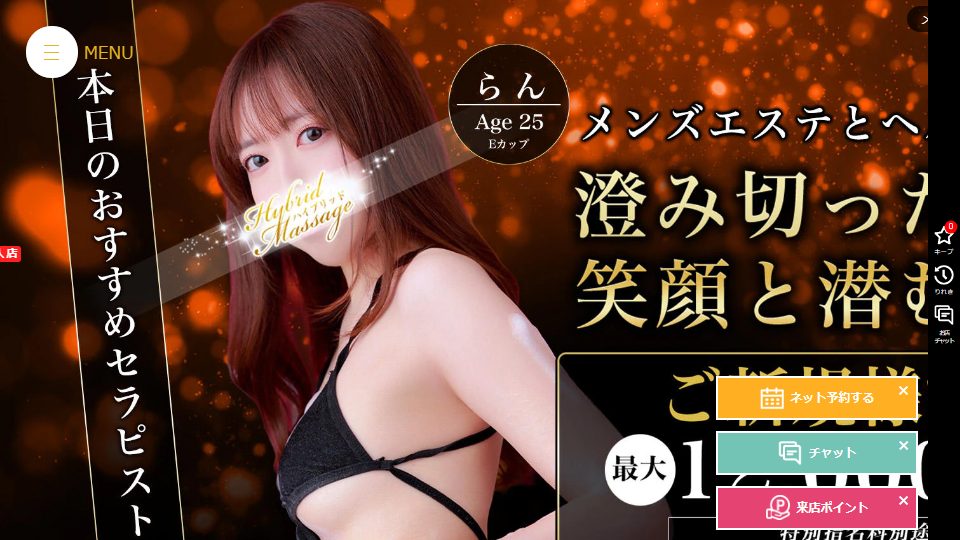

I have a working theory that you can read a shop's whole personality off its menu before a single hand touches a single shoulder. Shinagawa Hybrid Massage — an outcall esthetic working the Shinagawa-Takanawa side of the city and dispatching across the 23 wards — wears its thesis in its name. Hybrid. It's telling you, before you've dialed, that it wants to be two things at once: a real massage, and the other thing. The whole question of the visit is whether those two halves actually fuse, or whether "hybrid" is just a fancier word for "we do a little of both and neither one well."
The "Hybrid" Pitch, and Why It's a Real Claim
Strip the branding and the structure is classic deri-este: you call, reception runs availability, a therapist comes to your hotel or place with her kit. What separates the genre's top shelf from its bottom is one thing — whether the woman arriving can actually work, or whether the "esthetic" is a fig leaf draped over the service. Hybrid's pitch leans hard into the former. It markets the certification of its therapists, the grades and the training, the idea that you are paying for genuine bodywork that then opens into intimacy rather than a fantasy with a bottle of oil as a prop.
That's a meaningful claim because it's a falsifiable one. Anybody can write "healing" on a banner. A shop that foregrounds technique is putting a specific, checkable promise on the table: that the first twenty minutes will feel like someone who knows where the trapezius is. In a genre thick with vague sensual poetry, a shop that says we can actually massage you is, weirdly, the one taking the bigger risk — because now you'll notice if she can't.
The Board: ¥24,000 All-In, and What "All-In" Is Worth
Here's where I slow down, because the numbers are where a shop stops talking and starts telling the truth. The hundred-minute course runs ¥24,000, and the line that matters is the fine print: that figure already folds in the designation fee and the transport. The hundred-thirty runs ¥32,000 on the same all-in basis. There's a shorter discounted intro course for the guy testing the water, but the headline is those two long sessions priced as one clean number.
Read what that does. In outcall, transport and designation are the classic places a thin price gets fattened after you've committed — you're quoted a friendly base, then the dispatcher tacks on a ¥3,000 ride and a designation surcharge and suddenly the math is a different animal. Hybrid pricing the ¥24,000 as the number is the shop choosing not to play that game. It costs them the lure of a cheaper-looking headline, and it buys them a customer who isn't doing resentful arithmetic in his head when the doorbell rings. That's a shop optimizing for the second visit over the first impression, and on the strip that's the tell of an operator who plans to be here a while.
Ten to Five: The Hours Behind a Body-Based Service
A 10 AM to 5 AM window — phones opening at 9:30 — is a serious span, and for a service built on physical work it means something specific. Bodywork takes it out of a person; a shop holding a nineteen-hour board is signaling a roster deep enough that no single therapist is grinding dawn to dawn. Shinagawa runs on a businessman's clock — Shinagawa Station is a Shinkansen and commuter artery, men in transit, men with a daytime hole in the schedule between a meeting and a train — and an esthetic open at ten in the morning is positioned precisely for that traffic, not just the last-train crowd. The wide hours and the 23-ward dispatch net are the same message twice: this is built to reach you, on your clock, wherever in the city you've washed up.
The Read
Here's what I'll stand behind. Shinagawa Hybrid Massage is an outcall esthetic that has picked the harder, more honest lane in its genre — foregrounding actual technique instead of pure fantasy, and pricing its long courses all-in so the number you hear is the number you pay. The ¥24,000 hundred-minute and the ¥32,000 hundred-thirty are real money, but they're legible money, and legibility in outcall is a feature you pay for whether the menu names it or not. The daylight-to-dawn hours and the city-wide reach are coherent with a shop that wants the in-transit Shinagawa customer as much as the night owl.
I won't quote a session I didn't sit through, and I won't pretend a certification line on a banner is a guarantee that every therapist on the board is a virtuoso — that's the one variable a menu can't promise. What I'll say is that the structure under this shop's pitch is sound: a falsifiable craft claim, a price that doesn't ambush you, and the hours and the net to actually deliver on the "outcall" half of the deal.
Verdict: A Clean Number and an Honest Lane
- Concept honesty: ★★★★☆ — "hybrid" is a falsifiable claim, and the shop leans into the checkable half.
- Price clarity: ★★★★★ — all-in ¥24,000/¥32,000 with designation and transport folded in is the cleanest thing on the board.
- Fit for Shinagawa: ★★★★☆ — daytime-open, station-adjacent, built for the man in transit.
- First-timer friendliness: ★★★★☆ — a shorter intro course and a price you can read without a calculator.
- Going back: ◎ — I'd book the hundred-thirty and let the bodywork actually run.
I came to find out whether "hybrid" was a fusion or an excuse. The honest answer is the useful one: the menu is built like a shop that means the first word in its name, and the price is built like a shop that respects the guy reading it. In a genre that loves to sell you the fantasy and bill you for the extras at the door, an esthetic that names its craft and quotes you one clean, complete number is doing something I'll always tip my hat to — telling you the truth before you've even said yes.