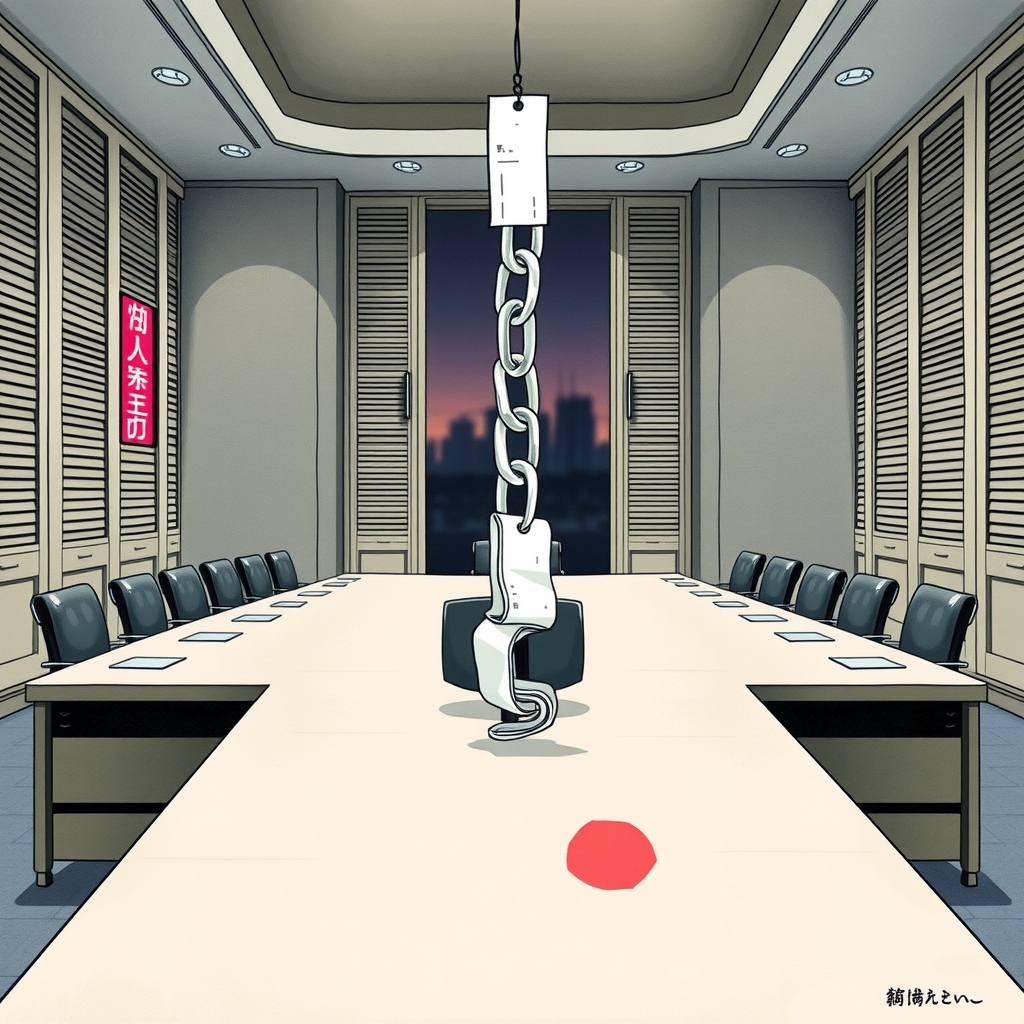
The Plan
For two decades, Japan's national strategy against human trafficking was a document about foreigners. On September 15, 2026, the government rewrote it around its own citizens.
Meeting at the Prime Minister's Office, the Human Trafficking Countermeasures Promotion Conference — its 13th session, chaired by Chief Cabinet Secretary Kihara Minoru — signed off on the draft of the Human Trafficking Countermeasures Action Plan 2026. It replaces the plan adopted in December 2022. Formal adoption will come shortly at the Ministerial Meeting Concerning Measures Against Crime, the cabinet-level body that issues these plans.
Two provisions in the draft reach directly into Japan's adult-entertainment economy. The plan commits the government to strengthened countermeasures against predatory host clubs — the bars where young women run up large tabs and are pushed toward sex work to clear them. And under the heading of stronger penalties, it brings the buyer who responds to a solicitation for prostitution into the enforcement frame.
Neither appeared in the 2022 plan. Both describe a domestic market.
| Action Plan 2026 (draft) | |
|---|---|
| Decided | September 15, 2026, Prime Minister's Office |
| Body | Human Trafficking Countermeasures Promotion Conference, 13th session |
| Chair | Chief Cabinet Secretary Kihara Minoru |
| Replaces | Action Plan 2022 (adopted December 20, 2022) |
| Formal adoption | Ministerial Meeting Concerning Measures Against Crime, date not announced |
| Public comment | July 27 – August 9, 2026, via the Cabinet Secretariat |
| New items | Predatory host club countermeasures; penalties reaching those who respond to solicitation; review of prostitution regulation; SNS consultation channel at the Immigration Services Agency; wider use of harder-to-forge electronic visas |
Why the Host Club Is in a Trafficking Document
Placing host clubs inside an anti-trafficking plan is a categorical statement, not a rhetorical one.
The mechanism the plan targets is the tsuke-barai — the running tab. A customer is encouraged to drink beyond her means on credit, the balance accumulates, and the debt becomes leverage. Reporting and prosecutions over the past three years have traced the same path repeatedly: the tab is settled by work in a fūzoku establishment or on the street, sometimes arranged by the club's own staff, sometimes by scouts operating alongside it.
Japan already legislated against this once. The 2025 amendment to the fūei-hō — the Businesses Affecting Public Morals Regulation Act, which licenses and polices nightlife and adult-entertainment businesses — took effect on June 28, 2025, with further provisions following in November. It barred manufactured romance used as a sales technique, false explanations of price, and, most directly, pressuring a customer over an unpaid balance or demanding prostitution or adult-video work as repayment. Violations carry business suspension, confinement of up to six months and fines of up to ¥1 million.
What the 2026 action plan adds is not a new offense. It is a reclassification. A business-conduct problem regulated by the public-morals statute is now also a trafficking problem, which pulls in the ministries that sit on the conference — justice, foreign affairs, health and welfare, immigration, the National Police Agency — and the victim-identification and support machinery that comes with that designation. Debt bondage has always been one of trafficking's textbook forms. The plan says so about a licensed Japanese industry.
The Buyer
The second provision runs parallel to a separate process already underway at the Ministry of Justice.
Japan's baishun bōshi-hō — the Anti-Prostitution Act of 1956 — declares that no person shall sell or buy sex, and attaches no penalty to either act. The penalties elsewhere in the statute fall on the seller and on the third parties around her: soliciting in public, procuring, providing premises, taking the proceeds, running the business. The man who buys has never been reachable under it, absent a minor or another offense.
On August 24, 2026, the ministry's expert panel on the regulation of prostitution circulated a draft report finding that solicitation by the buying side disturbs public order no differently than solicitation by the selling side, and that some regulation should be imposed. The panel also called for raising the statute's fines, which run from ¥20,000 to ¥300,000 depending on the provision and have not been meaningfully revisited in seventy years. It did not recommend raising terms of confinement, and it took a cautious position on regulating the transaction itself. A final report was expected in September, with a bill under consideration for the extraordinary Diet session.
The action plan's language is consistent with that work and gives it cabinet-level backing. The plan also commits the government to necessary consideration of how prostitution should be regulated in light of current social conditions — the formula that keeps the question open across ministries rather than leaving it inside one panel.
The Numbers That Changed the Framing
The statistics attached to the plan explain the shift better than the policy language does.
In 2025, police and other agencies protected 78 trafficking victims — 9 men and 69 women — up 12 from the previous year. 66 were Japanese nationals. 53 were children under 18.
That is a different population from the one Japan's trafficking policy was built for. The 2004 and 2009 plans, and to a large extent the 2022 plan, were written around foreign women brought into the country and held in debt by brokers. The 2025 figures describe a caseload that is roughly two-thirds domestic and two-thirds minors — Japanese teenagers, identified inside Japan.
Kihara framed the problem as one of visibility. Trafficking, he said, is a crime with high latency, and some victims do not recognize that they are victims. He called it a grave human rights violation causing mental and physical suffering that is very difficult to recover from, requiring a swift and accurate response, and noted that it is an international crime demanding coordinated action.
The United States State Department placed Japan on Tier 2 in its 2025 Trafficking in Persons Report — not fully meeting minimum standards for eliminating trafficking, but making significant efforts. That report credited Japan with more prosecutions and more victims identified, including male victims.
The Foreign Side Is Still There
The plan does not abandon the cross-border agenda; it modernizes the plumbing.
The Immigration Services Agency will open an SNS-based consultation channel so that foreign nationals can report exploitation through the platforms they actually use, rather than through an office they may be afraid to enter. Officials have pointed to the case of a 12-year-old Thai girl made to serve customers at a private-room massage shop in Tokyo's Yushima district — a case in which the child's own walk-in to the Tokyo immigration bureau in September 2025 was what finally exposed it, and whose operator was sentenced to five years' confinement and a ¥1 million fine on September 15, the same day the plan was agreed.
The draft also expands the use of electronic visas designed to be harder to forge, tightening entry controls. On labor migration, it carries forward the June 2024 amendments restricting support for Type 1 specified skilled foreign workers to registered support organizations, effective April 1, 2027.
What It Does and Does Not Do
An action plan is not a statute. It commits ministries to work, sets direction and supplies political cover; it does not by itself create an offense, and no penalty in it takes effect on adoption. The buyer provision becomes real only if the Ministry of Justice's bill reaches the Diet and passes. The host club provision becomes real only through enforcement under a public-morals law that already contains the prohibitions.
What the document does accomplish is definitional, and definitions in Japanese policy tend to precede enforcement by a year or two. As of this plan, the tab at a host club and the man who answers a solicitation are both inside the government's trafficking perimeter. Neither was there in 2022.
Sources: Jiji Press, TV Asahi's ANN, the Yomiuri Shimbun, nippon.com and Rodo Shimbun reporting of September 15, 2026, together with the Prime Minister's Office announcement of the 13th meeting of the Human Trafficking Countermeasures Promotion Conference, for the September 15 decision on the draft Human Trafficking Countermeasures Action Plan 2026, Chief Cabinet Secretary Kihara Minoru's chairmanship and quoted remarks, the new predatory host club and tsuke-barai provisions, the strengthening of penalties to reach those who respond to solicitations for prostitution, the commitment to consider how prostitution should be regulated in light of current social conditions, the Immigration Services Agency SNS consultation channel, the expansion of harder-to-forge electronic visas, the specified skilled worker support measures effective April 1, 2027, the plan's pending formal adoption at the Ministerial Meeting Concerning Measures Against Crime, and the 2025 figures of 78 protected victims — 9 men and 69 women, up 12 year on year, including 66 Japanese nationals and 53 children under 18; the e-Gov public comment listing by the Cabinet Secretariat for the July 27 to August 9, 2026 comment period on the draft; Jiji Press and the Sankei Shimbun reporting of August 24, 2026 for the Ministry of Justice expert panel's draft report on regulating solicitation by the buying side, the proposed increase in fines, its caution on regulating the transaction itself, and the anticipated September final report and extraordinary Diet bill; the Ministry of Justice's published schedule of the Study Group on the Regulation of Prostitution; contemporaneous reporting on the 2025 fūei-hō amendment effective June 28, 2025 for the prohibitions on romance-based sales tactics and on demanding prostitution or adult-video work against unpaid tabs, and the associated penalties; Jiji Press, Kyodo News, the Asahi Shimbun, the Sankei Shimbun and Bengo4.com reporting of September 15, 2026 for the Yushima sentencing; and the United States State Department's 2025 Trafficking in Persons Report for Japan's Tier 2 placement. Glossary: fūei-hō = the Businesses Affecting Public Morals Regulation Act, which licenses and polices nightlife and adult-entertainment businesses; baishun bōshi-hō = the Anti-Prostitution Act, which penalizes the seller's solicitation and third parties to prostitution but attaches no penalty to the act of buying or selling itself; tsuke-barai = payment on a running tab or credit; kōkinkei = the unified "confinement" penalty that replaced imprisonment with and without hard labor on June 1, 2025. The action plan remains a draft until adopted by the Ministerial Meeting Concerning Measures Against Crime; no date for that meeting had been announced at the time of writing.