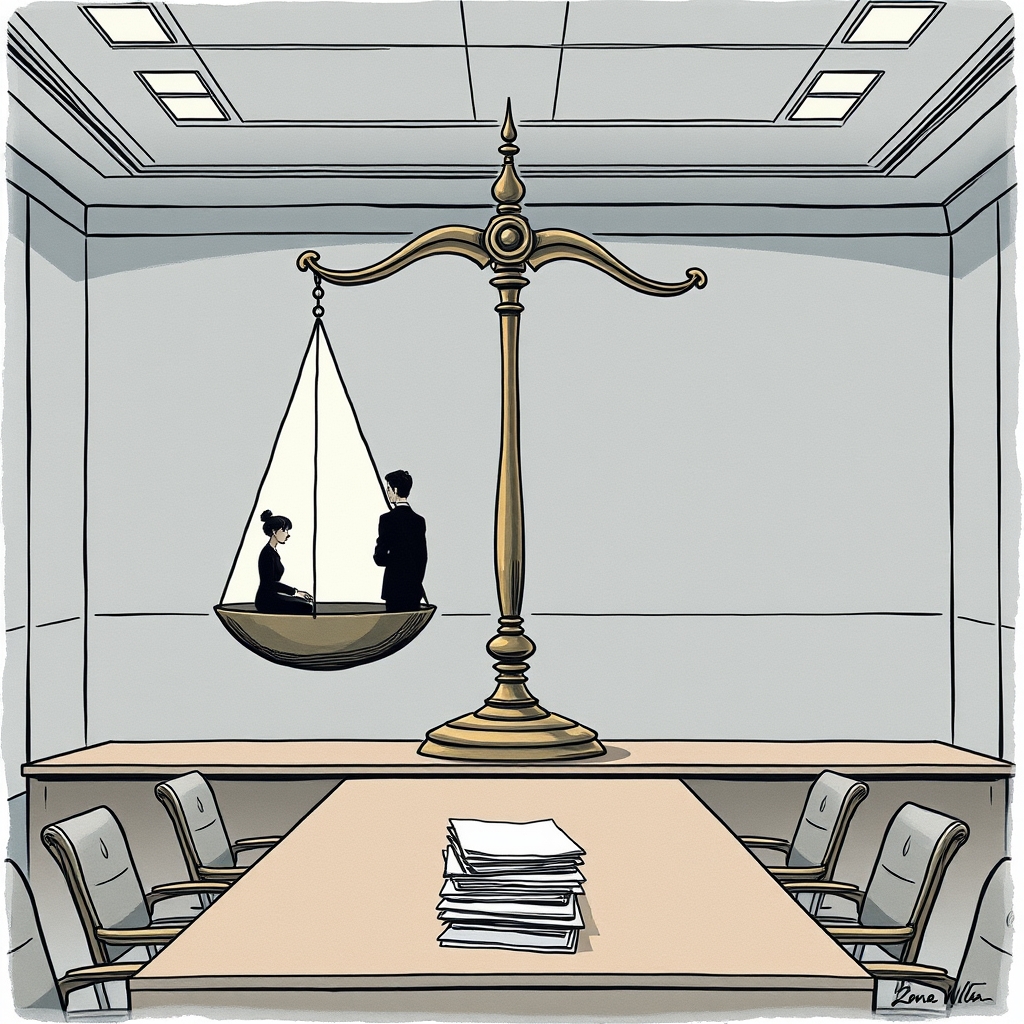
The Question the Law Has Never Answered
For nearly seventy years, Japanese law has treated the buying and selling of sex as something to be discouraged but only half punished. The woman who solicits on the street can be arrested; the man who pays her, in almost every case, cannot. A government panel is now deciding whether to close that gap—and, as of last week, how heavily the state should come down if it does.
On July 16, 2026, the Ministry of Justice convened the seventh meeting of its Study Group on the Regulation of Prostitution (baibaishun ni kakaru kisei no arikata kentokai), the expert body charged with the first fundamental review of Japan's baishun boshi-ho—the Anti-Prostitution Act—since it was written in 1956. The panel has met at a steady clip since late March, roughly every two to three weeks, and the July 16 session marked a shift in register. Among the materials the ministry circulated to members, according to its official record of the meeting, was a document on the sentencing patterns in Anti-Prostitution Act violation cases—a sign that the group has moved past whether to expand the law's reach and into the harder arithmetic of how severely it should punish.
What the Panel Is Weighing
The study group was set in motion last November, when Prime Minister Sanae Takaichi instructed the justice minister to examine what could be done about the country's lopsided prostitution rules. It held its first meeting on March 24, 2026, under the chair of Kayoko Kitagawa, a criminal-law professor at Waseda University, and is composed of about a dozen legal scholars, practitioners and experts. Its mandate, in the ministry's own framing, is to reconsider how prostitution should be regulated "in light of recent social circumstances, including solicitation on the streets."
Three questions sit at the center of the work, as laid out when the panel compiled its issues at a May meeting and reported by outlets including Jiji Press and the Tokyo Shimbun.
The first, and the one that has drawn the most public attention, is whether to penalize the buyer. As written, the baishun boshi-ho makes public solicitation, procuring and the provision of premises punishable—offenses that fall overwhelmingly on sex workers, brokers and operators—while the act of purchasing sex carries no criminal penalty at all. Panel members have argued that a buyer's solicitation should itself be examined for punishment, with particular concern for men who exploit a seller's vulnerability, such as intellectual disability, mental illness or economic desperation. Others have urged caution about criminalizing conduct that, on its face, rests on agreement between two adults.
The second question is how the statute punishes at all—the level of the hoteikei, or the range of penalties the law prescribes. It is this question that the July 16 sentencing data speaks to: before deciding whether to raise or otherwise recalibrate the penalties, the panel is examining how courts have actually punished violations under the existing framework. Reform, in other words, is being measured against the record of what the current law does in practice, not only against what it says on paper.
The third question is definitional, and quietly consequential. The 1956 law defines "prostitution" narrowly, as sexual intercourse with an unspecified person—a definition that leaves a wide range of paid sexual services outside its terms. The panel has taken up whether that boundary should be redrawn, though members have acknowledged that opinions on how to treat acts "similar to intercourse" vary widely and that consensus will be hard to reach.
Why Now
The review did not arrive in a vacuum. It sits atop a year of intensifying street-level enforcement that has thrown the law's asymmetry into sharp relief. Police in Tokyo have repeatedly arrested women for soliciting around Okubo Park in the Kabukicho district—dozens booked in the first half of this year alone—while the men who approach them walk away untouched. Across the country, meanwhile, prosecutors have brought a wave of cases against soapland operators and managers for providing premises for prostitution, and against the host clubs and scout networks accused of driving indebted young women toward sex work in the first place. Those cases enforce the law as it stands. The panel is asking whether the law as it stands is the right one.
The imbalance has become the reform's rallying point. Critics inside and outside the Diet have called it unfair that the seller is criminalized and the buyer is not, and the government's own deliberations increasingly treat the purchaser's impunity as the problem to be solved. In weighing that, the panel has looked abroad: Sweden and France penalize the buyer while decriminalizing the seller—the so-called Nordic model—whereas countries such as Belgium and Britain take different approaches to who bears criminal liability.
What Comes Next
Nothing was enacted on July 16, and nothing will be soon. A study group of this kind does not write law; it hands the justice minister a set of conclusions that may—or may not—become a bill. The ministry has signaled it hopes to have the group's work ripen into legislation as early as an extraordinary Diet session this autumn, with a regular session the following year as the fallback. The panel has also said it intends to hear from people directly affected, including sex workers and the organizations that support them, before it settles its recommendations.
For now, the meaningful movement is the one visible in the paperwork. Having spent its first several sessions mapping whether Japan should punish the men who buy sex and whether to widen what counts as prostitution at all, the panel has begun studying how the country actually sentences the conduct it already prohibits. That is the unglamorous middle of law reform—the point at which a principle has to be turned into a number. Seventy years after the baishun boshi-ho was written to discourage prostitution without quite daring to punish everyone involved in it, the government is finally doing the accounting.
This article is compiled from the Ministry of Justice's official record of the Study Group on the Regulation of Prostitution, including the July 16, 2026 seventh meeting and its circulated materials, and from reporting by Jiji Press, the Tokyo Shimbun, NHK and the Nikkei on the panel's establishment, membership, mandate and timeline. The three-issue framing, the chair's identity, the buyer-penalty debate and the international comparisons are attributed to those sources as published; the substance of the seventh meeting's deliberations had not been released by the ministry at the time of writing. Legal gloss: baishun boshi-ho = Anti-Prostitution Act, enacted 1956, which criminalizes solicitation, procuring and the provision of premises for prostitution but not the purchase of sex; hoteikei = the statutory range of punishment a law prescribes; fuei-ho = Businesses Affecting Public Morals Regulation Act, the separate statute that licenses and polices adult-nightlife businesses.