The Camera the Police Brought Themselves
The footage that ended six police careers was not taken by a bystander. It was not pulled from a shop's security system. Osaka Prefectural Police recorded it themselves, on cameras their own investigators set up inside the room.
On September 3, 2026, the force announced it could not determine who later deleted it.
The Osaka Prefectural Police said its investigation into the destruction of that video data — a criminal inquiry, opened on suspicion of evidence destruction under the Penal Code — had been exhausted without identifying a suspect. The case was referred to the Osaka District Public Prosecutors Office on May 28, 2026 with the suspect recorded as unknown. The announcement was reported by Kyodo News, Jiji Press, the Mainichi Shimbun, the Sankei Shimbun, Kansai Television, ABC News, MBS News and Yomiuri Television.
Dozens of officers were questioned. None admitted deleting anything.
What the Cameras Were There For
The raid was part of the largest sex-industry enforcement campaign now running in Japan.
On July 15 and 16, 2025, roughly twenty officers of the Osaka Prefectural Police's Investigation Division 4 — the force's organized-crime unit — searched an office building in Nishi Ward, Osaka City, in connection with a suspected violation of the Employment Security Act by "Natural," the organization investigators describe as the largest illegal scout group in the country. Scout groups recruit women in entertainment districts, place them into sex-industry establishments, and take a continuing share of what those women earn. The statute at issue, shokugyō anteihō, bars placing workers into occupations harmful to public health or morals, and it is the principal charge police have used to take Natural apart.
Inside the building, officers assaulted three men who were present. The purpose, as prosecutors later described it, was to make the men give up the passcodes to seized smartphones. One man was struck in the face repeatedly with his own phone. Another was pulled by the hair. One of the three was injured.
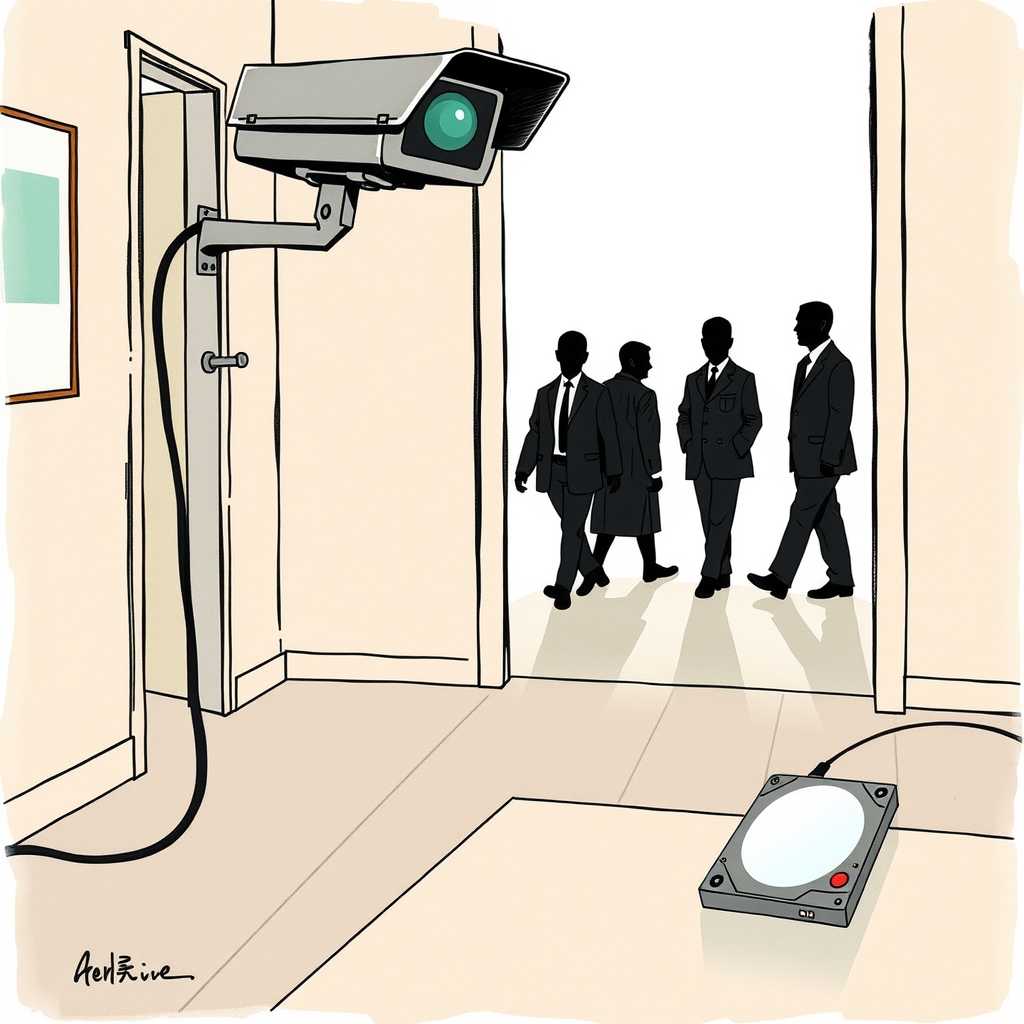
Two cameras that the investigators had installed in the room recorded it. The data was written to a police recording medium and held inside the task force, which was based at Sonezaki Police Station.
That arrangement is the detail worth pausing on. Investigation cameras exist to document a search — to establish what was seized, from where, and in what condition, so that the seizure survives a defense challenge in court. In this instance the equipment brought in to protect the integrity of the search became the only impartial record of the officers' own conduct.
Deleted, Then Recovered
The deletion was discovered in late July 2025, after the assaults became known inside the force.
The data was recovered. Restored, it went into evidence, and it was used at the trial of one of the officers — Yusuke Sakaguchi, 33, a former sergeant of Division 4 — where he denied any part in the erasure and said someone attached to the investigation unit had done it. Jiji Press reported the deletion and the restoration on January 23, 2026.
So the record of what happened in Nishi Ward was not lost. What was lost was the answer to who tried to lose it.
| Detail | As reported |
|---|---|
| Announcement | September 3, 2026 |
| Force | Osaka Prefectural Police, Investigation Division 4 |
| Search | July 15–16, 2025, office building in Nishi Ward, Osaka City |
| Investigation | Premises tied to the scout group "Natural"; suspected Employment Security Act violation |
| Conduct | Six officers assaulted three men to obtain smartphone passcodes |
| Recording | Two cameras installed in the room by investigators |
| Storage | Police recording medium held by the task force at Sonezaki Police Station |
| Deletion found | Late July 2025, after the assaults became known |
| Data recovered | Yes — restored and used as trial evidence |
| Officers questioned | Dozens with access to the stored data |
| Result | No suspect identified; no investigator admitted deletion |
| Referred to prosecutors | May 28, 2026, suspect unknown, on suspicion of evidence destruction |
| Separate case | Male police inspector referred on suspicion of harboring an offender; not prosecuted, September 3, 2026 |
The Statute That May Not Reach
The offense under investigation was evidence destruction, Article 104 of the Penal Code. It carries up to three years' confinement or a fine of up to ¥300,000.
It also carries a limitation that matters here. Article 104 reaches the destruction of evidence "relating to the criminal case of another person." Destroying evidence of one's own offense is not punishable under it. The reasoning is old and consistent across many legal systems: the law does not expect a person to preserve the proof of their own guilt.
Apply that to a task force in which some of the officers with access to the stored data were themselves the officers on the video, and the difficulty becomes structural rather than investigative. Even had police named the person who pressed delete, whether Article 104 covered the act would depend on whose case the footage belonged to. Police have not said publicly how they weighed that question. What they have said is that they questioned everyone who could have done it and got no admission.
The Second Closure, the Same Day
September 3 closed a second line of accountability as well.
Separately from the deletion, a male police inspector — a supervising officer, aged 45 in reporting at the time of his referral — was sent to prosecutors on suspicion of harboring an offender for telling the Osaka District Public Prosecutors Office that camera footage of the assault did not exist. It did exist. Nikkei reported that referral in January 2026.
On September 3, the Osaka District Public Prosecutors Office declined to prosecute him, according to the Mainichi Shimbun.
Two announcements, one day. The person who erased the record was never identified. The person who told prosecutors there was no record will not be charged.
What Has Been Punished
This is not a case in which nothing happened.
All six officers who committed the assaults were convicted. A former assistant inspector, Chikara Tsutanaga, 51, and Sakaguchi were arrested, indicted and convicted on January 26, 2026 — two years and two and a half years respectively, each suspended for three years. Four others were indicted without arrest; the last of them, a 36-year-old former sergeant, was convicted on July 29, 2026 and given a year, suspended for three. The charge in each case was assault and cruelty by a special public officer, Article 195 of the Penal Code — the provision that treats abuse of police power as its own offense, distinct from ordinary assault, with a maximum of seven years.
The administrative reckoning was wider. On January 23, 2026, the force disciplined 12 people formally, dismissing two, and took internal measures against more — a total that Japanese reporting described as the largest disciplinary action of its kind in the Osaka force's modern history. The officials who had headed the criminal investigation department and Division 4 at the time were cited for supervisory failure.
The assaults, in other words, were prosecuted and punished. It is the concealment that has produced no defendant.
Why the Gap Matters
The distinction is not academic, and it is not only about Osaka.
The Natural investigation rests on what comes off seized phones. Referral records, fee splits, the identities of the establishments taking the women — that material lives in messaging apps, and a locked handset is frequently the difference between a chargeable case and an unprovable theory. The pressure that produced the beatings in Nishi Ward was, at bottom, pressure to open devices.
A force that answers that pressure with violence damages the cases it is building. A force that then cannot say who deleted the proof of the violence damages something harder to rebuild, because the deletion was not committed by an outsider. It happened inside a task force, to data the police were holding, and the pool of people who could have done it was small enough to interview one by one.
The Osaka Prefectural Police's inspection division said the force would strengthen guidance and training for personnel and tighten the storage and management of collected data. Investigators indicated the inquiry could resume if new testimony emerges.
Whether the deletion was ever likely to yield a defendant is a fair question, given the limits of Article 104. But the outcome announced on September 3 stands on its own terms: the camera worked, the recording survived, the officers on it were convicted — and the only thing the department could not establish is which of its own people tried to make the recording disappear.
Sources: Reporting of the Osaka Prefectural Police's September 3, 2026 announcement by Kyodo News (via the Tokyo Shimbun and Web Toonippo), Jiji Press, the Mainichi Shimbun, the Sankei Shimbun, Kansai Television, ABC News, MBS News and Yomiuri Television. The May 28, 2026 referral to the Osaka District Public Prosecutors Office with the suspect unknown, the questioning of dozens of investigators, and the statement on data management and staff training are as reported by those outlets. The deletion and subsequent restoration of the footage, and its use as evidence at the trial of Yusuke Sakaguchi, are from Jiji Press, January 23, 2026. The referral of a male police inspector on suspicion of harboring an offender for reporting to prosecutors that the footage did not exist is from Nikkei, January 2026; the September 3, 2026 decision not to prosecute him is from the Mainichi Shimbun. Details of the July 15–16, 2025 search, the convictions of the six officers on January 26 and July 29, 2026, and the January 23, 2026 disciplinary actions are drawn from Kyodo News, Jiji Press, the Sankei Shimbun, Nikkei and MBS News, and from this site's prior reporting. Outlets describe the storage device variously as a hard drive, a portable SSD and a recording medium; it is given here as a recording medium held by the task force, the formulation common to the wire accounts. Legal glosses: evidence destruction = Penal Code Art. 104, up to three years' confinement or a fine of up to ¥300,000, applying by its terms to evidence relating to another person's criminal case; harboring an offender = Penal Code Art. 103; assault and cruelty by a special public officer = Penal Code Art. 195, maximum seven years; Employment Security Act = shokugyō anteihō, the statute barring placement of workers into occupations harmful to public health or morals. The inspector was not prosecuted and the deletion remains unattributed; no person is identified here as responsible for erasing the data.