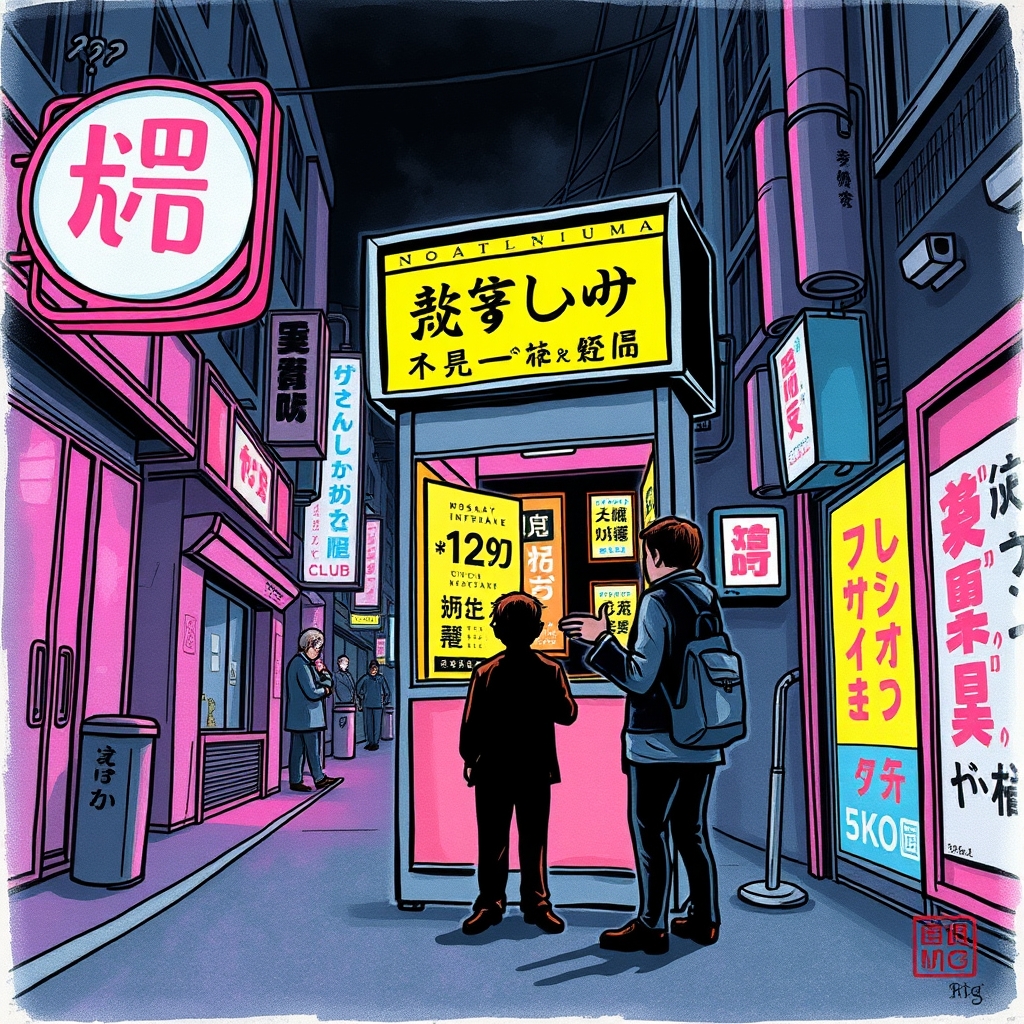
A Pitch on a Minami Street
The line, as Osaka police describe it, was equal parts flattery and misdirection: "I want you to go see some hosts. We've got insanely handsome guys. Would it be OK if you just stopped by the info center first?"
On July 15, 2026, Osaka Prefectural Police announced the arrest of two people they say used a so-called free information center in the Minami entertainment district as cover for illegal host-club solicitation. According to police, the venue—"Host Station Afro Banana"—was not really in the business of neutrally pointing tourists toward nightlife. It was, investigators allege, a funnel: a way to route women toward host clubs while keeping the actual sales pitch one step removed from the street.
Police identified the center's de facto operator as Rui Omori, 34, and arrested him alongside a 24-year-old female employee. The two are accused of violating the Osaka Prefectural Nuisance Prevention Ordinance (meiwaku boshi jorei), the local statute that, among other things, bars touting for host clubs, lounges and other venues that provide settai—regulated hospitality in which staff sit with and entertain customers.
How the Alleged Scheme Worked
The charged conduct is narrow and specific. On a night in May 2026, police say, the pair—acting together with a man in his 20s—approached a woman walking along a street in Soemoncho, in Osaka's Chuo Ward, and solicited her for a host club, steering her toward the information center as the first stop. The woman was an undercover officer.
What makes the case more than a routine street-solicitation bust is the structure police describe around it. Direct touting for host clubs is exactly what Osaka's ordinance forbids, and enforcement in Minami has tightened. So the alleged workaround, as investigators frame it, put a "free information center" in the middle: touts flag a woman down, walk her to the center, and host-club staff collect her from there. On paper, no one has solicited for a specific club on the street. In practice, police contend, the center functioned as a kakuremino—a disguise—whose purpose was to let the touting continue while dodging the rules written to stop it.
Police say they believe the center coordinated with more than one host-club group, and that the arrests are a step toward mapping those relationships. Investigators have not disclosed whether the two arrested admit or deny the allegation, and no charge has been tested in court. As with any arrest, the suspects have not been convicted.
The account above is the authorities' as relayed by the news outlets cited; the allegation that the center served as a front remains under investigation and has not been established.
Why Osaka Was Watching
The case sits on top of a deliberate push. Minami—the neon core around Namba, Dotonbori and Soemoncho—has spent the past year under a hardened solicitation crackdown, and touts there now trade warnings among themselves that even a casual "let's go" can be enough to get arrested. Osaka's ordinance treats aggressive street solicitation for hospitality venues as an offense in its own right, and the point of the enforcement is to keep the pipeline from the sidewalk to the host club visible and accountable.
The wider concern behind that pipeline is money—specifically, women's. Japan spent 2025 and 2026 tightening the screws on predatory host clubs, the kind that run up enormous bar tabs on customers and then lean on them to pay through sex work. Nationally, the fuei-ho (the Businesses Affecting Public Morals Regulation Act, which licenses and polices host clubs, cabarets and other adult-nightlife trades) was revised to ban the worst of those tactics, and police forces have followed with arrests of scouts and operators who move indebted women toward paid sex. Street touting is the front end of that same economy: it is how a first-time customer becomes a regular, and how a regular becomes a debtor.
Seen against that backdrop, a "free information center" that allegedly exists to feed host clubs is not a footnote. It is the trade adapting. When the rules make it illegal to sell a specific club on the street, the response—if police have it right here—is to build a layer that looks like neutral tourist help and route the same customers through it. According to the reporting, touting arrests are already climbing: nationwide in 2025, authorities booked 34 touts, more than double the prior year's figure.
The Larger Pattern
There is a familiar logic in play. A jurisdiction bans a practice; the practice does not vanish so much as reorganize itself around the ban. Kabukicho in Tokyo has spent the year producing its own version of this—touts, scouts and rip-off bars all shifting shape under a very public cleanup—and the Minami case reads as the same instinct at work five hundred kilometers west. The specific dodge here, dressing solicitation up as an "information center," is the kind of adaptation that regulators tend to see only after it is already running.
For the woman stopped on a Soemoncho street, none of that architecture is visible. What is visible is a friendly offer, a short walk, and a door. Whether this particular case holds will be settled in the ordinary course of investigation and any prosecution that follows. What the arrest signals is narrower: that Osaka police, a year into squeezing Minami's touts, are now willing to look past the storefront label and treat a "free information center" as what they say it really was.
This article is compiled from reporting by the Mainichi Shimbun and MBS News (Mainichi Broadcasting System), both dated July 15, 2026, with background context from Kansai Television's reporting on Minami's tightened solicitation rules. Details—names, ages, the venue name, the ordinance charge, the May solicitation and the quoted pitch—are attributed to those outlets as published, citing Osaka Prefectural Police. Given uncertain transliteration, the 24-year-old employee is identified here only by age and role. Legal glosses: meiwaku boshi jorei = prefectural nuisance-prevention ordinance, which bars persistent street touting for hospitality venues; settai = regulated hospitality service; fuei-ho = Businesses Affecting Public Morals Regulation Act. The suspects are accused of an ordinance violation; the broader allegation that the center was a front for host-club touting remains under police investigation and has not been established.