A New Target in Kabukicho
For two nights, officers from the Tokyo Metropolitan Police Department walked into a category of business that has spent years growing in Shinjuku's Kabukicho district largely outside the enforcement spotlight.
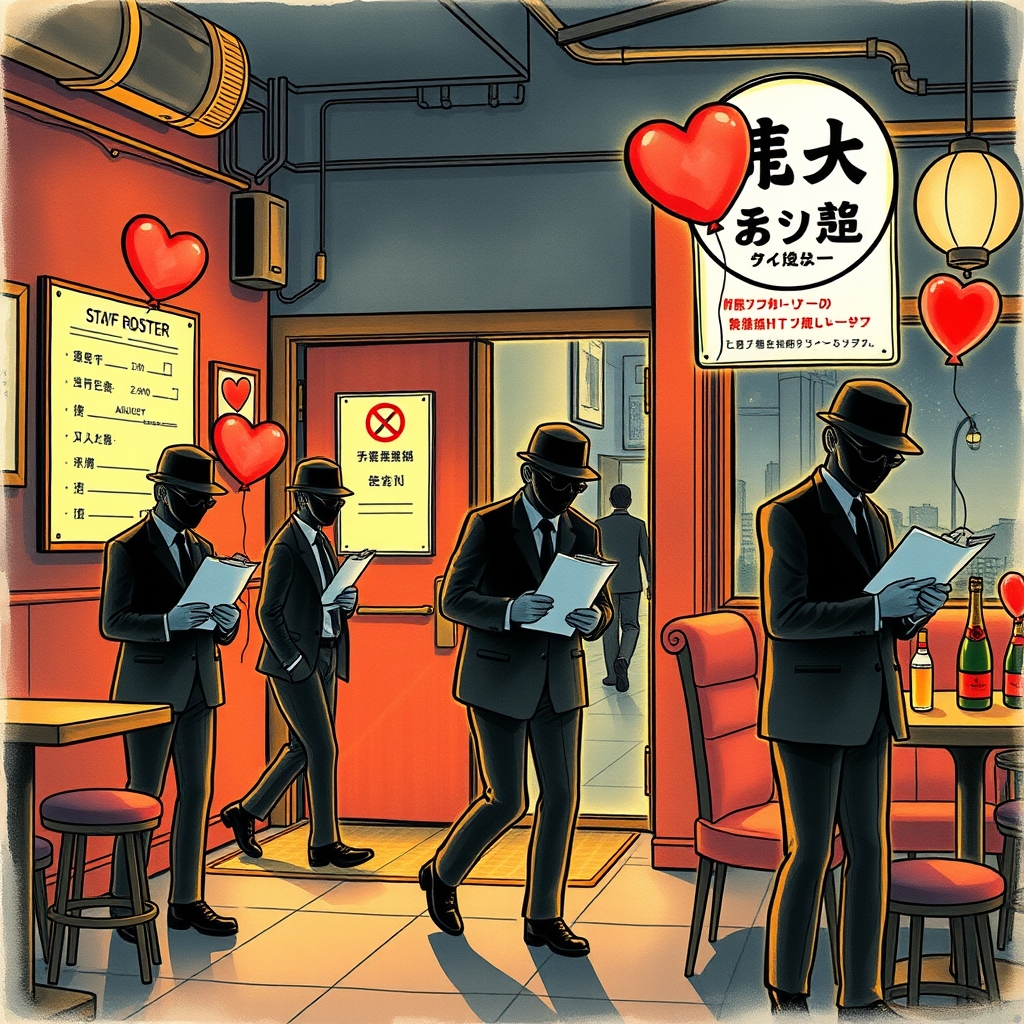
On July 22 and 23, the department conducted what it described as its first coordinated inspection of men's concept cafes — venues where male staff serve a mostly young, mostly female clientele — entering 20 establishments in and around Kabukicho to check operating permits and compliance. According to reporting on July 24 by NHK, TBS NEWS DIG (JNN), NTV's NNN and FNN Prime Online, investigators confirmed violations of the Businesses Affecting Public Morals Regulation Act (fuei-ho) at 12 of the 20 venues, or roughly 60 percent.
The violations police identified were administrative rather than dramatic: employee rosters that were not kept on the premises as required, and missing signage barring entry to minors. Officers issued verbal guidance to the establishments concerned. No arrests were announced in connection with the sweep.
| Detail | As reported |
|---|---|
| Operation | First coordinated inspection of men's concept cafes |
| Dates | July 22-23, 2026 |
| Venues inspected | 20, in and around Kabukicho, Shinjuku Ward |
| Venues with violations | 12 (about 60%) |
| Violations cited | No employee roster on premises; no signage barring minors |
| Action taken | Verbal guidance; no arrests announced |
| Parallel action | Guest-registry checks at 38 Kabukicho hotels |
| Agency | Tokyo Metropolitan Police Department |
Why the Paperwork Matters
The gap between the modesty of the infractions and the scale of the operation is the story.
An employee roster is not a bureaucratic nicety in this context. Under the fuei-ho — the statute that licenses and regulates Japan's hospitality and adult-entertainment businesses — a licensed operator is required to keep records identifying who works there, which is the mechanism by which police can establish whether an underage person is being employed and who is responsible for them. The signage requirement serves the same function on the customer side. Where neither exists, the question of who was in the building, on which side of the counter, and how old they were becomes very difficult to answer after the fact.
That is precisely the question Tokyo police have been trying to answer in a string of recent cases.
The Cases Behind the Sweep
Men's concept cafes — mensu konkafe in local usage — occupy an ambiguous position. They are not sex businesses. They sell drinks, conversation and the attention of a staff member the customer has chosen. What has drawn police attention is the economics that attention can generate among teenage customers, and where those teenagers find the money.
Investigators have described a recurring pattern in which male staff practice iro-koi eigyo — courtship-style sales, cultivating romantic feeling in young female customers — and those customers then spend heavily on oshikatsu, the fan-support spending directed at a favorite staff member. Police say they have confirmed cases in which girls turned to prostitution or papa-katsu, transactional dating arrangements, to fund that spending. NNN reported that the sweep followed a run of consultations about minors making large payments at these venues.
The individual cases are already on the record. On June 11, Jiji Press reported that the Metropolitan Police Department's Juvenile Development Division had arrested a 21-year-old former employee of a Kabukicho men's concept cafe on suspicion of violating the fuei-ho by admitting a 14-year-old junior high school student to a venue where minors were prohibited. According to that report, the man had come to know the girl through a men's underground idol group, encouraged her to visit, and asked her to buy champagne service; the girl was said to have paid the establishment roughly ¥200,000 and to have sold sex in the Kabukicho hotel district. Police were examining whether he had exploited her feelings toward him. He acknowledged the allegations.
In January 2026, TBS NEWS DIG reported the arrest of a manager and an operator of another Kabukicho men's concept cafe on suspicion of running an unlicensed hospitality business, along with a suspected violation involving admitting a high school student under 18. And in May 2025, Jiji reported the re-arrest of a men's concept cafe employee suspected of having a high school girl engage in papa-katsu.
This site is not naming the individuals in those cases.
The Hotels
The second half of the July operation is the part that connects the cafes to the sex trade directly. On the same nights, Metropolitan Police officers entered 38 hotels in Kabukicho, reviewed guest registries, and asked operators to cooperate by reporting cases where child prostitution or paid sex appeared to be taking place, according to TBS NEWS DIG and NHK.
Kabukicho's love-hotel district is where the money raised in the cafes is understood to be earned. Checking cafes and hotels in a single operation reflects an enforcement theory that treats them as two ends of one chain rather than as separate problems.
Where This Sits in the Law
Japan's regulatory architecture here is layered, and the men's concept cafe sits in a seam between the layers.
The fuei-ho governs licensed hospitality and adult-entertainment operations, imposing permit, recordkeeping, signage, hours and location requirements. A venue whose staff provide settai — hospitality service in the legal sense — needs the relevant license; several of the recent Kabukicho prosecutions have turned on operating without one.
The baishun boshi-ho, the Anti-Prostitution Act of 1956, does not punish the sale of sex itself. It reaches the apparatus around it: soliciting, procuring, providing premises, and contracting to make a person engage in prostitution. Where a minor is involved, the child prostitution and child pornography statutes and the Child Welfare Act carry heavier penalties, and those are the provisions that have anchored several arrests in this sector.
The fuei-ho was also amended in 2025, with the revised provisions fully in force by late November of that year, in response to the malicious host club problem — most notably by sharply raising penalties and targeting the practice of pushing indebted customers into sex work to settle bar tabs. That reform was written with host clubs in view. The July inspections suggest police now see a structurally similar dynamic — courtship, debt, and a route to the hotel district — operating in a venue type the reform did not name.
Police said they would continue awareness campaigns and strengthen enforcement.
This article is compiled from July 24, 2026 reporting by NHK, TBS NEWS DIG (JNN), NTV's NNN and FNN Prime Online on the Tokyo Metropolitan Police Department's July 22-23 inspection of men's concept cafes in Kabukicho, and from June 11, 2026 reporting by Jiji Press on a related arrest. The inspection dates, the count of 20 venues and 12 with violations, the specific violations cited, the verbal guidance issued, the 38 hotel checks, and the background description of iro-koi eigyo, oshikatsu and prostitution by minors are attributed to those outlets as published. Details of prior arrests are drawn from Jiji Press and TBS NEWS DIG reports as characterized by those outlets; the individuals are not named here, and none of those allegations has been proven in court. Legal gloss: fuei-ho = Businesses Affecting Public Morals Regulation Act, the statute licensing and regulating Japan's hospitality and adult-entertainment businesses, including requirements to maintain employee rosters and post notices barring minors; baishun boshi-ho = Anti-Prostitution Act, the 1956 law penalizing solicitation, procurement, provision of premises and contracting for prostitution rather than the sale of sex itself; settai = hospitality service in the legal sense, the trigger for a fuei-ho license. "Men's concept cafe" (mensu konkafe) denotes a cafe-format venue where male staff serve customers; "iro-koi eigyo" denotes courtship-style sales technique; "oshikatsu" denotes fan-support spending on a favored performer or staff member; "papa-katsu" denotes transactional dating arrangements.