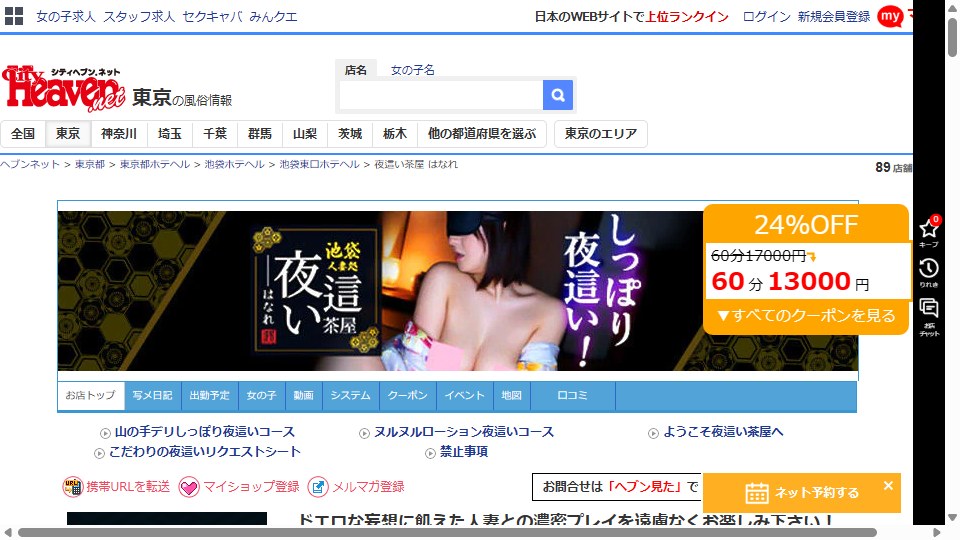

First, the category, because "yobai" gets thrown around loosely. Yobai Chaya Hanare is a hotel health — hoteheru, you meet at the shop and go to a room — working the Higashi-Ikebukuro side of the east exit, fourth floor of a small building off the main drag. Casting is hitozuma: married women, the whole roster. The premise sits right in the name — the yobai, the old night-crawl scenario, she's asleep and you're not supposed to be there — and the tagline goes at it without apology: dense play with married women starved for the fantasy. Hours run 10:00 to 24:00, and that daytime open isn't decoration. A married-women roster is a daytime roster. The 11 a.m. slot isn't the leftover shift here; it's the main one, and the building at that hour is quiet in a way that suits the concept better than midnight ever would.
The Options List That Isn't There
Here's the included list, and read it as a menu rather than a perk: eye mask, handcuffs, penlight, pink rotor, panties (yours to keep), pantyhose (yours to keep), denma from the 80-minute course up, brush, and vibe from the 100-minute course up. All free. No line item, no ¥2,000 rental, no awkward beat at reception where you point at a laminated card.
So why give away the thing every competitor sells? Because at this shop the props aren't accessories — they're staging. The yobai premise structurally requires a blindfold and restraints; that's not an upgrade to the scenario, that's the scenario's set dressing. You cannot run "she's asleep and doesn't know you're there" and then break frame to settle the rental fee on the eye mask. The second you itemize the blindfold, you've told the customer he's in a transaction, and the product he actually came for evaporates. Bundling here isn't generosity. It's the only pricing structure the concept permits. A shop selling a scenario has to eat the prop cost, and this one clearly ran that math before it printed the board.
The Ladder Climbs in Equipment, Not Clock
Then they did something genuinely sharp with it. Look again at the list: the denma unlocks at 80 minutes. The vibe unlocks at 100. The free-item list isn't flat — it's tiered against course length.
That's the upsell, and it's a far better one than an options sheet. On a normal menu, going from 60 to 80 buys you twenty more minutes of the same thing; you're purchasing duration, and duration is a weak thing to sell, because the customer can always tell himself sixty was plenty. Here, stepping up a rung changes what's in the room. The 80 isn't a longer 60, it's a 60 with hardware. The 100 isn't a longer 80, it's the full kit. They've converted a time-upgrade — easy to decline — into an equipment-upgrade, which reads as a different experience rather than more of the current one. I've watched software companies pay consultants six figures to arrive at that exact move. A hoteheru on the fourth floor in Higashi-Ikebukuro just does it quietly, on a price board, in a font nobody's admiring.
Two Lines, ¥2,000 Apart, All the Way Up
The board runs two parallel courses. The Shippori Yobai line — the base scenario — goes 60 min ¥15,000 / 80 min ¥20,000 / 100 min ¥25,000 / 120 min ¥30,000. Alongside it sits the Nurunuru Lotion Yobai line at ¥17,000 / ¥22,000 / ¥27,000 / ¥32,000. There's also a 40-minute ¥10,000 short course at the bottom of the board, and above the courses the usual door math: ¥2,000 entry, ¥2,000 for a repeat nomination, photo selection free, ¥5,000 per 20-minute extension.
The lotion line is the interesting one. It's exactly ¥2,000 more at every single rung — not ten percent, not scaling with the clock, a flat two thousand whether you're buying 60 minutes or 120. That's a shop pricing lotion as a consumable, not as a premium tier. They're recovering the cost of the stuff and the extra towels and the longer room turnaround, and that cost doesn't care how long you stay. Compare it to the way most houses handle a "special" course, where the upgrade quietly widens as you climb because they know the 120-minute customer has already stopped counting. Here the gap never widens. On the 60 it's a 13% bump; by the 120 it's under 7%, which means the lotion course gets proportionally cheaper the longer you book. If that's the version you want, the long rungs are where it stops being a decision.
What the Daytime Slot Actually Buys
The rest of the structure is honest and unremarkable in the good way. Twenty minutes of extension runs ¥5,000, which is the same ¥250-a-minute the course ladder itself is built on — no penalty for extending, no bonus for pre-committing, the clock costs what the clock costs. There's also a Yamanote delivery variant of the scenario for select hotels along the loop, ¥1,000 to ¥2,000 transport depending on area, which makes this a hoteheru that can behave like a deriheru when you'd rather not be seen walking into a fourth floor in Higashi-Ikebukuro at noon. That's a real consideration for this clientele and they've priced it like they know it.
What the 11 a.m. booking buys, though, is the thing the price board can't show you: a roster that's actually present at that hour instead of a skeleton panel. Married-women shops live and die on the daytime window, because that's when the roster can work. A midnight visit to a hitozuma house is usually a thinner board than the ad implies. Open at ten, and ten is the real shop.
The Verdict
- Included items: ★★★★★ — the blindfold, cuffs, rotor, penlight, brush and take-home panties and pantyhose all come with the course; for a scenario house this is structural, not a perk, and they got it right.
- Ladder design: ★★★★★ — gating the denma at 80 and the vibe at 100 turns a duration upsell into an equipment upsell. It's the smartest thing on the board.
- Lotion pricing: ★★★★☆ — flat ¥2,000 at every rung means it's priced as a consumable, and it quietly gets proportionally cheaper the longer the course.
- Door fees: ★★★☆☆ — ¥2,000 entry plus ¥2,000 nomination is standard, unglamorous, and worth remembering when you compare the ¥15,000 headline against anything else in Ikebukuro.
- Going back: ○ — for the daytime slot, on the 80 or above, where the list has actually finished unlocking.
I came in expecting to find the margin hidden in an options sheet, the way it usually is, and instead found a shop that understood its own product well enough to know the options sheet would destroy it. You can't sell a fantasy and invoice it at the same time. So the props are free, the upgrade path runs through the equipment list instead of the clock, and the lotion line is priced like the consumable it is rather than the luxury tier it could have pretended to be. None of that shows up in the catchphrase. All of it shows up on the board, if you read the free column instead of the price column — which, at Yobai Chaya Hanare, is where the menu actually is. First visit logged, at eleven in the morning, and the structure holds.