
The shop, plainly
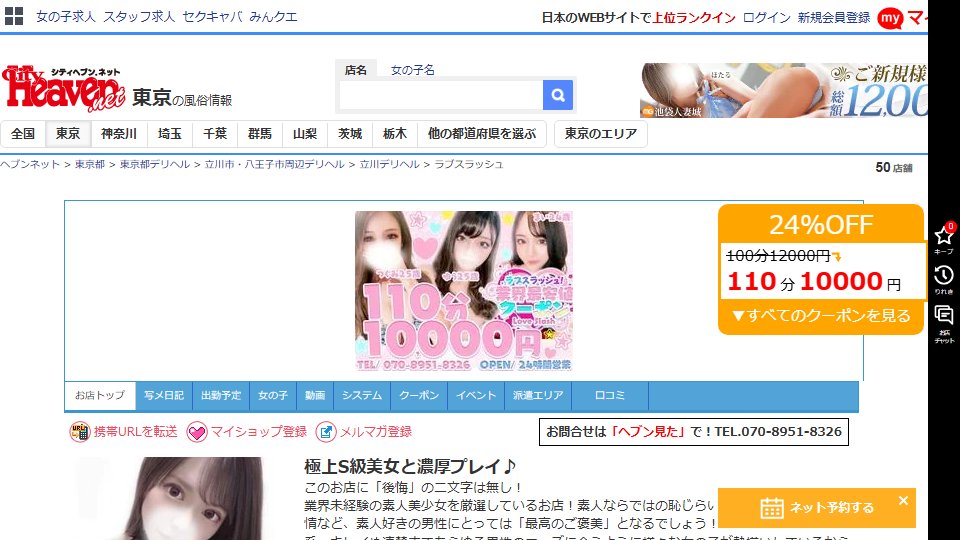
ラブスラッシュ — Love Slash — is a deriheru, a delivery health, filed on CityHeaven under 立川デリヘル with the genre label spelled out as デリヘル(激安/立川). Gekiyasu: ultra-discount. The shop tells you what bracket it's in before you read a single number.
It runs 24 hours a day with no closing day, the phone is 070-8951-8326, and the official site is loveslash.tokyo. The published dispatch area is narrow — Tokyo, Tachikawa (Tachikawa City) — and the fare table only quotes 立川駅周辺, the area around Tachikawa Station. Everything outside that is 応相談, a phone conversation. Hold that thought; on a discount board, an unpublished number is the only one that can hurt you.
The concept line is 極上S級美女と濃厚プレイ♪ — top-grade S-class beauties, intense play — followed immediately by body copy saying the shop carefully selects 業界未経験の素人美少女, amateur girls with no industry experience, and sells their 恥じらい, their shyness. Those are two different products. "S-class" is a grading claim about polish; "never done this before" is a claim about the absence of polish. Most shops pick one. This one prints both in the same paragraph and moves on.
Staff motto: 親切・丁寧・元気 — kind, careful, energetic. I'll come back to the phone manner, because on a board like this the phone is the product.
Shop page: Love Slash on CityHeaven.
The board, and the one step that matters
Five courses, published, no asterisks:
| Length | Course price | Per minute |
|---|---|---|
| 50 min | ¥8,000 | ¥160 |
| 100 min | ¥12,000 | ¥120 |
| 130 min | ¥16,000 | ¥123 |
| 160 min | ¥20,000 | ¥125 |
| 190 min | ¥24,000 | ¥126 |
Anything past 190 is by request on the phone.
Now price the steps instead of the totals, which is the only way these boards ever tell the truth:
| Step | Added cost | Per added minute |
|---|---|---|
| 50 → 100 min | +¥4,000 / 50 min | ¥80 |
| 100 → 130 min | +¥4,000 / 30 min | ¥133 |
| 130 → 160 min | +¥4,000 / 30 min | ¥133 |
| 160 → 190 min | +¥4,000 / 30 min | ¥133 |
| 30-min extension, on the clock | ¥10,000 / 30 min | ¥333 |
There it is. The jump from fifty minutes to a hundred costs ¥80 a minute — half the rate of the course you're already buying, and the cheapest minutes anywhere in the building. Fifty percent more money doubles your time. Every step after that settles at a flat ¥133 and never moves again.
So the ladder has one cliff and then a plateau. The 50-minute course exists to be the number in the advertisement; the 100 is where the board actually wants you, and unusually, the board is right.
And then the extension. ¥10,000 for thirty minutes on the clock, against ¥4,000 for the same thirty minutes booked in advance. That is a ¥6,000 penalty for changing your mind — seventy-five percent of the entire headline course, charged for a decision you could have made for free while you were still dressed. At ¥333 a minute the extension button is 4.2× the price of the 50→100 step. On a discount board, that spread is the widest number in the document.
The ¥8,000 that has never once been ¥8,000
Here is the part the genre label doesn't cover. Fixed charges, all published:
| Item | Price |
|---|---|
| 入会金 — entry fee, first visit | ¥2,000 |
| 指名料 — nomination (pick from photos) | ¥2,000 |
| 本指名料 — repeat nomination (ask for her again) | ¥3,000 |
| 自宅派遣料 — dispatch to a residence | ¥1,000 |
| 夜間・早朝料金 18:00–9:00 | ¥1,000 |
| 交通費, Tachikawa station area, 09:00–21:00 | ¥2,000 |
| 交通費, Tachikawa station area, 21:00–09:00 | ¥1,000 |
Add them to a first visit — hotel near the station, afternoon, you picked her from a photo — and the fixed side is ¥6,000 before a single minute is sold. Run that across the board:
| Length | Course | All-in, first visit | Real per minute |
|---|---|---|---|
| 50 min | ¥8,000 | ¥14,000 | ¥280 |
| 100 min | ¥12,000 | ¥18,000 | ¥180 |
| 130 min | ¥16,000 | ¥22,000 | ¥169 |
| 160 min | ¥20,000 | ¥26,000 | ¥162 |
| 190 min | ¥24,000 | ¥30,000 | ¥158 |
The advertised ¥8,000 is 57% of what the fifty-minute booking actually costs. The same ¥6,000 of fixed charges is 75% of the shortest course and 25% of the longest, which means the discount label gets more honest the longer you stay. At fifty minutes you are paying ¥280 a minute at a shop whose entire identity is the word gekiyasu. That's not cheap. That's a mid-market rate wearing a discount sign.
Nothing here is hidden — every line is printed on the system page in plain type. But a fee structure this front-loaded does a specific thing to a specific customer: the man who reads only the big number and books the short course is the one funding the board.
No change, no cancel — and what that does to ¥2,000
Now the rule that reorganizes everything above it. From the system table, two lines, no elaboration:
チェンジ 不可 — Change: not permitted. キャンセル 不可 — Cancellation: not permitted.
And from the terms of use, spelled out at length: once you have booked, or once she has been dispatched, there is no cancellation, no change, no shortening of the session, and no refund — none of it, at all.
Most deriheru allow a change, usually once, sometimes for a fee, sometimes only before she's inside the room. It's the industry's pressure valve. Love Slash has removed the valve and told you so in advance, which is more honest than a shop that promises a change and then makes it impossible on the night. But it has a consequence, and the consequence is the most important thing on this board:
The ¥2,000 nomination fee is not an upsell here. It is the only quality control you can buy.
Think about what 指名 does at a normal shop: it's a preference tax, a convenience, a way to skip the lottery — and if the lottery goes badly, you change. At Love Slash there is no changing. So the decision tree has exactly two branches: pay ¥2,000 and choose a specific woman from photographs, or pay nothing, accept whoever the desk sends, and be contractually finished with the matter the moment she's assigned. On the ¥8,000 course, that ¥2,000 is 25% of the course price. On the discounted 100-minute course it's 22%. That is an expensive insurance policy. It is also, functionally, the only one on sale.
I paid it. On a no-change board I'd pay it every time, and the math isn't close: ¥2,000 to control the single biggest variable in a ¥14,000–¥18,000 evening is cheap relative to the downside, and the downside has no exit.
Then there's the other direction. 本指名 — asking for the same woman a second time — costs ¥3,000, a thousand yen more than picking a stranger from a photo. That's the ordinary structure in this business, but notice the scale: on a ¥8,000 base course, wanting her again is a 12.5% surcharge, and it's the one charge that compounds visit after visit. A shop selling first-timers at a discount charges its loyal customers the most per minute. That tension runs through the whole board.
Two events, and the ¥9,000 hundred minutes
There are currently two events posted, both running from 30 January (Fri) onward, both requiring you to say 「ヘブン見た」 — "I saw it on Heaven" — on the phone, and both capped at 先着3名様, the first three customers.
期間限定イベント — the flat course discount:
| Length | Normal | Event | Saving | Event per minute |
|---|---|---|---|---|
| 100 min | ¥12,000 | ¥9,000 | ¥3,000 | ¥90 |
| 130 min | ¥16,000 | ¥13,000 | ¥3,000 | ¥100 |
| 160 min | ¥20,000 | ¥17,000 | ¥3,000 | ¥106 |
| 190 min | ¥24,000 | — | — | ¥126 |
即イク割引 — say 「即イク」 and take one of the women available for immediate dispatch, and it's ¥2,000 off any course, same three-customer cap.
Three observations, in order of how much money they're worth.
The event does not touch the 50-minute course — and neither does any coupon, as you'll see in a moment. That kills it outright. Event 100 minutes is ¥9,000. The plain 50 is ¥8,000. One thousand yen buys you fifty extra minutes. All-in on a first visit that's ¥15,000 against ¥14,000 — ¥150 a minute against ¥280. If the event is live and you book the short course, you have paid nearly double per minute to leave an hour earlier.
The discount ladder ends at 160, and the step past it is brutal. Under the event, going from 160 (¥17,000) to 190 (¥24,000, undiscounted) costs ¥7,000 for thirty minutes — ¥233 a minute, which is nearly extension pricing. The 190 is the only rung the event doesn't reach, and stepping onto it wipes out the saving you just banked. Event-priced, the 160 at ¥144 a minute all-in beats the 190 at ¥158.
The caps are unexplained, and that's the one thing I'd ask about. "First three customers" on a shop that never closes: three per day? Three per shift? Three since January? The page doesn't say, and I'm not going to invent an answer. Ask on the call, before you commit to anything, because on a no-cancel board you cannot discover the answer afterwards and back out.
I also can't tell you whether the ¥2,000 即イク discount stacks on top of the ¥3,000 course event. Nothing on the page says it does and nothing says it doesn't. Ask; don't assume.
Three coupons, ¥1,000 worse, and a much deeper bench
Separately from the events, the coupon page carries three more, all dated 30 January 2026 onward with 無期限 — no expiry:
| Coupon | Course | Normal | Coupon price | Badge | Cap |
|---|---|---|---|---|---|
| オープン記念!赤字覚悟! | 110 min | 100 min ¥12,000 | ¥10,000 | 24% OFF | first 10 |
| ヘブン限定クーポン!! | 130 min | ¥16,000 | ¥14,000 | 13% OFF | first 7 |
| まったりロング割り♪ | 160 min | ¥20,000 | ¥18,000 | 10% OFF | first 5 |
Check the badges first, because that's where these usually go wrong. The 160 coupon: ¥2,000 off ¥20,000 is exactly 10%, badged 10%. The 130: ¥2,000 off ¥16,000 is 12.5%, badged 13% — rounded up by half a point, which I'll allow.
The headline one is doing something different, and it's worth understanding rather than being annoyed by. ¥10,000 against ¥12,000 is 16.7% off in money, not 24%. The 24% is a rate: the normal course runs ¥120 a minute, the coupon runs ¥10,000 over 110 minutes, which is ¥90.9 a minute — 24.2% cheaper per minute. The badge is measuring the rate and the number in your wallet is measuring the cash, and the two differ because the coupon quietly adds ten minutes. In the shop's defence, the card prints both lines side by side — 100分12000円 above 110分10000円 — so the extra ten minutes is right there and nothing is concealed. Just know which quantity the starburst is describing.
Now the part that actually decides your booking. At every length where an event and a coupon overlap, the event is ¥1,000 cheaper — ¥13,000 vs ¥14,000 at 130 minutes, ¥17,000 vs ¥18,000 at 160. So why would you ever take the coupon?
The caps. The events are capped at three customers. The coupons are capped at ten, seven and five. On a shop that runs 24 hours a day with a 25-woman bench, three slots is nothing and ten is a real allocation. The structure is coherent once you see it: the event is the better price, the coupon is the deeper bench, and the coupon is what you fall back on when the desk tells you the event is gone.
And there's a twist once you add the fixed fees back. Because the ¥6,000 of entry, nomination and transport is fixed, spreading it over a longer session lowers your real rate — which means the 110-minute coupon, despite costing ¥1,000 more in cash than the event 100, actually beats it per minute on a first visit:
| Booking | Course | All-in, first visit | Real per minute |
|---|---|---|---|
| Event 160 min | ¥17,000 | ¥23,000 | ¥144 |
| Coupon 110 min | ¥10,000 | ¥16,000 | ¥145 |
| Event 130 min | ¥13,000 | ¥19,000 | ¥146 |
| Event 100 min | ¥9,000 | ¥15,000 | ¥150 |
| Coupon 160 min | ¥18,000 | ¥24,000 | ¥150 |
| Coupon 130 min | ¥14,000 | ¥20,000 | ¥154 |
Six ways to book and the spread across all of them is ¥10 a minute. Once the fixed fees are in, this board is almost perfectly flat between 110 and 160 minutes, and the choice stops being about price at all — it's about how long you want to stay, and which cap is still open when you call.
One caution I'd rather flag than guess at: each coupon card is illustrated with a named woman — ちいな (20), あい (24), ひめか (19). The printed conditions don't say the coupon is restricted to her, and CityHeaven cards routinely carry a cast photo as decoration. But the conditions also don't say it isn't. On a no-cancel board, confirm that on the phone before you name a different woman.
A 24-hour clock with exactly one expensive window
This is my favourite structural quirk here, and it takes a table to see. The night surcharge runs 18:00–9:00 at ¥1,000. The transport fee runs the other way: ¥2,000 in the 09:00–21:00 band and ¥1,000 in the 21:00–09:00 band. The two bands don't line up — they overlap by three hours. Stack them:
| When you book | Transport | Night surcharge | Total clock cost |
|---|---|---|---|
| 09:00 – 18:00 | ¥2,000 | — | ¥2,000 |
| 18:00 – 21:00 | ¥2,000 | ¥1,000 | ¥3,000 |
| 21:00 – 09:00 | ¥1,000 | ¥1,000 | ¥2,000 |
Daytime and deep night cost exactly the same. The cheaper night fare and the night surcharge cancel each other out to the yen. The only window that costs more is 18:00 to 21:00 — three hours in the early evening, ¥1,000 worse than every other hour of the day — and it is, of course, precisely when a man finishing work would think to call.
I doubt this was designed as a trap; it looks like two fee tables written at different times that happen to overlap. But the effect is real and it's simple to route around: book before six or after nine and the clock costs you nothing extra. An hour's patience is worth a thousand yen, and a shop that never closes has no scarcity argument to make against waiting.
One more line item: 自宅派遣 +¥1,000 for dispatch to a residence rather than a hotel. Not unusual, but at this price tier it's 12.5% of the base course, and unlike the clock you can't wait it out.
The option board is where the discount ends
The base play included in the course price is broad for the money: deep kissing, kissing, oral, full-body lip service, sumata, 69, fingering, and handjob. Full sex is not on it. It's a deriheru; it isn't going to be.
The options run in clean tiers:
| Tier | Options |
|---|---|
| ¥1,000 | rotor, eye mask, gokkun, pantyhose, arriving without underwear, arriving without a bra |
| ¥2,000 | vibe, denma, lotion bath, masturbation viewing, rimming, sokushaku, panties to take home, seisui |
| ¥3,000 | cosplay (one outfit), handcuffs, facial, irama |
| ¥4,000 | prostate massage |
| ¥8,000 | AF |
Individually these are cheap — a ¥1,000 option at a ¥8,000 shop is proportionate, and the ¥2,000 tier here holds several things that cost ¥3,000 elsewhere. The problem is proportion in the other direction. AF at ¥8,000 is the entire 50-minute course, a second time. Four options off the ¥2,000 shelf is also the entire 50-minute course. On a board this low, the option list is the fastest route from gekiyasu to mid-market, and there's no ceiling on it.
Standard caveat, printed on the page and worth repeating: availability of any given service depends on the woman's condition on the day. Nothing on the option list is a guarantee.
Twenty-five women, eighteen to thirty
The roster ran 25 women the day I looked — small, which for a 24-hour operation means the desk is juggling a thin bench across the whole clock. 16 were listed as working or waiting. Ages span 18 to 30, and the shape of that span is the real story: eleven of the twenty-five are 21 or under, and the median sits around twenty-two. For a shop selling 業界未経験 — no industry experience — that age curve is at least consistent with the pitch. This is a young board, and it doesn't pretend otherwise.
Two things it doesn't have. Zero women carry a 新人 badge, which is a small irony for a shop whose entire concept is newcomers; the badge is a time-limited marker and the marketing is permanent, so they were never going to agree, but it does mean you can't use the badge to find the thing you were sold. And no video profiles at all — 動画アリ reads zero. On a no-change board, where photographs are the only information you get before committing ¥2,000 and then losing the ability to change your mind, the absence of video is worth noticing. Seven women carry customer reviews, which is the only independent signal on the page.
The 即ヒメ panel — women bookable right now — was live and timestamped to the minute when I loaded it, which on a 24-hour shop is the single most useful widget on the site and pairs directly with the 即イク discount. If you're flexible about who, that's the combination that gets the price down.
Late, in Tachikawa
Tachikawa after midnight is one of the more honest places in Tokyo to do this. The station is huge and by then mostly empty, the business hotels sit a short flat walk out, and nobody is performing anything for anybody — no touts, no neon canyon, no sense of a district watching you. It's a commuter town that happens to be awake.
The desk was quick, and — to the motto's credit — unbothered and clear. Course length and total fee confirmed on the phone before anything else, which is the correct order of operations and is not universal at this price tier. I said the event name and the coupon phrase because the page told me to, and I'd be blunt about this: on this board the phone call is not an administrative step, it is the transaction. Every discount here is verbal. Every fee outside the station area is verbal. The cap on the events is verbal. Nothing is claimed by clicking; the price you end up paying is the price you established out loud before she left the office.
The woman who arrived was the woman in the photographs, which on a no-change board is the whole ball game, and I'd note it either way. What struck me more was the pacing: a hundred minutes is a genuinely different session from fifty, and when the second fifty costs ¥80 a minute there's no virtue in rushing. The concept's shyness angle is marketing copy and I'd treat it as such — the roster is young, the room was relaxed, the desk didn't oversell anything on the phone, and that's about as much as anyone can honestly report.
Language: no English support that I could find, anywhere — not on the site, not implied on the phone, and the discounts all require saying specific Japanese phrases correctly to a person who is timing your booking. This is a suburban Japanese shop serving a suburban Japanese market. If you can't run the call in Japanese, this board's floor price is out of reach and its no-cancel rule is a genuine hazard rather than a quirk.
The verdict
| Item | Rating |
|---|---|
| Value of the 50 → 100 minute step | ★★★★★ |
| Event and coupon pricing between 110 and 160 minutes | ★★★★★ |
| Transparency of the published fee tables | ★★★★☆ |
| Honesty of the no-change rule being stated up front | ★★★★☆ |
| 24-hour operation, no closing day | ★★★★☆ |
| Breadth of base play for the price | ★★★★☆ |
| Discount badges saying what they mean (two of three) | ★★★☆☆ |
| Value of the headline 50-minute course | ★☆☆☆☆ |
| Extension pricing | ★☆☆☆☆ |
| Information available before you commit (no video, 25 women, 7 reviewed) | ★★☆☆☆ |
| Clarity of the event caps, coupon conditions and stacking rules | ★★☆☆☆ |
| Published fare coverage outside the station area | ★★☆☆☆ |
| Suitability for a non-Japanese-speaking first-timer | ★☆☆☆☆ |
Love Slash is a real discount board with real discounts on it, and every one of them lives above the same line: a hundred minutes. Everything shorter is a fee-collection device, the 190 is the one rung the discounts abandon, and the extension button should be treated as radioactive. Between 110 and 160 minutes the board is flat to within ¥10 a minute once fees are counted, which is a rare and genuinely customer-friendly shape — you pick a length, not a price. The no-change, no-cancel rule is the shop's defining feature, and while I'd rather it had a pressure valve, I'd take a shop that prints the rule over one that improvises it at midnight.
Routing, plainly:
First visit, hotel near Tachikawa Station: the 110-minute coupon at ¥10,000, photo nomination, booked before 18:00 or after 21:00. All-in ¥16,000 — ¥145 a minute, the best rate available to a first-timer, and its cap of ten is the most likely one to still be open. Say 「ヘブン見た」, name the coupon, and ask whether the ¥9,000 event 100 is live first — it's ¥1,000 less cash if you'd rather have that than the extra ten minutes.
Been before, flexible about who, after eleven at night: the 110 coupon at ¥10,000 with no nomination. ¥12,000 all-in, ¥109 a minute — the floor of the board. Understand exactly what you're trading: on a no-change board, skipping the ¥2,000 is skipping your only veto.
You want the long one: the event 160 at ¥17,000, or ¥18,000 on the coupon if the three event slots are gone. ¥144 a minute all-in, the lowest rate on the board and nearly three hours.
You want a specific woman you've met before: ¥3,000 本指名, and accept that loyalty is the one thing this board prices upward. Often worth it. Decide it knowingly.
Never: the 50-minute course at ¥280 a minute all-in; the extension button at ¥333; the 190, which no event and no coupon will touch; and the 18:00–21:00 window, which charges you ¥1,000 for the sin of calling at a reasonable hour.
Fix your length before you dial — on this board that decision is final the moment you make it, and ¥6,000 says you should make it correctly.