
A fetish-category shop on a commuter's clock
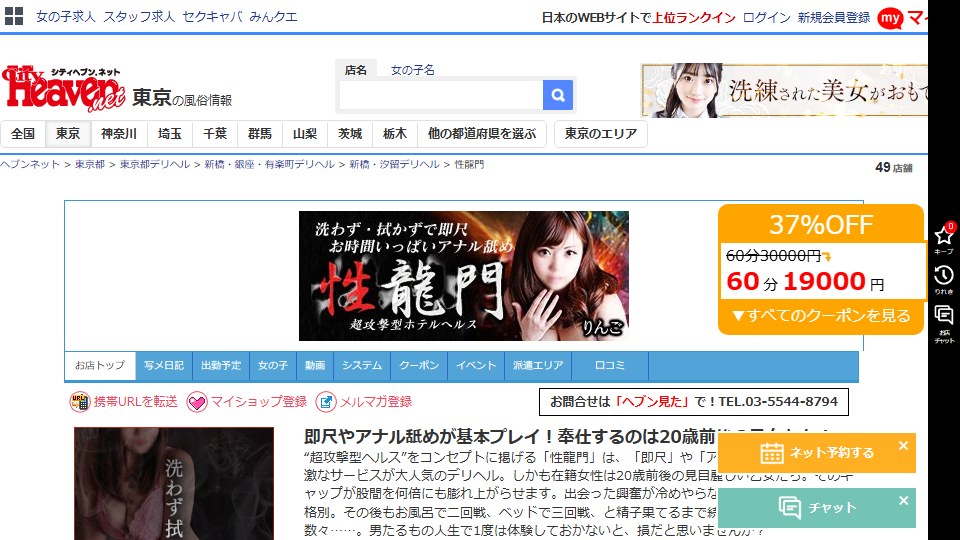
性龍門 — Seiryumon — works Shinbashi and Shiodome, in Minato ward, and Cityheaven files it under デリヘル(フェチ系): delivery health, fetish category, not standard. That subclassification is the first honest thing on the page, and it matters more than the marketing beneath it. This is a specialist shop. It advertises two specific services as its entire concept — 即尺 and アナル舐め — under the banner 超攻撃型ヘルス, an "ultra-offensive health," where the premise is that the woman leads and the customer receives. The catchphrase printed at the top of the page is 洗わず拭かずの真の即尺・時間いっぱいのアナル舐め.
I'm not going to write the play-by-play; that's not what this column is for and you can read the shop's own copy for it. What I care about is whether a shop that narrow — two named services, nothing else on the menu — knows how to price itself. Narrow shops usually don't. They tend to believe the specialty is the whole product and let the numbers go feral.
The operating facts:
- Hours: 10:00 to 5:00 the following morning, Monday through Saturday. Sunday: 10:00 to 2:00.
- Regular holiday: none.
- Phone: 03-5544-8794.
- Dispatch: Minato, Shibuya, Chiyoda, Shinjuku, Setagaya, Meguro and Bunkyo wards.
- Reservations open 9:30 a.m., two days ahead.
- Its official site is hard-mania.com, which is also the shop's URL slug on Cityheaven — a leftover from a previous brand identity that nobody bothered to bury.
That Sunday line is the geography talking. Every other day the shop runs nineteen hours; Sunday it runs sixteen and shuts three hours earlier. Nothing about consumer demand for a fetish specialist changes on a Sunday. What changes is Shinbashi. This district is a workplace with restaurants attached, and on Sunday the offices are dark, the izakaya are thin, and the men who make the 3 a.m. market are at home in Saitama. The shop isn't expressing a preference. It's reading a train timetable.
Two completely different specialties, one identical price
Here is the board. Entry is ¥2,000.
| Course | 60 min | 80 min | 100 min | 120 min |
|---|---|---|---|---|
| T course (即尺) | ¥24,000 | ¥30,000 | ¥36,000 | ¥42,000 |
| A course (アナル舐め) | ¥24,000 | ¥30,000 | ¥36,000 | ¥42,000 |
| Z course (both) | — | ¥33,000 | ¥39,000 | ¥45,000 |
Look at the first two rows. They are the same row.
The T course and the A course are different services with different demands on the woman working them, and Seiryumon charges identical yen for both at all four durations. No premium on either. No "our signature service costs more." That tells you something structural about how the house thinks: it is not pricing the act. It is pricing the hour. The specialty is a variable you select, like a color, and it costs nothing to choose one over the other.
Now the Z course, which is both services in one booking. Subtract:
- 80 min: ¥33,000 − ¥30,000 = ¥3,000
- 100 min: ¥39,000 − ¥36,000 = ¥3,000
- 120 min: ¥45,000 − ¥42,000 = ¥3,000
A flat three thousand yen to add the second specialty, and the figure does not move with duration. Not a percentage. Not a sliding scale. Three thousand, whether you're booking eighty minutes or two hours.
I want to be clear about how unusual this is. The standard industry move is to price a combination course as a percentage uplift, because a percentage grows with the base and quietly harvests more yen from the customers already spending the most. Seiryumon charges the same ¥3,000 to the man spending ¥30,000 and the man spending ¥42,000. As a share of the bill, the two-hour customer pays 7.1% where the eighty-minute customer pays 10%. The board is, if anything, tilted slightly in favor of the bigger spender — but by accident of flat pricing, not by design.
Note also that the Z course has no 60-minute option. The shop starts it at eighty. That's the one piece of paternalism on the board and I think it's correct: two specialties inside an hour, minus the shower, minus the conversation at the front, is a schedule, not an experience.
The ×2 rule, verified on all seven rungs
This is the part that made me sit up.
Seiryumon's two-woman courses:
| Course | Price | Twice the solo price |
|---|---|---|
| 3P T or A, 60 min | ¥48,000 | ¥48,000 |
| 3P T or A, 80 min | ¥60,000 | ¥60,000 |
| 3P T or A, 100 min | ¥72,000 | ¥72,000 |
| 3P T or A, 120 min | ¥84,000 | ¥84,000 |
| 3P Z, 80 min | ¥66,000 | ¥66,000 |
| 3P Z, 100 min | ¥78,000 | ¥78,000 |
| 3P Z, 120 min | ¥90,000 | ¥90,000 |
Every single one is exactly double the solo course. Not approximately. Not double-minus-a-token-discount. Not double-plus-a-coordination-fee. I ran all seven through a calculator expecting one of them to be off by a thousand yen the way these boards always are, and none of them were.
That is a policy, stated in arithmetic rather than in words: a second woman costs a second woman's price. No bulk discount for booking two, which is the honest position — her time isn't worth less because you're also buying someone else's. And no premium for the logistics, which is the generous position, because coordinating two women onto one dispatch is real work for a desk and plenty of shops charge for it.
Put the three findings together and a philosophy falls out. T equals A. Z equals single plus a flat ¥3,000. 3P equals exactly ×2. There are no cross-subsidies anywhere on this board. Nothing is inflated to quietly fund a discount somewhere else. Every variable is priced at what it is, independently, and the total is the sum of the parts.
I have written up a lot of Shinbashi shops on this site. I have never typed that paragraph about one of them before.
The one line that breaks the pattern: ¥6,000 versus ¥8,000
Every step up the course ladder buys you twenty more minutes. Price them:
- 60 → 80 min: ¥30,000 − ¥24,000 = ¥6,000
- 80 → 100 min: ¥36,000 − ¥30,000 = ¥6,000
- 100 → 120 min: ¥42,000 − ¥36,000 = ¥6,000
- And on the Z ladder: 80 → 100 and 100 → 120 are ¥6,000 apiece as well.
So inside a booking, twenty minutes costs a flat ¥6,000 — ¥300 a minute — no matter where on the ladder you buy it, and no matter which specialty you're on. Consistent with everything else.
Then the extension line:
延長20分 — 8,000円
Twenty minutes bought after the fact costs ¥8,000. ¥400 a minute. That is exactly ¥2,000 more than the identical twenty minutes bought at the moment you booked — a 33% penalty for changing your mind at minute fifty-five instead of deciding at minute zero.
And here's the detail that makes it elegant rather than merely expensive: ¥400 a minute is precisely the rate of the 60-minute entry course (¥24,000 ÷ 60 = ¥400). The extension isn't priced off the ladder at all. It's priced at the shop's floor rate — the worst per-minute number on the board. Extending doesn't continue your booking at your booking's rate. It restarts you at the entry rate, as though the previous hour bought you nothing.
For the record, the ladder does reward duration if you commit up front:
| Course | Per minute |
|---|---|
| 60 min ¥24,000 | ¥400 |
| 80 min ¥30,000 | ¥375 |
| 100 min ¥36,000 | ¥360 |
| 120 min ¥42,000 | ¥350 |
A clean descent from ¥400 to ¥350. Decide correctly at the start and every additional minute is cheap. Decide late and you're paying the ¥400 you thought you'd escaped.
The read: book the length you actually want. On this board that is not generic advice — it is a specific, quantified ¥2,000 per twenty minutes. If you think there's any real chance you'll want a hundred minutes, book a hundred minutes. The shop has built exactly one trap and it has built it around indecision, which in Shinbashi at 9 p.m., three drinks in, is a well-chosen place to put it.
The 37% that's actually 21%, and why it's still the best number on the page
Seiryumon runs a coupon: 37% OFF — 60 minutes, ¥30,000 → ¥19,000.
Put that against the price table above, where sixty minutes is ¥24,000. The coupon's "regular price" is ¥6,000 higher than the shop's own board. Measured honestly — ¥19,000 off a listed ¥24,000 — the discount is 20.8%, not 37%. The 37% figure only works if you accept a ¥30,000 sixty-minute price that appears nowhere on the system page.
I've stopped treating this as scandalous, because on Cityheaven it's endemic; campaign art gets written once and never reconciled against the table. But I'll keep pointing it out, because the number you should carry to the phone is the ¥19,000, not the percentage.
And ¥19,000 is worth carrying. Divide it: ¥316.67 a minute. Now look back at the ladder. The best per-minute rate the full-price board can offer is the 120-minute course at ¥350. The couponed sixty minutes beats every uncouponed course on the board, including the two-hour one. That is the cheapest minute Seiryumon sells, and it's sitting on the shortest course — an inversion of how this normally works, and the single strongest reason to make a first visit a sixty rather than a talked-up eighty.
Say the number on the phone. Not "do you have any discounts" — sixty minutes at nineteen thousand, is that available today. Name the course and the figure and let the desk confirm it or tell you the condition you missed.
Transport: the free line and the ¥2,000 line are closer together than they look
This is the part of the page that will cost a first-timer money, because two of the entries look identical and are not.
| Destination | Transport |
|---|---|
| Rental room / love hotel near Shinbashi station | Free (limited period) |
| Shinbashi area (general) | ¥2,000 |
| Rental room / love hotel near Akasaka station | Free (limited period) |
| Hotels near Akasaka-mitsuke / Tameike-sanno | ¥2,000 |
| Shinagawa / Shibuya / Roppongi / Azabu | ¥2,000 each |
| Anywhere else | Ask |
Read the first two rows again. Free transport is not a Shinbashi benefit. It's a benefit attached to a rental room or love hotel near the station — and the very next line prices the broader "Shinbashi area" at ¥2,000. Pick a hotel eight minutes' walk in the wrong direction and you have converted a free dispatch into a ¥2,000 one without ever leaving the neighborhood you thought was covered. Same structure in Akasaka, where station-adjacent is free and Akasaka-mitsuke is ¥2,000.
Also note 期間限定 — limited period. The free window has no published end date. It is true today and it is not a promise.
The hotel charge itself is ¥2,200 and up, billed separately.
What a first visit actually costs
The line items are honest; a total is still a total. Designation is ¥2,000 for a photo nomination (写真指名料) and ¥2,000 for a repeat nomination (本指名料) — and those two being identical is one more piece of the no-cross-subsidy pattern. Most shops charge a premium to request a woman you've met before, monetizing loyalty. Here, becoming a regular costs precisely nothing extra. It also earns you nothing. The house is neutral on whether you come back, which is at least an honest neutrality.
Two realistic first-visit totals:
- The coupon route: ¥19,000 (60 min) + ¥2,000 entry + ¥2,000 photo nomination + ¥2,200 hotel = ¥25,200, with station-area transport free.
- The considered route: ¥30,000 (T or A, 80 min) + ¥2,000 + ¥2,000 + ¥2,200 = ¥36,200 on the same free-transport terms; add ¥2,000 if your hotel isn't station-adjacent.
That ¥6,200 of fixed cost on top of the course is the number nobody budgets for. On the coupon route it's 33% on top of the headline price.
Options are separately priced and clearly listed — a ¥2,000 tier (fishnets, pantyhose-tearing, panties as a gift, eye mask and cuffs for the customer, anal vibrator for the customer) and a higher tier (prostate massage ¥3,000; 顔射 ¥5,000; ごっくん ¥5,000; photography with face shown ¥10,000). The page adds that not every woman offers every service and to ask in advance. Good. That sentence protects the women working there and it saves you an awkward negotiation in a hotel room.
What the page does not tell you
Three gaps, and they're the expensive kind:
Cancellation policy is not stated. Anywhere. For a shop taking reservations from 9:30 a.m. two days in advance, that's a real omission — the longer the booking horizon, the more likely something moves.
Payment methods are not stated. No mention of cards, no mention of a card surcharge, no confirmation that cash is required. In this industry the default assumption is cash and the surprise is expensive.
No address and no nearest-station detail. Largely irrelevant for a delivery shop, but worth knowing you won't find one.
So the phone call has four questions in it: confirm the course and the couponed price, confirm whether your specific hotel qualifies for free transport, confirm the payment method, confirm what happens if you cancel. Sixty seconds, and it converts every unknown above into a number a human being agreed to.
The roster, and the gap between the copy and the board
The shop's concept copy describes the cast as 20歳前後の乙女たち — maidens of around twenty. Set against that, here's what the 即ヒメ board — the women listed as immediately available — actually showed at 1 p.m. on the day I looked: 26, 21, 28, 27.
That's four women at one moment on one afternoon, not a roster survey, and I won't pretend it's a census. But it's the sample the shop itself put on its own front page at that hour, and three of the four are in their mid-to-late twenties. "Around twenty" is doing some work there.
I don't hold it against the place, and I'd argue you shouldn't either — for a shop whose concept depends entirely on a woman leading with confidence, the late twenties is an asset, and the copy is arguably underselling its own roster. But it's a reminder to read the actual board rather than the banner. The banner is written once. The board is who is working tonight.
One more counting note, because these numbers trip people constantly: the "49 shops / 3,517 women" figures near the top of the page are Cityheaven's counters for the Shinbashi-Shiodome district, not Seiryumon's roster. Nobody at this shop has 3,517 women. Seiryumon also runs a sister shop in Ueno under the same name, filed there as standard rather than fetish category — same brand, different classification, which tells you the categorization follows the menu and not the marketing.
The evening
I booked the 80-minute T course on a Thursday, station-area hotel, and called at 7:40 p.m. with the number written down.
What I'll say about the desk: it was fast, it was unembarrassed, and it answered the transport question without me having to push. That last one matters. A shop with a conditional free-transport offer has an obvious incentive to let you assume you qualify and then mention the ¥2,000 at the door. This desk volunteered the condition and asked which hotel before I'd finished the sentence. That is a small thing, and it is the entire difference between a shop that runs on rules and a shop that runs on what it can get away with.
She arrived four minutes inside the window, said the shop's name and her own at the door, and got the practical part — the envelope, the time — finished in under a minute without making it feel transactional. That's a professional trait and it's rarer than it should be. What follows is the shop's concept, and it is exactly what the page says it is, delivered with conviction and without the checked-out quality that specialist shops slide into once the specialty has become a routine. The shop advertises 発射回数制限無 — no limit on the number of finishes — and I'll note only that in eighty minutes the limit was never going to be the shop's policy.
The part I'll actually praise is the ten minutes at the end. Seiryumon is an aggressive concept sold in aggressive language, and there is no structural reason a shop like this would bother with a soft landing. This one did — the conversation kept running through the shower and out the door, unhurried, about nothing in particular. A shop that sells intensity and then puts you on the street at the buzzer is selling a transaction. The decompression at the end is what makes it an appointment.
The verdict
| Item | Rating |
|---|---|
| Internal consistency of the price board | ★★★★★ |
| The ×2 rule on two-woman courses (no premium, no discount) | ★★★★★ |
| Flat ¥3,000 to combine specialties, at every length | ★★★★★ |
| Identical photo / repeat nomination fee (no loyalty tax) | ★★★★★ |
| Value of the ¥19,000 60-minute coupon (¥316/min) | ★★★★★ |
| Extension pricing (¥8,000 / 20 min = ¥400/min) | ★★☆☆☆ |
| Honesty of the "37% OFF" framing | ★★☆☆☆ |
| Clarity of the transport table | ★★☆☆☆ |
| Published terms: cancellation, payment | ★☆☆☆☆ |
| Desk professionalism on the phone | ★★★★★ |
Seiryumon is the most arithmetically honest price board I've audited in Shinbashi, and I did not expect to write that sentence about a shop whose marketing copy is this loud. Two specialties at one price. A flat fee to combine them. Two women at exactly two prices, verified on all seven rungs. A repeat-nomination fee that doesn't punish you for coming back. Whatever else this place is, it is not built to take money off you sideways.
The margin is in one line and one line only: the ¥8,000 extension, which sells the same twenty minutes the ladder sells for ¥6,000, at the entry-course rate of ¥400 a minute. That's a 33% tax on indecision, and it is entirely avoidable by anyone willing to decide before the woman is dispatched rather than at minute fifty-five.
Where I take real stars off is the paperwork around the edges. The 37% headline is measured against a price the shop's own table contradicts by ¥6,000. The free-transport line looks like a neighborhood benefit and is actually a hotel-specific one, with the ¥2,000 "Shinbashi area" rate printed directly beneath it for anyone reading fast. Cancellation terms and payment methods aren't published at all. None of that is dishonest, and all of it is fixable in a sixty-second phone call — but all of it lands on the first-time customer who assumed the page was complete.
Take the ¥19,000 sixty. Book the length you want up front. Ask which hotels are actually free. Then let the board do what it is clearly built to do, which is charge you for exactly what you ordered and nothing else.