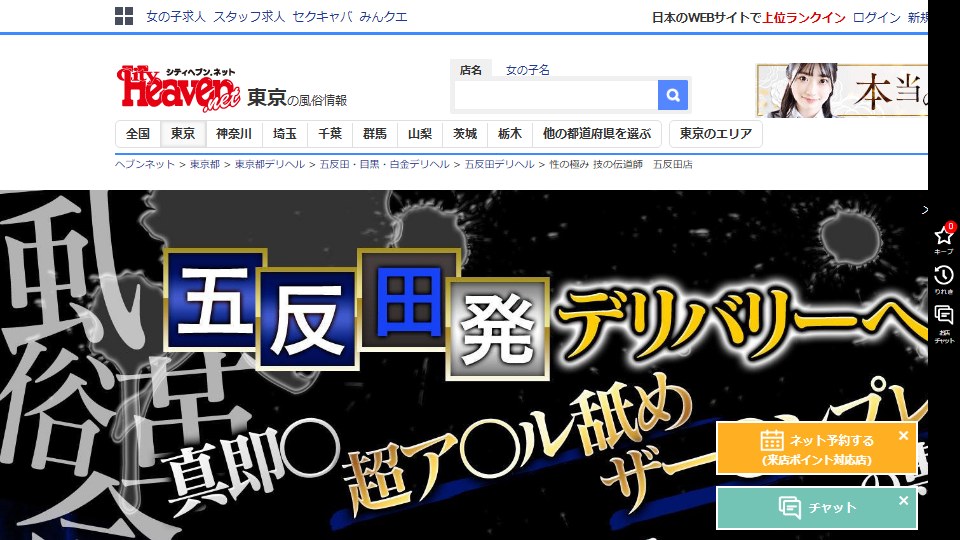

Let's start with the thing nobody reads, because at Sei no Kiwami Waza no Dendoshi Gotanda it's the most informative document on the site: the fee board.
55 minutes, ¥22,000. 75 minutes, ¥31,000. 90 minutes, ¥34,000. 105 minutes, ¥40,000. 180 minutes, ¥65,000. All-time pricing — no daytime rate, no late tax. Two of those, the 90 and the 180, are marked net-reservation only, which is the shop telling you plainly that the phone will not sell you its two best-value slots. Extension runs ¥12,000 per 30 minutes, identical across every course, which is rarer than it sounds; most houses scale the extension to the course so the long bookings punish you twice.
Then the nomination fees, and here's where the house does something worth noticing. Booking a specific woman online the first time costs ¥1,000. Booking her again — second visit onward — costs ¥3,000. The two cannot be stacked. Read that in isolation and it looks backwards: loyalty is supposed to be cheaper, not triple. It isn't backwards, it's the standard Japanese split between a casual net pick and a true repeat nomination, but it does mean the second date is the expensive one, and a lot of first-timers don't budget for it.
I Ran the Arithmetic Against Ten Strangers' Receipts
Price boards are easy to write and hard to honor. So I took the ten most recent reviews — all posted between September 7th and September 16th, 2026 — and checked their stated totals against the published sheet.
- 90 minutes, ¥32,000. That's ¥34,000, minus the ¥6,000 newcomer discount, plus ¥1,000 nomination, plus a ¥3,000 option. Reconciles exactly.
- 75 minutes, ¥26,000. ¥31,000 minus ¥6,000 plus ¥1,000. Exact.
- 90 minutes, ¥37,000. ¥34,000 plus the ¥3,000 repeat nomination. Exact.
- 75 minutes, ¥37,000. The reviewer itemized it himself: ¥31,000 course, ¥1,000 nomination, ¥5,000 transport. Exact — and that ¥5,000 is a real number off the dispatch map, which I'll get to.
- 90 minutes, ¥33,000, delivered to a private residence. ¥34,000 minus ¥6,000, plus ¥1,000, plus ¥4,000 transport. Exact.
Five clean reconciliations out of ten, and the rest don't contradict the board so much as omit their line items. That is a better honesty rate than most of the "all-inclusive" houses I've priced out, and it tells you the front desk is quoting from the same sheet it publishes.
One caveat, and it's the one that bites tourists: every one of those totals is tagged room not included. This is a no-premises operation. There is no building with a sign on it. The listed address is simply "Gotanda, Shinagawa-ku," which is not an address, it's a neighborhood. She comes to a love hotel, a business hotel or your apartment, and the room is your problem and your bill.
Six Discounts, and Every One of Them Is Buying the Same Two Things
Here is the full stack, as published:
- Newcomer / "tasting" discount — ¥6,000 off. The big one.
- Review discount — ¥2,000 off, applied at the next visit, repeatable every single time.
- Week-mach discount — return within 7 days: ¥2,000 off a 55, ¥3,000 off anything 75 and up.
- Seconds discount — ¥5,000 off the second course if you book a different woman the same day.
- Buddy discount — ¥1,000 off for everyone when you come with a friend.
- First-registration discount — ¥1,000 off for signing up.
- Plus a birthday discount, valid any number of times in the month, which is a sentence I had to read twice.
Look at what those levers actually pull. Three of them (week-mach, seconds, buddy) buy frequency and headcount. Two of them (tasting, review) buy reviews. Nothing on that list is a general price cut. There is no "10% off Tuesdays," no idle-hours rate, none of the blunt instruments a shop reaches for when it just needs bodies through the door. Every lever is aimed at a specific number on somebody's dashboard.
And then the points scheme, which is where the mask comes off entirely. One point equals one yen. Silver tier — one visit a month — earns 1.5% back. Gold, three visits a month, 3%. Platinum, five visits a month, 5%. Points stack with coupons even though the coupons don't stack with each other, and the 20th of every month is a bonus-rate day. That is not nightlife. That is an airline.
The ¥6,000 Discount Is a Cold-Start Fix
Now the tasting discount, because it's the most precisely engineered thing on the site.
It is ¥6,000 off, and it does not apply to whoever you want. It applies to women who are within 40 days of joining, or who have fewer than ten reviews. It requires you to post a review and complete a post-session questionnaire afterward. And it is void on repeat nominations — you cannot use it on a woman you've already seen.
That's not a promotion. That's a cold-start algorithm written in yen. A new woman on a review-driven board is invisible, and invisible means empty shifts, and empty shifts mean she quits inside a month. So the house pays ¥6,000 a head to route traffic at exactly the names whose ledgers are empty, and collects a written review as the price of admission. Once she clears ten, the subsidy switches off and she's expected to sell herself.
Does the targeting actually bind? I counted the board. Thirty women listed. Eight of them carry fewer than ten reviews — one has a single review, one has none at all and is marked simply "reviews wanted." That's roughly one name in four sitting inside the subsidy window on any given day. The mechanism isn't decorative; it's covering about a quarter of the roster right now.
A wrinkle worth knowing before you call: the shop states this discount's terms two different ways. The events page says 40 days or under ten reviews, either condition. The coupon page says newcomer mark and twelve reviews or fewer. The same two pages also disagree on the discounted 90-minute price — one shows ¥28,000, the other ¥29,000, both claiming to be ¥6,000 off a ¥34,000 base. ¥28,000 is the one that survives contact with a calculator. Ask on the phone, get the number confirmed before you're standing in a hotel lobby.
3,316 Reviews, and Half of Them Belong to Ghosts
The shop's review count reads 3,316. It has been named to Cityheaven's Top 100 list four years running — 2023, 2024, 2025 and 2026. Ten reviews landed in the ten days before I looked. This is a heavily-trafficked address.
But the interesting number isn't the total, it's the distribution. Adding up the review counts of all thirty women currently on the board gives roughly 1,686 — a bit over half the lifetime total. The other half was written about women who no longer work here. Every review board in this industry is partly an archive of departures, but seeing it at fifty percent is a useful reminder of what you're actually reading when you read "3,316 reviews": not the shop as it exists tonight.
And the live half is brutally top-heavy. One woman accounts for 373 reviews on her own — 22% of the entire current roster's total. The top five names hold about 62% between them. Below that it falls off a cliff: 21, 19, 18, 14, 9, 6, 4, 3, 2, 1, 0. What the board shows you is not thirty comparable options. It's five established draws, a working middle, and a rotating intake the ¥6,000 discount exists to launch.
Ages run 19 to 32, clustered hard in the 20-to-25 band. Today's shift sheet listed 14 names, earliest on at 12:00, the last finishing at 05:00. Three new arrivals are dated on the board: one on August 21st, one September 1st, one September 8th.
The No-Conversation Shop, Whose Reviews Are All About the Conversation
Here's the part I genuinely did not expect, and it's the most useful thing in the entire file.
I read every "what's good about this shop" line in the ten most recent reviews. Not one of them is about the concept. Not one mentions the no-greeting gimmick, the shock copy, the transgression. They say, in ten different men's words: the phone manner is polite. Staff were courteous. Always careful, always reassuring. Rarely see service handled this well. Ten out of ten, unanimous, on a shop that advertises the abolition of pleasantries.
One reviewer went further and said the quiet part out loud: he noted that this house, unlike others, doesn't make you write your review during your paid session — at competing shops the review-for-discount deal is settled on your clock — so his 90 minutes were actually 90 minutes. He then added that he enjoys talking, had a long conversation, and had a great time. At the no-talking shop.
There's your real product. The concept is the storefront — it's what gets a man who is tired of fake romance to dial the number instead of scrolling past. What keeps him is a competent dispatcher who picks up, confirms the room, calls thirty minutes ahead, and doesn't nickel him on the clock. The only wobble in the whole file is a single review describing a fee mix-up communicated through the woman rather than the desk — some confusion over what had been agreed, sorted out on the spot, and the reviewer still scored it well. Settle the money with the office, not in the room.
The Photography Rulebook, Which Is Funnier Than It Should Be
Options run ¥3,000 to ¥4,000 for the various finishes. The outlier is the photography option at ¥6,000, and it comes with a written policy that is, I swear, better drafted than some employment contracts:
No lighting rigs, tripods or strobes. Your camera is verified on the booking call, and if the desk judges it to be professional-grade — the stated reason being that it would unnerve the woman — they refuse it. One camera. One. Shooting undeclared gets you billed per device after the fact and the data confiscated. And the clause that matters: consent is scoped to specified acts, anything outside it, and any pressuring for poses, is prohibited outright.
A shop selling maximum transgression published the tightest consent-and-equipment policy I've read on a Japanese shop page this year. Whatever you think of the concept, somebody there has thought hard about where the line is and then written it down where customers can't claim they didn't see it.
Getting Her There: The Colored Map
Because there's no building, access is really a logistics question, and the house answers it with a color-coded map of Tokyo.
Gotanda and immediate surroundings: free. Then it steps outward in rings — ¥2,000, ¥3,000, ¥4,000, ¥5,000, ¥6,000, ¥7,000 — with a note that they've dispatched beyond the 23 wards before and will discuss it. The banner brags that Shinagawa and Shibuya are close, which the map backs up. That ¥5,000 line item on a real receipt earlier? A mid-ring booking. The map isn't decorative.
Two operational rules to write down. Dispatch outside the Gotanda area — and dispatch to private homes — starts at 22:30, not at opening. And in-area, they go to love hotels and business/city hotels only. Hours are 12:00 to 05:00, seven days. Cards are accepted. The number is 03-6456-2050, with the usual "saw it on Heaven" attribution line, and there's a LINE account the shop claims answers instantly across the full trading day — which, if you'd rather not conduct this conversation out loud, is the better door.
One more piece of context: this is one node of a six-shop group, with siblings in Ikebukuro, Shin-Yokohama and Chiba, including a married-woman branch and a plus-size one. The pricing discipline and the points architecture aren't a Gotanda eccentricity. They're chain infrastructure.
The Verdict
- Price transparency: ★★★★★ — a full course ladder, a flat extension rate, both nomination tiers stated, and five customer receipts that reconcile to the yen against it.
- Honesty of the pitch: ★★★★★ — you cannot possibly misunderstand what this shop sells. The copy is many things; coy is not one of them.
- Concept execution: ★★★★☆ — the reviews are uniformly warm, but note that they praise the desk and the person, not the gimmick. Buy accordingly.
- Value for money: ★★★☆☆ — ¥34,000 plus nomination plus your own hotel room is not cheap. With the ¥6,000 discount aimed at a newcomer it becomes genuinely competitive for 90 minutes.
- Roster depth: ★★★☆☆ — thirty names, but 62% of the review weight sits with five of them and the tail is very thin.
- Documentation of the fine print: ★★☆☆☆ — the discount terms contradict themselves across two pages, and the two stated 90-minute discount prices differ by ¥1,000. Confirm before you book.
- Access: ★★★★☆ — free in Gotanda, a clear paid map beyond it, minus a point for the 22:30 rule on out-of-area and home dispatch.
- Going back: ○ — booking the 90 online, on a name inside the subsidy window, with the hotel sorted in advance and the nomination fee budgeted.
What stays with me isn't the copy, which is engineered to be unforgettable and largely succeeds. It's the gap between the copy and the machine. A shop that sells the abolition of small talk turns out to be run by people whose single most praised attribute is how they talk to customers on the telephone. A shop that sells pure impulse runs a points ladder with tiers, a bonus day on the 20th, and a booking-window hierarchy that rewards monthly attendance. A shop that sells transgression publishes a consent policy for its camera option. The sign outside is shouting. The office behind it is doing quiet, unglamorous, extremely deliberate work — and after four consecutive years on the Top 100 list, it's fairly clear which of the two is keeping the lights on.