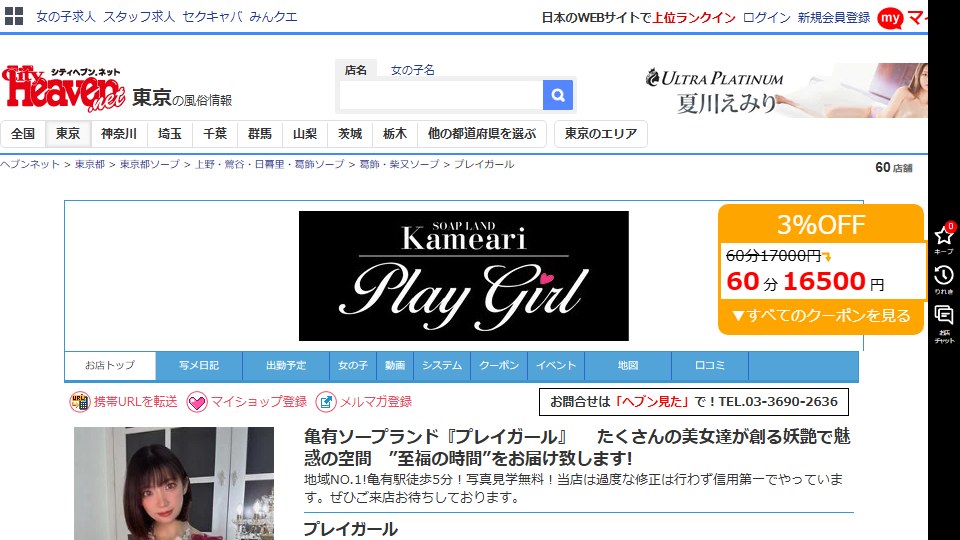

Playgirl — プレイガール, at 3-4-2 Kameari, Katsushika-ku, five minutes on foot from Kameari Station — is a soapland that Cityheaven files under the genre tag 激安, gekiyasu, the site's own word for ultra-budget. It is open 9:00 to 24:00, every day, no closing days, and it is the only shop of its kind on the board for this entire slice of Tokyo's far northeast. Kameari's other claim to national fame is a forty-year manga about the cops at the local koban, which gives the neighborhood a gentle, unglamorous reputation that the shop does nothing whatsoever to contradict. The number is 03-3690-2636, and as everywhere, you say Heaven mita — "saw it on Heaven" — and the call gets easier.
What it does not have is the apparatus. No membership fee. No points card. No options menu. No transport schedule. No event calendar — the events tab, checked today, reads 現在イベントを開催しておりません: none currently running. The price page is a table you can read in eight seconds.
Six Numbers, and That's the Whole Business
Both the Cityheaven system page and the shop's own site publish the identical sheet, which is already more than most manage:
| Course | Total | Extension, 30 min | |
|---|---|---|---|
| 9:00 – 19:00 | 60 minutes | ¥17,000 | ¥8,000 |
| 19:00 – LAST | 70 minutes | ¥20,000 | ¥10,000 |
Plus nomination ¥1,000, flat, and membership free. Everything is marked tax included, and the word used throughout is 総額 — grand total. That matters more at a soapland than anywhere else in this business, because the traditional soap price is quoted as a bathing fee with the service fee handed over separately in the room, and the number on the poster is therefore not the number you pay. Here it is. Six figures, one of them a zero, and no second envelope.
Advance booking opens at 19:00 the day before. That's the whole reservation system: you cannot book Friday on Wednesday, and at seven o'clock Thursday evening the phones open for Friday. Walk-ins are taken — one reviewer describes wandering in straight off a company trip with no reservation and being seated within minutes — but on a board with one shop and sixty-three names, the previous evening is when the good slots go.
Daytime Is the Only Board I've Priced Where Extending Costs Less Than Starting
Convert all of it to yen per minute and the architecture falls out immediately:
| What you buy | Cost | Minutes | Per minute |
|---|---|---|---|
| Day course | ¥17,000 | 60 | ¥283.3 |
| Day extension | ¥8,000 | 30 | ¥266.7 |
| Night course | ¥20,000 | 70 | ¥285.7 |
| Night extension | ¥10,000 | 30 | ¥333.3 |
Read the day column twice. The extension is 5.9% cheaper per minute than the course it extends. That is backwards. Every price sheet in this industry is built the other way around — the extension is the impulse purchase, bought late, bought happy, bought without arithmetic, and it is priced accordingly at a thirty, forty, fifty percent premium. Playgirl's daytime board rewards it instead. Ninety minutes at the day rate comes to ¥25,000 — ¥277.8 a minute. A hundred and twenty comes to ¥33,000, ¥275.0 a minute. The longer you stay before seven in the evening, the cheaper every minute of it gets, converging downward on ¥266.7.
After seven the sheet snaps back to normal and then some. The night extension runs ¥333.3 a minute — a 16.7% premium over the night course, and a full fifty percent on top of a day-course minute. A 100-minute night session (70 plus one extension) is ¥30,000, ¥300.0 a minute, the most expensive way to buy time in this building.
There's a subtler thing inside the night course itself. Going from the 60-minute day product to the 70-minute night product costs ¥3,000 for ten extra minutes, which prices those minutes at ¥300 each — more than a day minute, less than a night extension minute. The board is a clean four-rung ladder, ¥266.7 → ¥283.3 → ¥300.0 → ¥333.3, and nobody has written that down anywhere except here.
One caveat with teeth: the extension is not guaranteed. A reviewer records asking for one at the end of a session and being told no. On a premises shop with a fixed-slot clock, the half hour you were counting on is somebody else's booking. Buy the time at the front desk, not in the room.
The Late Discount Is Exactly One Nomination Fee
There are two coupons. Both live permanently on the Cityheaven coupon tab, both require the Heaven mita line or the screen shown at reception, and — this is the part nobody mentions — both are capped at 毎日先着10名様, the first ten customers each day.
早割 / Early discount. Play between 9:00 and 19:00, get ¥500 off the total: ¥17,000 → ¥16,500. Badged as 3% OFF.
遅割 / Late discount. Play after 19:00, get ¥1,000 off: ¥20,000 → ¥19,000 for the 70-minute course. Badged as 5% OFF.
Per minute: the day coupon takes you from ¥283.3 to ¥275.0. The night coupon takes you from ¥285.7 to ¥271.4 — which makes the discounted night course, nominally the premium product, the cheapest single course in the building. The only way to beat it is to keep extending in the daytime: 120 minutes with the early discount lands at ¥270.8 a minute, and it takes you two full hours and ¥32,500 to save ¥0.60 a minute over simply showing up at eight at night.
Now put the nomination fee back in, because you are going to nominate.
- Day, coupon, nominated: ¥16,500 + ¥1,000 = ¥17,500 for 60 minutes.
- Night, coupon, nominated: ¥19,000 + ¥1,000 = ¥20,000 for 70 minutes.
That second line is worth sitting with. ¥20,000 is the undiscounted list price of the night course. The late discount is, to the yen, exactly the size of a nomination fee — book after seven and choose the woman you actually want, and you pay the same as the man who took whoever was free. The early discount, at ¥500, covers precisely half a nomination. Whether that's design or arithmetic accident, the night side of this board is where the shop quietly stops charging you for choosing.
Both coupons carry a validity line: 2022/08/22 ~ 無期限. Effective from August 2022, no expiry. These are not campaigns. They are the price, wearing a starburst, for four years and counting.
What the Shop Doesn't Print, and Forty-Three Strangers Did
The card fee isn't the only operational fact living exclusively in the review column. Two separate reviewers, seven months apart, report the same structural thing about this shop, and it may be the most important disclosure on the page:
"The wash area is cramped, and they don't appear to do play in the wash area." — November 2025
"There's no wash area, just the room." — a later account of a 60-minute booking
At a soapland, the arai-ba — the tiled wash space with the air mat — is the defining apparatus of the genre. It is nominally what the bathing fee buys. At Playgirl, by two independent customer accounts, the bathing happens in the tub in the room and the mat work does not happen at all. Nobody says this on the shop's pages. Both reviewers report it as a neutral fact rather than a complaint, and both marked the shop highly anyway — one wrote "no wash-area play, but the value is plenty there" — but if the mat is the reason you were going to Kameari, you need to know before you are standing at the curtain.
The rest of the operational picture, assembled from the same source:
- The rooms are small. Three reviewers say so independently; two add that they're clean and that it didn't bother them. "Small but tidy, exactly enough" is the representative verdict.
- Reception is old-fashioned and quick. You pay at the desk, sit in a waiting room with chairs, and get called through a curtain beside reception where she is already waiting. One man arrived at dusk to find every chair in the waiting room taken, and remarked on it; his companion for the hour suggested it was payday.
- Drinks come to the room. In a 60-minute session, one reviewer was offered a drink twice and still finished unhurried — he called the time management "magical," which is high praise for a fixed hour.
- 写真見学無料 — photo viewing is free. The shop advertises this in its own header. At an older premises shop, browsing the album at the counter is not always a free service.
- 過度な修正は行わず信用第一 — no excessive retouching, trust first. Also the shop's own copy, and unusually, the one boast on this page with a measurable proxy behind it: across all 43 reviews the 写真 (photo accuracy) sub-score averages 4.50 out of 5, and one reviewer used the phrase gyaku-panel-magic — reverse panel magic, better in person than in the picture.
Sixty-Three Women, and Not One Published Age
The roster runs 63 names. Every single one is listed as 〔?歳〕. Sixty-three profiles, three-size data on all of them, zero ages. That isn't one woman declining to say; it's a house policy expressed as sixty-three consecutive blanks in a field Cityheaven built to be filled.
What is published is given to the centimetre, and the measurements are where it gets interesting:
- Height: 147 to 174 cm, mean 159.1, median 159. Thirteen women under 155, nine at 165 or over. A genuinely wide spread.
- Bust: 75 to 107 cm. Cup distribution: B 6, C 11, D 12, E 12, F 12, G 7, H 1, I 1, J 1. Forty-six of the sixty-three are D or larger; twenty-two are F or larger.
- Waist: 55 to 63 cm. And here the spread collapses. Twenty-two of the sixty-three women have a waist of exactly 59 cm. Forty-seven of sixty-three fall between 58 and 60. Sixty-three adult women, an eight-centimetre total range, and a third of them landing on the same integer.
Read the height column and you are looking at a population. Read the waist column and you are looking at a house style — a number written down at intake rather than measured. That is not a scandal; it is how most of this industry fills that field. But it's worth knowing which of the three numbers on a profile card is doing real work, and at this shop it's the first one.
The engagement figures on the same page tell you where the shop's attention goes. 39 of 63 keep a photo diary. Only 2 of 63 have any video. And 46 of the 63 — 73% — carry no customer review at all, marked 口コミ募集, "reviews wanted." Seventeen women hold 29 reviews between them, and the two busiest names have four apiece. The shop's headline count is 43, which means roughly a third of this shop's entire review history belongs to women who are no longer on the board.
Today's board showed 16 of the 63 either working or listed for the day, with five available inside a forty-minute window around lunchtime. Pull up the week ahead and a substantial block of the roster has no shifts entered at all. Sixty-three is the bench. Sixteen is the shop.
Forty-Three Reviews in Three and a Half Years
The full review history runs from December 29th, 2022 to July 15th, 2026 — forty-three reviews across forty-two and a half months, or almost exactly one a month for three and a half years. Busy Yoshiwara houses post that in a fortnight. The board has been silent for 64 days as I write this.
The scores themselves are strong and oddly shaped:
- Overall: mean 4.51, median 4.5. Fourteen of the forty-three are straight 5.0s. Only five sit below 4.0, and the single lowest score in three and a half years is a 3.4 — from a man who said he'd had a great time and would return, and who is the one who warned everybody about the credit card fee.
- By component: 女の子 (the woman) 4.77 · プレイ (the session) 4.69 · 写真 (photo accuracy) 4.50 · 料金 (value) 4.44 · スタッフ (staff) 4.20.
That ordering is the most revealing thing in the file. This shop's genre tag is literally the word for ultra-cheap, its banner is about price, both of its coupons are about price — and price satisfaction is only its third-best attribute. What its customers actually rate highest, by a clear margin, is the women. What they rate lowest, consistently, is the front desk: staff is the only component under 4.3, and the only one where men who gave the woman a 5 handed the counter a 3.
The reviewer base skews knowledgeable, which makes the numbers worth more than the sample size suggests. Several regulars carry Cityheaven badges reading 吉原のソープ愛好家 — Yoshiwara soapland enthusiast — men who spend their money on the most competitive soap street in Japan and come out to Kameari anyway. Their verdicts on the price, verbatim: "for this money, this service is a steal", "an easy shop to just drop into", "reasonable." One of them has posted here five times.
The Badges Are Older Than They Look
Three small artifacts, in ascending order of how much they should worry you — which is to say not much, but it is a pattern.
The area list page carries an editorial blurb from Cityheaven's own staff that opens: "A soapland has OPENED in Kameari!" The coupons on that same page are dated August 2022, and the review history starts four months after that. The shop has been trading for at least four years, and the copy welcoming it to the neighborhood is still running.
The same list entry displays an イベント開催中 badge — event in progress. The events tab it links to says there are none.
And the list entry quotes the shop at 60分 総額16800円〜 — ¥16,800 — while the system page, the shop's own website and both coupons all agree the day course is ¥17,000 and the discounted day course is ¥16,500. Two hundred yen, in the one place a man comparison-shopping is likely to look first. Nobody is being cheated by ¥200. It's that the listing furniture at this shop has been sitting undusted for a while, which is worth knowing when you decide how much weight to put on any badge here.
Getting There
Kameari Station, five minutes on foot, and the shop is at Kameari 3-4-2, Katsushika-ku. Kameari sits on the JR Joban local line, which runs straight through onto the Chiyoda subway, so from Otemachi or Kita-Senju you are on one train. There is a large shopping mall at the station — one reviewer's entire account of how he ended up here begins with the sentence "I happened to be at the mall" — which means the walk is ordinary, busy, well-lit and completely unremarkable. If you would rather not be conspicuous, that is the whole point of coming to Kameari instead of Yoshiwara.
There is no pickup service, no meeting fee and no transport schedule of any kind, because there is nothing to transport. It's a premises shop, you go to it, and the address is printed in full.
The Verdict
- Price transparency: ★★★★☆ — six numbers, both totals quoted as sōgaku, identical on Cityheaven and the shop's own site, no second envelope in the room. One star gone for the 10% card fee, which belongs on that table.
- Value for money: ★★★★★ — ¥271 a minute at the best published rate, in Tokyo, all in, with Yoshiwara regulars travelling out to say so in writing.
- Discount design: ★★★☆☆ — two clean coupons that do exactly what they claim, one of which precisely cancels a nomination fee. Minus points for the first-ten-a-day cap that isn't in the headline, and for four years of "campaign."
- Extension pricing: ★★★★☆ daytime, ★★☆☆☆ after 19:00 — the same shop rewards you for staying before seven and taxes you 17% for it afterwards.
- Disclosure of what you're buying: ★★☆☆☆ — a soapland where the mat work reportedly doesn't happen should say so somewhere other than in a stranger's review from November.
- Roster information: ★★☆☆☆ — 63 names, 63 blank ages, a third of them sharing a waist measurement, 73% with no review.
- Reputation depth: ★★★☆☆ — a 4.51 average is real, but forty-three data points over three and a half years is a thin file to lean on.
- Access: ★★★★★ — five minutes from a station on a through-running line, in a neighborhood where nobody is looking.
- Going back: ○ — after seven, coupon claimed on the phone the evening before, nominated, cash in the jacket.
What stays with me about Playgirl is that it is the only shop in its district and it refuses to behave like one. A monopolist raises prices, thins the sheet, stops explaining. This one publishes an all-in total, charges ¥1,000 to let you choose, prices its daytime extension below its own hourly rate, and hands out a night coupon that works out to exactly the fee it just charged you for choosing. Somebody in that back office thinks carefully about how time should be priced. And then the same operation lets a four-year-old "NOW OPEN!" blurb sit on its listing, leaves an event badge lit over an empty events page, and allows the most expensive item on your receipt — a ten percent card surcharge — to reach the public only because one polite first-timer thought to mention it on his way out. The pricing is the work of someone paying close attention. The page around it is the work of someone who stopped.