
Kinshicho does not perform for anybody. Cross the Sumida heading east and Tokyo stops posing — the signage gets shorter, the arcades get older, the bars downstairs have hand-lettered menus and no English and no intention of acquiring any. It's four stops from Akihabara on the Sobu line, ten minutes door to door, and it may as well be a different decade. The south exit is where the trade lives, and it lives there because a room in Kinshicho costs what a coffee costs in Ginza.
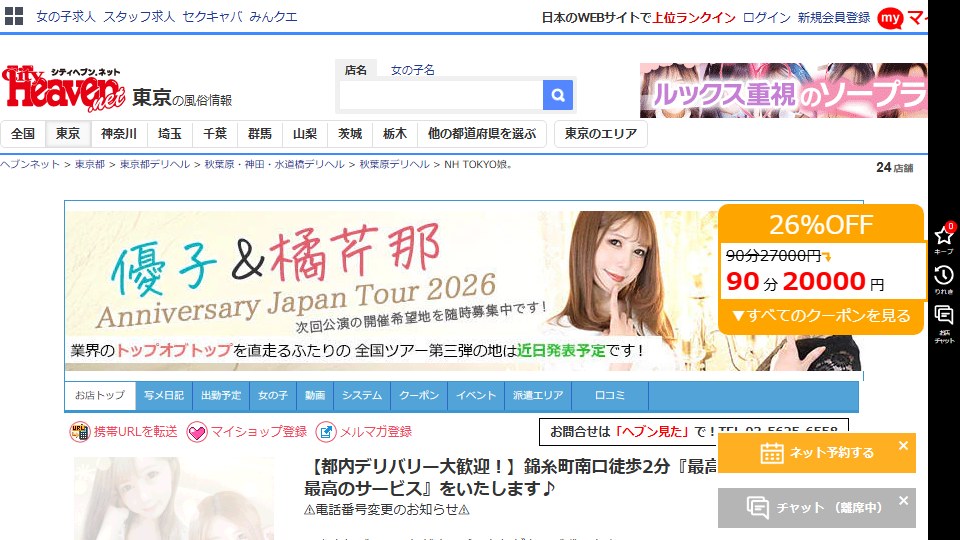
The shop is NH TOKYO娘。(NH TOKYO Musume) — a deriheru (delivery health: outcall only, she comes to your room) with an all-newhalf cast. Phone is 03-5625-6558. Two minutes on foot from Kinshicho's south exit, dispatching across all twenty-three wards, with its home corridor named on its own site: Koiwa, Shin-Koiwa, Asakusa, Uguisudani, Ueno, Yushima. Sobu line and Joban line, east and northeast. It knows which trains its customers are on.
One filing quirk before you go looking for it: on Cityheaven the shop is categorized under Akihabara, in the 秋葉原・神田・水道橋 block, while every operational detail on the page — the two-minute walk, the quoted room rates — is Kinshicho. Search Akihabara. Meet in Kinshicho.
First, the word
Newhalf (ニューハーフ, nyūhāfu) is the standing Japanese trade term for trans women working in nightlife and adult entertainment. It's an industry label, printed on signage and used by the cast themselves as a professional descriptor, and in Japanese it carries none of the sting the English-language equivalents picked up along the way. I use it here because it's what the shop uses and what you'll see on every listing site in the country. The cast are trans women. That's the entire explanation; there is no second layer.
Seventeen women are listed, ages running 21 to 41 — a wider band than the photos suggest, and wider than most specialty shops carry. The copy runs to individual taglines rather than a house concept: one billed as the heavy-repeat regular, one as the model type, one as the actress type. No unifying gimmick, no invented world. In this segment that's a quiet point in its favor; specialty shops that also insist on a theme are usually compensating for something.
The printed ladder, and the cell that breaks it
Six courses on the 料金システム block. Here they are with the arithmetic filled in, which the shop does not do for you.
| Duration | Price | Per minute |
|---|---|---|
| 45 min | ¥13,000 | ¥288.9 |
| 60 min | ¥19,000 | ¥316.7 |
| 75 min | ¥21,000 | ¥280.0 |
| 90 min | ¥24,000 | ¥266.7 |
| 105 min | ¥27,000 | ¥257.1 |
| 120 min | ¥29,000 | ¥241.7 |
Look at the second row. The 60 costs more per minute than the 45 — by ¥28 a minute. Every other step behaves, sliding from ¥288.9 down to ¥241.7 the way a volume taper is supposed to. The 60 sticks straight up out of the middle of its own column.
The marginal view is worse. Every step is fifteen minutes:
| Step | Extra cost | Rate for those 15 min |
|---|---|---|
| 45 → 60 | +¥6,000 | ¥400/min |
| 60 → 75 | +¥2,000 | ¥133/min |
| 75 → 90 | +¥3,000 | ¥200/min |
| 90 → 105 | +¥3,000 | ¥200/min |
| 105 → 120 | +¥2,000 | ¥133/min |
The quarter hour that takes you from 45 to 60 costs three times what the very next quarter hour costs. At list price there is no configuration of preferences under which the 60 is correct: want short, and the 45 is ¥6,000 cheaper; want an hour-plus, and the 75 is ¥2,000 away and strictly longer.
And then, directly underneath that table, in the shop's own footnote:
60分コースが特にお得にご利用いただけるコースとして設定しております。 "The 60-minute course is set up as the course you can use at especially good value."
Against the numbers printed six lines above it, that is simply false. The footnote bothered me for an hour. Then I found where it's true.
The coupon tab is the actual price sheet
Where it's cheap is one tab over. The coupon page carries a campaign ladder, tax included, explicitly marked 全てのお客様にご利用をいただけるキャンペーンコース — a campaign every customer can use:
| Campaign course | Price | Per minute |
|---|---|---|
| 60 min | ¥15,000 | ¥250.0 |
| 90 min | ¥20,000 | ¥222.2 |
| 120 min | ¥25,000 | ¥208.3 |
Now the footnote makes sense. At ¥15,000 the 60 really is good value — ¥250 a minute, cleanly under the 45-minute course's ¥288.9. The sentence was written against this number, not the ¥19,000 on the printed sheet.
And look at the shape of it. Every additional thirty minutes costs a flat ¥5,000. One straight line, no fudge:
Price = ¥5,000 + (¥166.67 × minutes)
60 → 5,000 + 10,000 = ¥15,000. 90 → 5,000 + 15,000 = ¥20,000. 120 → 5,000 + 20,000 = ¥25,000. Three for three. So the shop that publishes a lumpy, non-monotonic ladder out front is running a perfectly linear one out back, at a marginal rate of ¥167 a minute against the printed sheet's ¥133-to-¥400 zigzag.
Against list, the campaign takes ¥4,000 off the 90 and ¥4,000 off the 120, and ¥4,000 off the 60. Consistent discount, wildly different starting points.
Two of the shop's own coupons are strictly worse than its own campaign
This is the part worth the click. Alongside the campaign block, the coupon page carries two separately-listed offers with their own headlines and discount badges:
| Standalone coupon | Price | Per minute |
|---|---|---|
| 80 min | ¥20,000 | ¥250.0 |
| 110 min | ¥25,000 | ¥227.3 |
Put them next to the campaign ladder and the result is blunt:
| Money | Standalone coupon | Campaign course | Difference |
|---|---|---|---|
| ¥20,000 | 80 min | 90 min | +10 minutes, free |
| ¥25,000 | 110 min | 120 min | +10 minutes, free |
Same yen, ten more minutes, both times. The 80 and the 110 are dominated — there is no state of the world in which paying ¥20,000 for eighty minutes beats paying ¥20,000 for ninety. And they're the ones with the loud badges on them: the 80 is stamped 23% OFF, the 110 is stamped 29% OFF, and both are beaten by an unbadged line item in somebody else's fine print.
The honest qualification, and it's a real one: the campaign block is labeled 新メンバーお披露目 — a debut showcase for newly-joined cast — and the 90-minute coupon carries a validity window of 2026/08/02 through 2026/08/31. The 80 and 110 coupons are marked 無期限, no expiry. So the better ladder is conditional: you're picking from the new-arrival roster, and you're booking this month. If the woman you want isn't a recent arrival, the standalone coupons are what you get, and they're still ¥2,000 under the printed 80 and ¥6,000 under the printed 110. This is a tradeoff, not a trick.
One more caveat that only shows up if you read both halves of the coupon: the auto-generated comparison table zeroes out the ¥2,000 entry fee, while the shop's own hand-written 利用条件 underneath says first-time customers still pay the ¥2,000 入会金 separately. The two contradict each other inside the same box, and a third coupon quotes the same fee as ¥1,000. Budget ¥2,000, confirm on the phone, be pleasantly surprised or not surprised at all.
The extension is the most expensive time in the building
Extensions run ¥10,000 per 30 minutes. That's ¥333 a minute — higher than every cell on both ladders, printed and campaign. Extending here is never a plan; it's a surrender. Run it against the printed sheet and every line loses:
| You end up with | Book it outright | Short course + one extension | You lose |
|---|---|---|---|
| 75 min | ¥21,000 | 45 + ext = ¥23,000 | ¥2,000 |
| 90 min | ¥24,000 | 60 + ext = ¥29,000 | ¥5,000 |
| 105 min | ¥27,000 | 75 + ext = ¥31,000 | ¥4,000 |
| 120 min | ¥29,000 | 90 + ext = ¥34,000 | ¥5,000 |
And the line that belongs on the door: the printed 60 plus one extension is ¥29,000 — exactly the printed 120. Ninety minutes for two hours' money, to the yen.
On the campaign ladder it's the same lesson with cleaner numbers. Campaign 60 (¥15,000) plus one extension is ¥25,000 for ninety minutes; the campaign 90 is ¥20,000, and ¥25,000 is what a full two hours costs. Decide the length before you dial. In-room improvisation is priced at double the campaign's marginal rate, and there's no version of this where it comes out even.
What it actually costs
The course price is not the price. Stack it properly:
- 入会金 (entry fee): ¥2,000, one-time, first visit.
- 写真指名料 (photo nomination): ¥1,000, currently ¥0 with the standing "saw the homepage" offer — that's choosing a specific woman off the listing.
- 本指名料 (repeat nomination): ¥1,000–¥3,000, varying by cast; the coupons quote ¥2,000.
- 電話予約料 (phone booking fee): ¥0. Online nomination is also free.
- Room: not included. Kinshicho hotels from ¥2,480, rental rooms from ¥1,000.
Note the inversion, because it's the opposite of what newcomers expect and it's the number that grows: choosing her the first time is currently free, and asking for her again costs ¥1,000 to ¥3,000. The acquisition price is zero; the loyalty price is real. Budget for it the moment you like someone.
Cheapest honest door, campaign 60, rental room, first visit:
¥15,000 + ¥2,000 entry + ¥0 nomination + ¥1,000 room = ¥18,000
The sensible booking — campaign 90, rental room, entry fee already paid on a previous visit — comes to ¥21,000 for an hour and a half. Swap in a Kinshicho love hotel at ¥2,480 and add fifteen hundred. Compare that to walking in cold and booking the printed 90 with the fees stacked: ¥24,000 + ¥2,000 + ¥1,000 = ¥27,000, which is the exact "before" figure the coupon itself prints. Seven thousand yen, one tab.
There's also a デートコース at ¥10,000 for 60 minutes, stated plainly to include no sexual services — a straight companionship hour, combinable with a regular course if you want both. Rare to see it priced honestly and separately rather than smuggled in as an upsell.
Condoms are standard. The included-service list is long and published in full on the page, and it's worth reading before you order anything à la carte, because a fair amount of what other Tokyo shops bill as paid options is already inside the base course here. Four genuine paid options are posted with prices attached — ¥1,000 to ¥8,000, all listed openly. Read them yourself and order what you want.
The administrative stuff nobody writes about
Hours are 12:00–23:00, phone reception from 11:30, closed Mondays. Eleven hours a day in a trade where the shop up the street runs to five in the morning. This is a daytime operation and you should plan like it. Same-day booking opens at 9:30 in the morning; advance booking is tiered by membership — regular members can book multiple days out, VIP further, platinum up to three days ahead.
Calls from withheld numbers, payphones, and hotel-room phones are refused. Standard defensive policy, but it catches out visitors who dial from the room extension because their carrier is roaming. Use your mobile.
Receipts are issued under a separate corporate name, specifically so the line item doesn't read as an adult shop. For anyone expensing a Tokyo trip that isn't a small thing, and it's rare for a shop to say it out loud.
Foreign customers are explicitly welcomed, with online reservation available — directly relevant if you're reading this in English. Plenty of Tokyo shops post a flat 外国人お断り and mean it. This one advertises the opposite, and the online booking path means your first contact isn't a cold phone negotiation in a second language.
Verdict
- The campaign ladder (60/90/120 at ¥15,000/¥20,000/¥25,000): ★★★★★ — linear, flat ¥5,000 per extra half hour, and ¥208 a minute at the top end is a genuinely strong central-Tokyo number for a specialty shop.
- The printed ladder: ★★☆☆☆ — publishes a 60 at ¥316.7 a minute, worse than its own 45, with a footnote underneath calling it the bargain.
- Coupon design: ★★☆☆☆ — two badged coupons (80 at ¥20,000, 110 at ¥25,000) are strictly beaten by the unbadged campaign at identical money, and the entry-fee fine print contradicts the table it sits under.
- Extension policy: ★★☆☆☆ — ¥333 a minute punishes every improviser; 60 + extension equals the two-hour price on both ladders.
- Access & logistics: ★★★★☆ — two minutes from a JR turnstile, rooms from ¥1,000, discreet receipts, foreigners welcome, free online nomination.
- Going back: ◎ — weekday afternoon, campaign 90, rental room, entry fee already sunk.
What stays with me isn't the arithmetic, clean as the back ladder turns out to be. It's that everything I just spent two thousand words on is published — the lumpy sheet, the contradicting footnote, the campaign that beats the coupons, the fine print that argues with its own table. None of it is concealed. It's a small east-side operation that has run campaigns for years and never went back to reconcile the layers, and the entire edge available to you costs one click and five minutes of reading. Cross the river, book the afternoon, take the ninety at twenty — and let the man who reads only the first table pay ¥27,000 for the privilege of not looking further.