
gossip girl 小岩店 — Gossip Girl Koiwa — files on Cityheaven as デリヘル (スタンダード/小岩・新小岩), a standard delivery health working the Koiwa and Shin-Koiwa end of Edogawa ward, with the dispatch net thrown west toward Kinshicho and Sumida. Phone's on the listing at 03-6458-0980. Doors run 17:00 to 05:00, and there are no closing days.
The banner line is the whole thesis: gossip girl遂に東京上陸!圧倒的クオリティを小岩にお届け! — Gossip Girl finally lands in Tokyo, delivering overwhelming quality to Koiwa. The group behind it runs 61 shops and north of five thousand cast across its network. So this is not a shop. This is a franchise opening a store, and everything on the page reads differently once you hold it that way.
The Beachhead Is Twenty Minutes East of Everything
Koiwa is not a destination. It's a commuter station at the eastern hem of Tokyo, two stops from the Chiba line, a town of cheap standing bars, tired shopping arcades, and a working population that comes home after ten at night. Kabukicho it is not. Yoshiwara it is not. Nobody takes a train to Koiwa.
Which is exactly why a chain plants here first. The rent works, the licensing is quieter, and the local competition is long-established rather than well-funded. You cannot buy your way into Kabukicho — there's no oxygen, and everybody there has already fought this war. You can absolutely buy your way into Koiwa. The copy shouts TOKYO because Tokyo is what the brand is announcing to its own network; the address whispers Edogawa because Edogawa is where the math closes.
The hours confirm it. Seventeen hundred to five in the morning is a twelve-hour door with no daytime whatsoever — no morning course, no lunch-hour visit, nothing before five in the afternoon. Compare that to the eighteen- and nineteen-hour operations you find in the central wards, which run long because central Tokyo has traffic at eleven in the morning. Koiwa doesn't. Koiwa has men getting off the Sobu line at seven and men leaving the izakaya at one. The clock is cut to the shape of a commuter town, and cutting it that way is a cost decision as much as a demand one.
Three Courses, and the Minute Gets More Expensive the Longer You Stay
Here's the printed course table:
| Course | Price |
|---|---|
| 70 min | ¥13,000 |
| 100 min | ¥22,000 |
| 130 min | ¥29,000 |
Now run the per-minute rate, which almost nobody does at the booking stage and everybody should:
- 70 min → ¥186 a minute
- 100 min → ¥220 a minute
- 130 min → ¥223 a minute
That ladder runs backwards. In most of this trade the long course is the value buy — you pay a premium for the short one because the shop's fixed costs per booking (dispatch, coordination, travel) get amortized over more time. Here the opposite is true, and it's not marginal. Look at what the extra time actually costs: stepping 70 → 100 is ¥9,000 for thirty minutes, or ¥300 a minute at the margin — sixty percent more expensive than the minutes in the entry course. Stepping 100 → 130 is ¥7,000 for thirty, still ¥233 a minute, still above the base rate.
There is one clean explanation and it's the one the banner already told us. The 70-minute course is a customer-acquisition price. A new branch in a new market doesn't need you to stay long. It needs you to come once, so it can put a name in the book, a face in the review section, and a data point in the group's Tokyo file. Everything past that first seventy minutes is priced at what the shop actually thinks the time is worth.
Which tells you how to buy here, and it's the reverse of my usual advice: take the seventy. It's the cheapest minute in the house and it's the only rung where you're being subsidized.
A War Chest Dressed as a Coupon Page
The discount stack is where the land-grab stops being a theory:
- 新規割 (first-timer): up to ¥7,000 off
- 新人割 (new-cast): up to ¥7,000 off
- ロング割 (long-course): stated, amount unlisted
- 即口コミ割 (instant review): ¥3,000 back
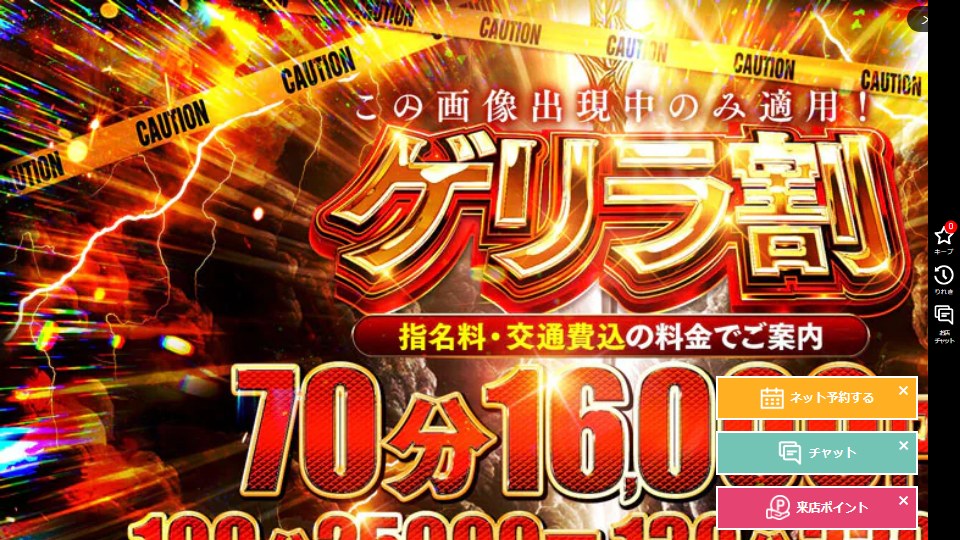
- ゲリラ割 (guerrilla): the rotating all-in banner above
Seven thousand yen off a ¥13,000 course is a fifty-four percent discount. That is not a promotion; that is a shop buying a booking at close to cost, and no established operator does it for long. It's what the first months of a market entry look like, and it is genuinely the best window a customer ever gets with a chain — the prices you see here are the friendliest this brand will ever be to Koiwa.
The 即口コミ割 needs its own line, though. A ¥3,000 kickback for an immediate review is aimed squarely at the one problem a brand-new branch cannot solve with money alone: it has no reviews. A shop with three hundred writeups can shrug at the marginal one. A shop that opened last quarter has an empty page, and an empty page reads as risk to every man scrolling past. So it pays cash to fill it, fast, from the exact cohort that just walked in on a fifty-four-percent-off first-timer coupon and is therefore in the best mood it will ever be in. Nothing about that is against the rules. But it means the early review base on this listing is a paid, discount-selected sample, and the average it produces is not the average you'd get from a full-freight visit. Read the individual writeups, note their dates, and weight the older ones more.
The One Thing to Settle on the Phone
The listing carries a small internal tension worth two seconds of your attention. The genre label puts the shop in 小岩・新小岩, and the breadcrumb agrees. The dispatch-area copy reaches further west — 錦糸町(墨田区)および近郊エリア, Kinshicho in Sumida ward and surrounding areas. Those are two different halves of eastern Tokyo, and the fee that connects them (交通費) is charged separately outside the guerrilla bundle.
That is not a contradiction, it's a chain casting a wide net from a small base — but it does mean the transport charge is a real variable rather than a rounding error, and the listing doesn't publish a table for it. If you're calling from a hotel anywhere west of Koiwa, get the dispatch fee quoted before you pick a course. It is the single most common way an eastern-Tokyo deriheru booking ends up thirty percent over the number you had in your head.
The Verdict
- Positioning: ★★★★☆ — a 61-shop chain making its Tokyo entry at the cheapest viable door on the east side. The 遂に東京上陸 copy is aimed at the network as much as at you, and the Koiwa address is the honest part of the sentence.
- Price transparency: ★★☆☆☆ — the course table excludes nomination and transport; the guerrilla banner includes them and lands ¥3,000–¥4,000 higher. Both are true, neither is labeled clearly, and the two sit on the same page with nothing reconciling them. No published transport table at all.
- Value: ★★★★☆ — ¥13,000 for seventy minutes is a genuinely low Tokyo entry, and stacked with 新規割 it gets absurd. The four stars are for the first visit specifically; the ladder claws it back on anything longer.
- Hours / access: ★★★☆☆ — 17:00 to 05:00, no closing days, but zero daytime. Fine for a commuter town, useless if your window is before dinner.
- Review integrity: ★★☆☆☆ — ¥3,000 cash for an instant review on a new branch's empty page. Disclosed, common, and still a paid sample. Discount the aggregate.
- Going back: △ — worth one trip on the seventy while the acquisition pricing holds. I'd want to see the price sheet again in six months before I'd call it a regular.
Here's what I actually took away, standing at the far end of the Sobu line in my head. Everything I liked about this shop — the ¥186 minute, the fifty-four-percent door, the cash in your hand for a review — exists because the brand doesn't have Koiwa yet and wants it. That's not cynicism, it's just the read. Introductory pricing is real money and it spends the same as any other money; the only mistake is mistaking it for the shop's permanent character.
So go now, or don't bother going for this reason. Take the seventy, get the transport fee quoted before you commit to anything, screenshot the guerrilla banner while it's on screen, and understand that you're being paid a small amount to be an early data point in a chain's Tokyo expansion. Fair trade, honestly. Just know which side of the transaction the ¥7,000 is coming from. First visit logged.