
Ebisu is the wrong neighborhood for this.
I mean that literally, as geography. Come out of the JR west exit and the street tells you exactly what it thinks of you: natural-wine places with six seats and no sign, a ramen shop with a queue of people in good coats, the escalator running up toward Garden Place where the ad agencies keep their expense accounts. Ebisu is where Shibuya goes when it grows up and gets a salary. It is not Kabukicho, it is not Gotanda, and it is emphatically not a red-light district.
And then, sixty seconds from that exit, on the second floor of the Toa Ebisu Building in Ebisu-Minami 1-chome, there is a fashion health shop that has been open for more than thirty years.
The word that makes this interesting
The shop's own description runs four sentences and the first one carries all the weight: 恵比寿で唯一の店舗型ヘルス — Ebisu's only store-type health. Thirty-plus years, it says, an 老舗 — an old establishment, the word you would normally see on a soba restaurant.
Here is why that sentence is worth more than any photo on the page. Almost everything in Tokyo's industry today is delivery: you book, you take a room somewhere, she travels to you. That isn't fashion, it's regulation. Japan's licensing regime for store-premises adult businesses has been closed off by degrees since the eighties and tightened again in the mid-2000s, with zoning that rules out essentially every neighborhood anyone would want to open in. The practical effect is that you cannot start one of these. A store-type licence today is an inheritance, not a purchase. The stock of them moves in one direction, and it isn't up.
So "the only one in Ebisu" isn't marketing puff. It's a census. And a shop with a thirty-year run sitting one minute from a Yamanote station, in one of the most expensive postcodes in the city, is a survivor of a category that is quietly going extinct.
Which produced my favourite fact of the day, and I want it on the record before anything else: the business is older than every woman working in it. The oldest name on Saturday's board is twenty-five.
The arithmetic nobody puts on a poster
The menu here is refreshingly short. 45 minutes, ¥16,000, shower time before and after included. There's a coupon on the page that takes it to ¥14,000.
| Price | Per minute | |
|---|---|---|
| 45 min, list | ¥16,000 | ¥355 |
| 45 min, with the coupon | ¥14,000 | ¥311 |
| 45 min, new-customer ¥1,000 off | ¥15,000 | ¥333 |
| 60 min, new-arrival rate, nomination included | ¥19,000 | ¥317 |
Small thing, and I enjoyed it: the coupon is badged 13%OFF. Two thousand off sixteen is 12.5%. Somebody rounded their own discount up, which is the most human piece of copy on the entire page.
Now the part that actually matters, and it's the whole reason a store-type shop is worth the detour. The page says it plainly — 「ホテル代は一切かかりません!」, no hotel charges at all.
Think about what you really pay at a delivery shop in this part of Tokyo. You pay the course. Then you pay for a room, in Shibuya-ku, on a Saturday, which is not a number anyone enjoys. Then, depending on where you are and where she's coming from, a transport fee. Then you pay in the currency nobody itemises: the wait. The call, the room hunt, the text with the room number, the twenty-odd minutes sitting on a hotel bed looking at your phone.
Here the ¥14,000 is the number. There is no second number. You walk sixty seconds from the west exit, you go up one floor, and the clock that starts is the one you paid for. For a man with a gap between a meeting in Ebisu and dinner somewhere else, that isn't a marginally better deal — it's a different product.
I read the Saturday board hour by hour
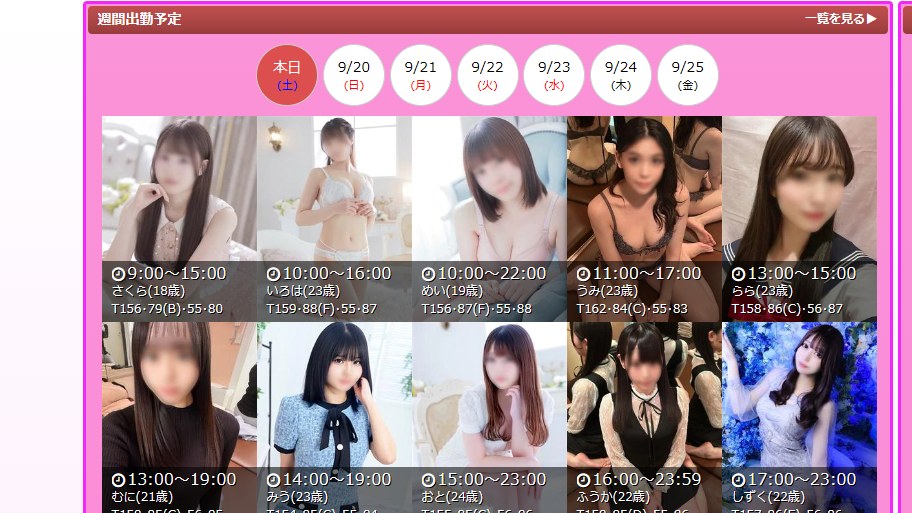
Thirteen women on the schedule the day I went. That's not a big roster by Ikebukuro standards, and the shop doesn't pretend otherwise. What's interesting is the shape of it.
| Start of hour | On the floor |
|---|---|
| 9:00 | 1 |
| 10:00 | 4 |
| 11:00–12:00 | 5 |
| 13:00 | 6 |
| 14:00 | 7 |
| 15:00–17:00 | 6 |
| 18:00 | 7 |
| 19:00–21:00 | 6 |
| 22:00 | 4 |
| 23:00 | 1 |
Add the shifts up and you get roughly 76 woman-hours spread across a 15-hour day — call it five on the floor at any given moment, which is a remarkably flat line for a shop this size. Somebody builds this schedule properly. The plateau runs from one in the afternoon to nine at night and barely moves.
The two ends are where the information is. At 9:00 there is exactly one woman clocked on, with a second arriving at 9:30 — opening hour isn't a choice, it's an assignment. And at 23:00 the board collapses to a single name working until 23:59. If you're the type who rolls out of a second bar at eleven thinking you'll browse, understand that you will not be browsing. You'll be taking whoever is left, or going home.
Go at 14:00 or 18:00. Those are the two peaks, seven women each, and they're the only hours where the word "choice" means anything.
The narrowest age band I've seen on a board
Ages as listed, in order: 18, 19, 21, 21, 22, 22, 22, 23, 23, 23, 23, 24, 25.
Median 22. Mean, to one decimal, 22.0. Total spread: seven years.
I've written up shops in this city fielding rosters that run from twenty to the early fifties and called it a strength, because depth is a strength. This is the opposite philosophy, executed just as deliberately. Ebisu New York isn't assembling a range and letting you pick from it. It's doing one specific thing — young, and only young — and the schedule confirms that isn't an accident of who happened to be free on a Saturday.
Be honest with yourself about whether that's your thing before you get on the train. It isn't better. It's narrower. If what you want is someone in her thirties who's been doing this for a decade and can read a room before you've sat down, this is not your shop and no coupon fixes that. If it is your thing, you've found a place that has organised its entire roster around it.
One more detail from the board that I liked a great deal: three of the thirteen had no photo online. In place of a face, a card reading 店頭のみお写真公開中 — photos on display in-store only.
That is a sentence a delivery shop physically cannot write. It only works if there's a store, with a counter, and a book on it. It's the oldest mechanic in the business, it's the reason the category existed in the first place, and in 2026 in Tokyo there are very few counters left where it still happens. Whether the women behind those three cards are worth the blind pick I genuinely can't tell you — that's the point of a blind pick. But I'll say that in a market where every face has been chosen, lit, retouched and A/B tested, an envelope you can only open by turning up in person is not nothing.
Forty-five minutes
Nine in the morning to midnight, every day of the year. There's online booking and there's a phone number, and at a shop with five women on the floor I'd use the phone, because the question you actually want answered — who's free at the hour you can get there — is a fifteen-second conversation and a three-message exchange.
The building does exactly what a second-floor shop in Ebisu ought to do, which is absolutely nothing to announce itself. You go up, and then you're inside, and the street with the wine bars is a memory. No parking, by the way — this is a one-minute-from-the-gates shop and it expects you to have arrived by train, which in Ebisu everyone has.
I took the forty-five. It's the whole menu, more or less, so there's no agonising over tiers.
I'm not filing a stroke-by-stroke account — never have, not starting now. What I'll say about a forty-five-minute course is that it's a genuinely hard format to run well, and it's the real test of a shop like this. Shower, course, shower, and the showers live inside the forty-five, not bolted on either end. There is no slack in that. It works when the pacing was decided before you walked in, by someone who's done it enough times to know that the first five minutes set the temperature for the other forty. It fails when the clock is visibly doing the driving.
Mine worked. What I'd flag is that this is precisely where a roster with a mean age of twenty-two carries its risk: the format demands someone who knows how to run it, and knowing how to run it is a thing you learn by doing it. The upside of the concept and the variance in the concept are the same fact. I got a good draw. I'm not going to dress that up as a guarantee.
I was back on the street at the west exit with time to spare before dinner, which — and I want to be clear that this is the actual selling point — is not a sentence you get to write after a delivery booking.
The coupon sheet, read properly
Four things are posted, and they reward different people:
- New-customer discount — ¥1,000 off courses of 45 minutes and up, listed as valid all-time across the shop's full 9:00–24:00 day. No awkward window to hit.
- New-arrival rate — 60 minutes, ¥19,000 all-in including the nomination fee, for women newly joined to the shop. Fifteen more minutes and the shimei bundled, at ¥317 a minute.
- Review coupon — ¥2,000 off your next visit for posting one. Honest exchange, plainly stated.
- A Sunday-night campaign is listed. I couldn't pull its terms off the page, so I'm not going to invent them — ask at the counter or on the phone.
What I can't confirm is whether the ¥14,000 coupon and the ¥1,000 new-customer discount stack, and I'd rather tell you that than guess. Ask when you book. Either way the honest first-visit number lands somewhere between ¥13,000 and ¥15,000 for forty-five minutes, with no room charge waiting behind it.
About Ebisu New York
Store-type fashion health. Ebisu-Minami 1-8-3, Toa Ebisu Building 2F, Shibuya-ku, Tokyo — about one minute from the JR Ebisu Station west exit. Open 9:00–24:00, year-round. Tel 03-3710-7669. Course: 45 minutes ¥16,000, shower time before and after included; coupon rate ¥14,000. No hotel charge. No parking. 18+ only. The shop describes itself as the only store-type health in Ebisu, with a history of more than thirty years. Official site listed as tokyo.mxy.jp/ebisu/top.html; the Cityheaven listing is the page actually kept current, and it's where the shift board and the coupons live.
The verdict
| Item | Rating |
|---|---|
| Location (60 seconds from a Yamanote gate) | ★★★★★ |
| Total-cost honesty (no room, no transport, no wait) | ★★★★★ |
| Scarcity — a store-type licence in 2026 | ★★★★★ |
| Schedule construction (flat 13:00–21:00 plateau) | ★★★★☆ |
| Roster size (13 on a Saturday) | ★★★☆☆ |
| Roster range (ages 18–25, and that's the whole menu) | ★★☆☆☆ |
| Menu flexibility (one course, essentially) | ★★☆☆☆ |
| Overall | ★★★★☆ |
Four stars, and I want to be precise about where they come from, because it isn't the roster and it isn't the price.
It's the delta. Every shop in Tokyo quotes you a course fee and then lets the evening quietly add a hotel room, a transport charge and forty minutes of your life to the bill. This one quotes ¥14,000 and the evening adds nothing, because the room is upstairs and the clock starts when you do. Take that seriously and it's one of the better-value forty-five minutes on the Yamanote line, by a margin the per-minute column never shows you.
Two conditions. Go at 14:00 or 18:00, where the board has seven names on it instead of one. And go knowing exactly what the age band is, because a mean of 22.0 across thirteen women isn't a coincidence — it's the product. If that's what you came to Ebisu for, there's a thirty-year-old shop one minute from the west exit that has been doing nothing else since before any of them were born.