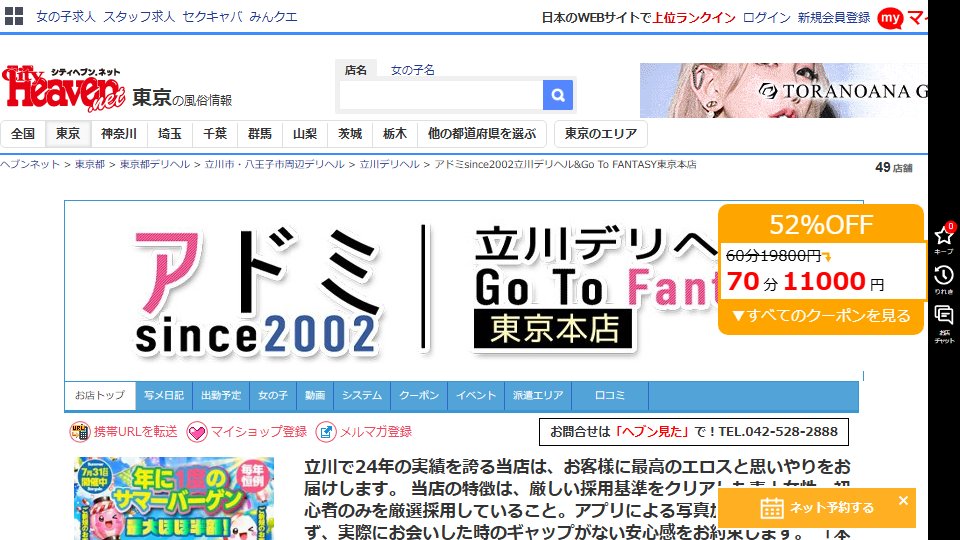

The full banner is a mouthful — アドミ since2002 立川デリヘル & Go To FANTASY 東京本店, or Adomi since2002 Tachikawa deriheru & Go To FANTASY Tokyo main branch — and it's a delivery health (deriheru: the girl comes to your room, no shopfront) operation working Tachikawa and the Hachioji stretch out on Tokyo's western spine. The concept line is 本物の美女と、ファンタジーなひとときを — "real beauties, a fantasy interlude" — and the hiring policy underneath it is stated flat: 素人女性、初心者のみを厳選採用, they select only amateur women and beginners. Phone's right there on the listing, 042-528-2888, which in itself tells you what era of shop this is. Nothing about the presentation is trying to be a Kabukicho house. It's a suburban operation that knows its catchment and has known it for a long time.
The Price Ladder Is Arithmetic, and That's the Story
Here's the course sheet, and I want you to look at it as numbers rather than as a menu:
| Course | Price | Cost per minute |
|---|---|---|
| 60 min | ¥16,500 | ¥275 |
| 90 min | ¥22,000 | ¥244 |
| 120 min | ¥27,500 | ¥229 |
| 150 min | ¥33,000 | ¥220 |
Every step up is exactly ¥5,500 for thirty more minutes. Not "roughly." Exactly, four times in a row. That's a shop that sat down and picked a marginal rate — ¥183 a minute — and then refused to fiddle with it. The entry course carries the overhead, which is why the sixty looks expensive per minute and the ladder gets cheaper the longer you climb, but the shop isn't running a psychological staircase where step two is suspiciously cheap and step four is where they get you. There's no bait step and no trap step. New customers get +10 minutes free, and note the shape of that bonus: it's time, not yen. A discount discounts the shop's product. Extra minutes hand you more of it.
The ladder stops at 150, and how they handle what's beyond it is the punchline. There is no three-hour course. If you want 180 minutes, the shop's own note tells you to buy two 90s; five hours is two 150s — and it adds, without dressing it up, that the nomination fee multiplies right along with them (×2, ×3). No premium long-course tier, no bulk rate, no negotiation. The menu is literally additive. I've read a hundred of these sheets and I can't remember the last one that just admitted its pricing is a multiplication table.
One asterisk on all of that, and it's worth flagging because it's the only place the shop's numbers stop agreeing with each other. Alongside the official sheet runs a 52%-off coupon: 70 minutes for ¥11,000 — and the struck-through figure it discounts from is ¥19,800 for sixty, not the ¥16,500 the price table quotes. Both numbers are on the same listing. That's the ordinary gap between coupon-copy math and the real sheet, and it's the one moment in an otherwise very legible presentation where you should trust the table and treat the percentage as marketing. The ¥11,000 is still the cheapest door into this shop by a wide margin. Just don't let the "52%" do your arithmetic for you.
Read the option list and the same discipline shows up. Rotor, vibe, and denma at ¥1,100 each; costume and soft SM at ¥3,300; SM play at ¥5,500; photography at ¥11,000. Every one of those is a clean multiple of 1,100 — that is, quoted tax-inclusive, no consumption-tax surprise waiting at the door. Small thing. Also the kind of small thing that a shop only bothers to get right when it plans on the customer coming back.
The Amateur Line Next to the Option Menu
Now the friction, because there is some. The shop's hiring pitch is amateurs and beginners only, staff listed up to 33. Directly beneath that sits an option menu that runs through soft SM, SM play, and paid photography. Those two things don't contradict each other — but they do describe two different customers, and it's worth being clear-eyed about which one you are before you call.
The honest reading: the option list is what the shop can arrange, not a guarantee of what any individual will accept. That's standard across the trade and it is not a knock on this house. But when the roster is deliberately weighted toward women new to the work, the gap between "on the menu" and "available tonight from this person" gets wider than it would at a veteran-heavy shop. If you're coming for the amateur texture — the slightly-unpolished, not-yet-professionalized thing that a lot of men are genuinely paying for — then you and the concept are aligned and you should ignore the bottom half of the option list entirely. If you're coming with a specific option in mind, say so at the booking, not at the door. Reception is where that conversation belongs, and a shop that's been standing since 2002 has had that conversation ten thousand times.
The Door: Nineteen Hours, Not Twenty-Four
10:00 to 05:00 the following morning, last booking 05:00, open year-round. Nineteen hours a day, every day. It gets called "all-night" in casual conversation and it very nearly is, but the distinction matters if you're planning around a last train or an early flight — there is a five-hour window, roughly 5 AM to 10 AM, where this shop simply isn't there. Against that, the daytime opening is the underrated half. A 10 AM door in a commuter suburb serves the man on a day off, the shift worker heading home, the traveler with a free afternoon before the Chuo line carries him back east. Most shops treat daylight as an afterthought. Nineteen straight hours means this one doesn't.
Transport Is a Published Number, Not a Mystery
The other structural note is delivery reach, and here the shop does something I wish more deriheru would: it prints the transport table instead of saying "ask us."
| From | Transport fee |
|---|---|
| Hotels around Tachikawa station | ¥1,100 |
| Tachikawa, Hachioji station area, Akishima, Hino, Fussa, Hamura, Kokubunji, Kunitachi, Fuchu, Tama, Kodaira and neighbors | ¥1,650~ |
| Ome, Mitaka, Chofu, Musashino, Nishi-Tokyo, Inagi, Kiyose, Tokorozawa and neighbors | ¥2,200~ |
| Setagaya, Suginami, Nerima, Komae, Machida, Sagamihara, Kawagoe, Sayama, Hanno, Asaka and neighbors | ¥3,300~ |
Two things fall out of that table. First, the catchment is far bigger than the listing's headline suggests — the nominal dispatch area says Tachikawa, but the fee tiers reach into inner Tokyo wards and across the prefectural line into Saitama. This shop is not confined to the western suburbs; it just charges you honestly for leaving them. Second, and this is the practical part: transport is a rounding error if you book near the station and a real line item if you don't. From a Tachikawa station hotel you're adding ¥1,100 to a ¥16,500 course — under seven percent. From Setagaya you're adding ¥3,300-plus, and the tilde on that figure is doing work. Being a deriheru, you also need to have solved the room problem yourself before you dial; there's no shopfront to walk into.
The Cancellation Policy Has Teeth
Read this part before you book, because it is stricter than the category norm and the shop makes no attempt to soften it. Same-day cancellation is 100% of the total — and explicitly, that applies whether you cancel before meeting or after. The day before is 50% of the course fee. Two or more days out costs nothing, but it comes with a consequence: your next booking is restricted to same-day reservations only. Charges are settled within three days by card or bank transfer.
That is a hard policy, and I'm not going to pretend it's customer-friendly. A 100% same-day charge means a cancelled evening costs you the entire price of a night you didn't have. What I'll credit is that they wrote down why: the note says cancellation costs land on other customers and on the cast, which is the actual truth of how a dispatch schedule works and is more explanation than most shops bother with. It's also of a piece with everything else here — this is an operator that would rather state an unpopular rule plainly than bury it and argue at the door. Know it going in, and don't make a reservation you're not sure about.
The Verdict on Twenty-Four Years
- Price transparency: ★★★★★ — a flat ¥5,500 per additional half hour across the entire ladder, tax-inclusive options, a published transport table, and long sessions sold as plain addition. You can budget this shop to the yen from the listing alone. Only the coupon's ¥19,800 reference price breaks the pattern.
- Value: ★★★★☆ — ¥16,500 for sixty is mid-market for Tokyo and slightly premium for the western suburbs; the case improves as you climb, and the +10 free minutes for new customers is a real ¥1,800-odd of product. The ¥11,000/70min coupon is the cheapest honest way in.
- Concept coherence: ★★★☆☆ — the amateur-only hiring line is clear and consistent, but it sits somewhat awkwardly next to an option menu that reaches further than a beginner-weighted roster typically will. Ask first.
- Access / hours: ★★★★☆ — 10:00–05:00 every day of the year, with delivery reaching from Tachikawa station hotels (¥1,100) out to Setagaya, Machida and Kawagoe (¥3,300~); strong daytime coverage, with a genuine five-hour dead zone in the early morning.
- Booking terms: ★★☆☆☆ — 100% same-day cancellation charge, 50% the day before, and a same-day-reservations-only penalty even for a polite two-day heads-up. Stated openly and explained, but severe. Don't reserve on a maybe.
- Going back: ○ — yes, on a longer course, booked from close to the station, with the option conversation had up front rather than improvised.
I went west expecting since 2002 to be decoration and came back thinking it's the most informative thing on the page. Twenty-four years in this trade isn't luck and it isn't marketing — it's the residue of a shop that has priced its product the same legible way for long enough that the regulars stopped checking. The ladder is arithmetic. The options are quoted tax-in. The transport table is printed instead of mumbled. Three hours is just ninety twice. Even the cancellation policy, which I don't much like, is written out in full with its reasoning attached rather than hidden where it can ambush you.
That's the shape of the whole place: nothing here is generous, and nearly everything is legible. You will not be surprised by this shop in either direction. For a trade that runs on managed expectations and vanishing storefronts, being the operator whose numbers still add up the same way they did in 2002 is a genuinely rare thing — and out here on the Chuo line, it turns out to be the whole point. First visit logged.