The Machine on Matsunoki Street
For roughly eight months, a camera mounted above a bar street in the capital of Ibaraki Prefecture has been watching the way men walk.
On September 3, 2026, Earth Eyes Inc. — a Tokyo firm based in Minato Ward and founded in September 2015 — published an account of its AI surveillance system's deployment in Daikumachi, the nightlife district of Mito City. The system went live in December 2025. The release is the first public description of how it has been operating since.
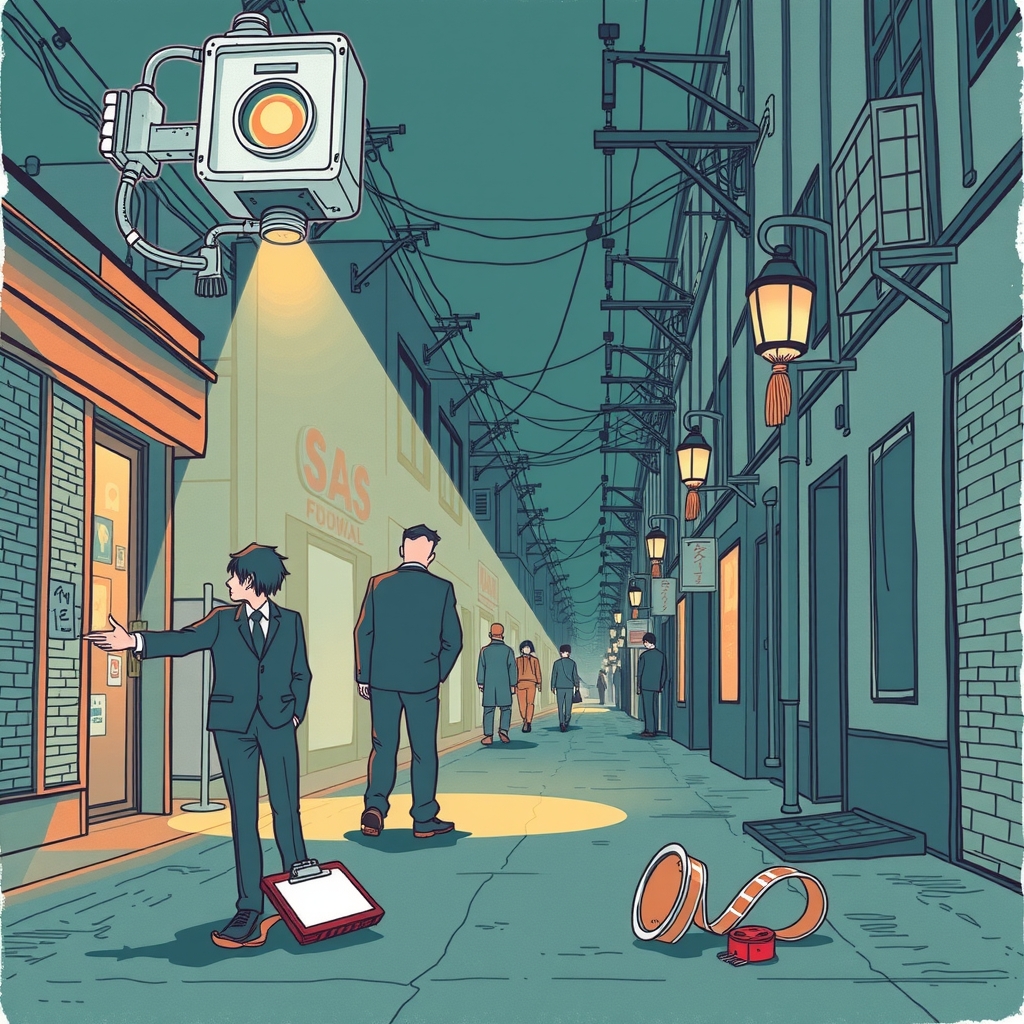
What the AI is looking for is not a face, at least not first. It is looking for a sequence of movements. According to the company's account, the software evaluates whether a person lingers or waits in place, moves back and forth over the same ground, makes repeated attempts at contact, positions himself at close range to passersby, or falls into step alongside someone and then peels away. It weighs those patterns together with what the company calls appearance tendencies.
That list is not arbitrary. It is a description, rendered into machine vision, of the conduct a prefectural ordinance already prohibits.
The Statute the Camera Reads
Touting in Japan is not policed by one national law. It is policed largely by prefectural nuisance prevention ordinances — meiwaku boshi jorei — and Ibaraki's is explicit about what kind of touting it means.
Article 6 of the Ibaraki Prefectural Nuisance Prevention Ordinance bans soliciting customers in a public place for three categories of business. The first is shows, goods or services that arouse sexual curiosity, including "services involving physical contact with a person in response to sexual curiosity." The second is the business of entertaining customers and serving them food and drink "by a method that produces an atmosphere of pleasure" — the statutory formula that captures cabaret clubs and hostess bars. The third is services performed exclusively by touching a person's body between 10 p.m. and 6 a.m., the clause that reaches late-night massage and men's esthetic salons.
A separate subsection bans touting by "persistent methods": taking hold of a person's body, clothing or belongings, blocking their way, or following them.
The penalty under Article 11 is a fine of up to ¥500,000 or detention. For habitual offenders it rises to up to six months' confinement or a fine of up to ¥500,000.
Read the ordinance's verbs and then read the AI's detection list, and they are close to the same document. Blocking a path. Standing too near. Walking with someone who did not ask for company. Mito's contribution is that a machine now watches for them continuously, and a speaker issues a warning on the spot.
What Was Installed, and When
Mito City announced the program on December 17, 2025, according to the Nikkei. Three cameras were installed in Daikumachi 1-chome, with recording and review available from that day. A fourth was to be added once the reconstruction of the nearby Daikumachi police box was finished, bringing the planned total to four.
The Ibaraki Shimbun, which reported the installation on December 22, placed the three cameras along the stretch running from the road facing National Route 50 to Matsunoki-dori, a street thick with bars, snack lounges and izakaya. The paper reported that the AI would learn from around-the-clock recorded footage, automatically detect touting that violates the prefectural ordinance — the examples it cited were blocking a path and placing a hand on a passerby's shoulder — and play a warning message.
The Ibaraki Shimbun also reported the terms that govern the footage. Recordings are deleted after one month for privacy, and are handed to police only for criminal investigations into illegal touting. The project cost roughly ¥10 million, with half covered by a national subsidy.
Full operation, after a training period of several months, was set for March 2026. That is also when the rebuilt police box opened: a steel-frame, two-story building of about 114 square meters, with a newly added women's rest room for officers on night duty, and AI cameras fixed to it. Roughly thirty people attended the opening ceremony on March 14, including the chief of the Mito Police Station and the mayor of Mito.
One detail from the Nikkei's account goes further than automated warnings. Where a person is found to be touting repeatedly, the article states, facial recognition technology will be used to identify him and the information shared with police. The paper also reported that the city was considering publishing real-time crowd conditions from the cameras on its homepage.
The Number That Isn't There
The September 3 release describes the apparatus in detail. It does not describe a result.
A Mito City official, quoted in the release, frames the system's purpose in procedural terms: to grasp conduct suspected of being touting, to issue warnings where necessary, and to feed data to police and other agencies. On whether any of it has deterred anyone, the city's position is that the effect must continue to be verified. The release contains no figures — no count of detections, no count of warnings played, no before-and-after measure of touting on Matsunoki-dori.
There is also a discrepancy worth noting plainly. The December reporting by both the Nikkei and the Ibaraki Shimbun described three cameras installed and a fourth planned. The vendor's September release describes two monitoring areas with one camera each. The accounts have not been reconciled publicly, and neither the city nor the company has explained the difference.
Why Daikumachi
The district did not get cameras for nothing. The Ibaraki Shimbun reported in 2023 that illegal touting around Daikumachi was recurring, that prefectural police were putting effort into arrests, and that the area's energy had not fully returned after the pandemic. Restaurant operators told the paper that competition for customers had intensified — a market explanation for a nuisance problem. Fewer people on the street, the same number of businesses, and more men working the sidewalk to bring them in.
Elsewhere, It Is Still a Man in Plain Clothes
Mito is the exception. In most of Japan, the tout is still caught the old way.
On September 2, 2026, Miyagi Prefectural Police arrested a 36-year-old man of no fixed address on suspicion of violating the prefecture's nuisance prevention ordinance. He had been working a sidewalk in Kokubuncho, Sendai's entertainment district in Aoba Ward, pitching what he described as women's-type establishments — girls bars, cabaret clubs, icha-kyaba and oppabu, the latter two categories of venue built around physical contact with customers. The man he approached was a plainclothes officer on patrol. He admitted the conduct, telling police there was no mistake that he had been touting. Sendai Hoso reported the arrest on September 3; TBC and TBS News Dig also carried it.
The day before, on September 1, the same prefectural police arrested a 22-year-old man, the former operator of a Kokubuncho restaurant, on suspicion of having his employees tout on a nearby street at around 12:40 a.m. on July 9. His employees, according to the allegation, were pitching passersby with lines about a girls bar. The man denies it, telling police he did not have his employees tout and did not instruct them to. His shop had closed a week before the arrest. Police say they are examining whether there are further offenses.
Two arrests in two days, in one district, each requiring an officer to be physically present.
What the Camera Can and Cannot Do
The case for Mito's system is that touting is a volume problem, and volume problems are what machines are for. An officer can stand on one corner. A camera can watch that corner every night, and a speaker can interrupt a pitch before it lands.
The case against it is narrower than it first appears, and it is not really about the warning. It is about the second function. A system that plays a recorded message at a man loitering on a sidewalk is a public-address system with better timing. A system that identifies him by his face because he has loitered before, and passes his identity to the police, is something else — and the offense at issue carries, on a first violation, a fine or detention.
Mito has built both. Eight months in, what the city can report is that the environment for monitoring and police coordination is now in place. Whether fewer men are working Matsunoki-dori than were working it in December is a question the city says it is still verifying.
Sources: Earth Eyes Inc. press release, "Earth Eyes' AI surveillance system introduced for anti-touting measures in Daikumachi, Mito City," distributed via PR Times, September 3, 2026, and carried by Livedoor News. Nihon Keizai Shimbun (Nikkei), "Mito City introduces AI cameras in the Daikumachi commercial district, aiming to eradicate touting," December 17, 2025. Ibaraki Shimbun, "Mito's nightlife district: AI cameras for anti-touting measures — automatic detection, voice warning," December 22, 2025; "New Daikumachi police box opens — a base of safety and security for the prefectural capital; AI cameras automatically detect touting," March 2026; and "Illegal touting recurring around Daikumachi in Mito, Ibaraki — 'the energy has not returned' after COVID," 2023. Text and penalties of the Ibaraki Prefectural Nuisance Prevention Ordinance, Articles 6 and 11, from the prefecture's published regulations. Sendai arrests: Sendai Hoso (FNN), September 3, 2026; TBC Tohoku Hoso and TBS News Dig, September 1 and 2, 2026; khb Higashi-Nippon Hoso, September 3, 2026. The camera counts reported in December 2025 and in the vendor's September 2026 release differ, and are given here as each source states them. The Sendai suspect arrested on September 1 denies the allegation; no charges described in this article have been proven in court.