Four Words
The student said he wasn't interested. That, according to Kanagawa prefectural police, is the whole of what he did.
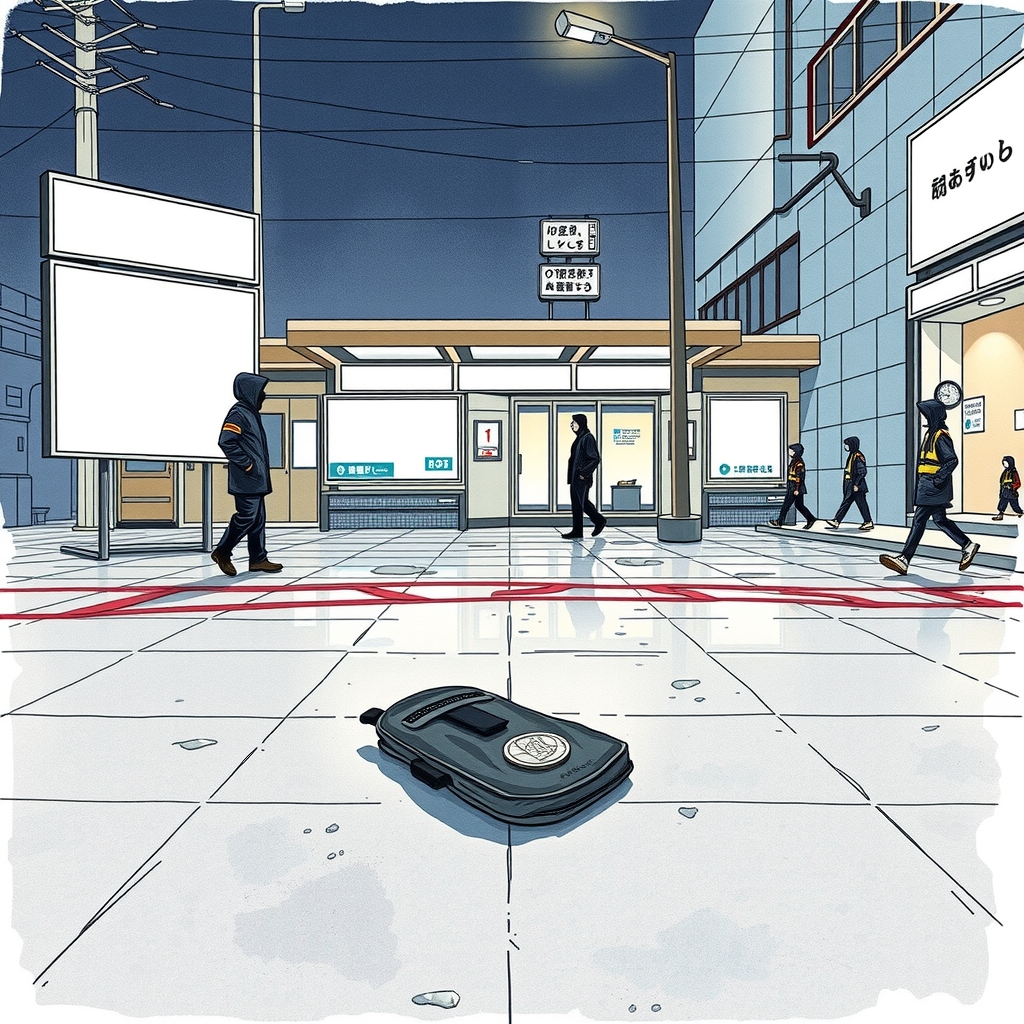
It was a night in May 2026, on the street outside Honatsugi Station on the Odakyu Line — the center of the nightlife district in Atsugi, a city of about 220,000 some 50 kilometers southwest of Tokyo. A male university student, 21 and in his third year, had parted from a friend and was walking alone. Two men working the street as touts approached him with a pitch for an eating-and-drinking establishment.
He turned them down. Kyomi nai, ikanai yo — not interested, I'm not going.
Police say the two men then punched him in the face and kicked him in the abdomen. Nippon Television's NNN reported the injuries required roughly a month to heal; FNN Prime Online, the Fuji Television network's news service, described them as serious.
On August 20, three months after the assault, Kanagawa police announced the arrest of both men on suspicion of injury — shōgai, Article 204 of the Penal Code, which carries up to fifteen years' imprisonment. One is identified in Japanese reports as Morohoshi, 22; the second man's details were not given. Both, according to police, have admitted the allegations.
What Police Had Already Heard
The detail that gives the case its weight is not the assault. It is what police say they were holding before it.
Officers had received multiple complaints about these same two men, according to both NNN and FNN. They were not anonymous figures who materialized on a street corner one night in May. They were known.
Investigators have since searched the restaurant the two were working for and are examining the business's involvement in the case. They are also, both broadcasters reported, investigating whether the pair committed other offenses.
The Ordinance That Had Just Been Strengthened
What makes Atsugi's timing uncomfortable is that the city had moved on exactly this problem six weeks earlier.
Atsugi has had an anti-touting ordinance since 2012, in force since April 2014. As originally written, it reached the businesses most people associate with street solicitation: host and hostess clubs, and sex-industry establishments. Those are the categories already regulated under the fūei-hō — the Businesses Affecting Public Morals Regulation Act, Japan's licensing statute for nightlife and adult entertainment, which separately bars licensed operators from touting for customers on the street.
That left a hole, and the hole is where the trade moved. Izakaya, girls bars and karaoke shops are not fūei-hō businesses. Their employees could work the pavement outside Honatsugi Station without touching either the national law or the municipal one.
So on April 1, 2026, an amended ordinance took effect. It extended coverage to alcohol-serving restaurants and karaoke establishments. It banned loitering, lingering and gathering in public places with the intent to solicit — not merely the solicitation itself. It barred operators from accepting customers delivered by prohibited touting, and required them to supervise their staff. It gave city officials power to conduct on-site inspections, question people and examine business records. And the city raised its complement of anti-touting patrol officers from ten to thirteen, working the station area from 5 p.m. to 11 p.m., Monday through Saturday.
That same day, roughly sixty people — Atsugi police officers, residents, merchants' association members and crime-prevention volunteers — walked the streets around the station and the Atsugi Ichiban-gai arcade handing out notices.
Mayor Takahiro Yamaguchi said touting in the district had fallen by 80 percent since the ordinance first came into force. Takaji Takada, who heads the local environmental improvement council, put the amendment plainly: businesses the city previously could not regulate, it now could.
Six weeks later, a student who said no to a tout outside that station spent a month recovering.
Fifty Thousand Yen
The gap this case exposes is not one of coverage. It is one of consequence.
The penalty attached to Atsugi's ordinance, as the city describes it, tops out at an administrative fine of ¥50,000 — roughly $340 — including for those who refuse questioning or obstruct an inspection. An administrative fine is not a criminal conviction. It produces no criminal record. For a tout earning commission on every body he walks through a door, it is a cost of doing business, and a modest one.
This is the structural fact behind touting enforcement across Japan, and it is not specific to Atsugi. Municipal anti-tout ordinances in Tokyo's Shinjuku, in Sapporo's Susukino, in Nagoya and Osaka and dozens of smaller districts are built as nuisance instruments. They are designed to make a street less unpleasant, not to remove anyone from it. When police want to actually take a tout off the pavement, the charge they reach for is usually something else — assault, extortion, fraud, or a fūei-hō violation by the employing business.
That is what happened here. The ordinance was expanded, the patrols were reinforced, the mayor announced an 80 percent reduction — and the thing that produced two arrests was Article 204 of the Penal Code.
The Employer
The open question is the restaurant.
Japanese anti-touting ordinances, Atsugi's amended version included, increasingly try to reach past the man on the street to the business paying him. The April amendment explicitly prohibits operators from taking customers brought in by illegal solicitation and obliges them to supervise employees. Police searching the establishment and examining its involvement is the test of whether that provision has teeth.
It is also the harder case to make. A tout who throws a punch leaves a victim, a medical certificate and a confession. A business that hires aggressive touts, takes the customers they produce and declines to ask questions leaves paperwork, and paperwork is contestable.
For now the record is narrower and clearer. Two men were working a station plaza in a city that had just told them, formally and with sixty people and a stack of leaflets, that they could not. A student walked past and declined. Police say they beat him for it. It took three months and a criminal charge to end their run — and complaints about them had already reached police before the night that produced one.
This report is based on Japanese-language coverage by Nippon Television's NNN (August 20, 2026) and FNN Prime Online (August 21, 2026), together with published materials from the City of Atsugi on its Customer Solicitation Prevention Ordinance and the April 1, 2026 amendment. Suspects are named here only as Japanese news organizations identified them. Arrest is not conviction, and the allegations described have not been tested at trial.