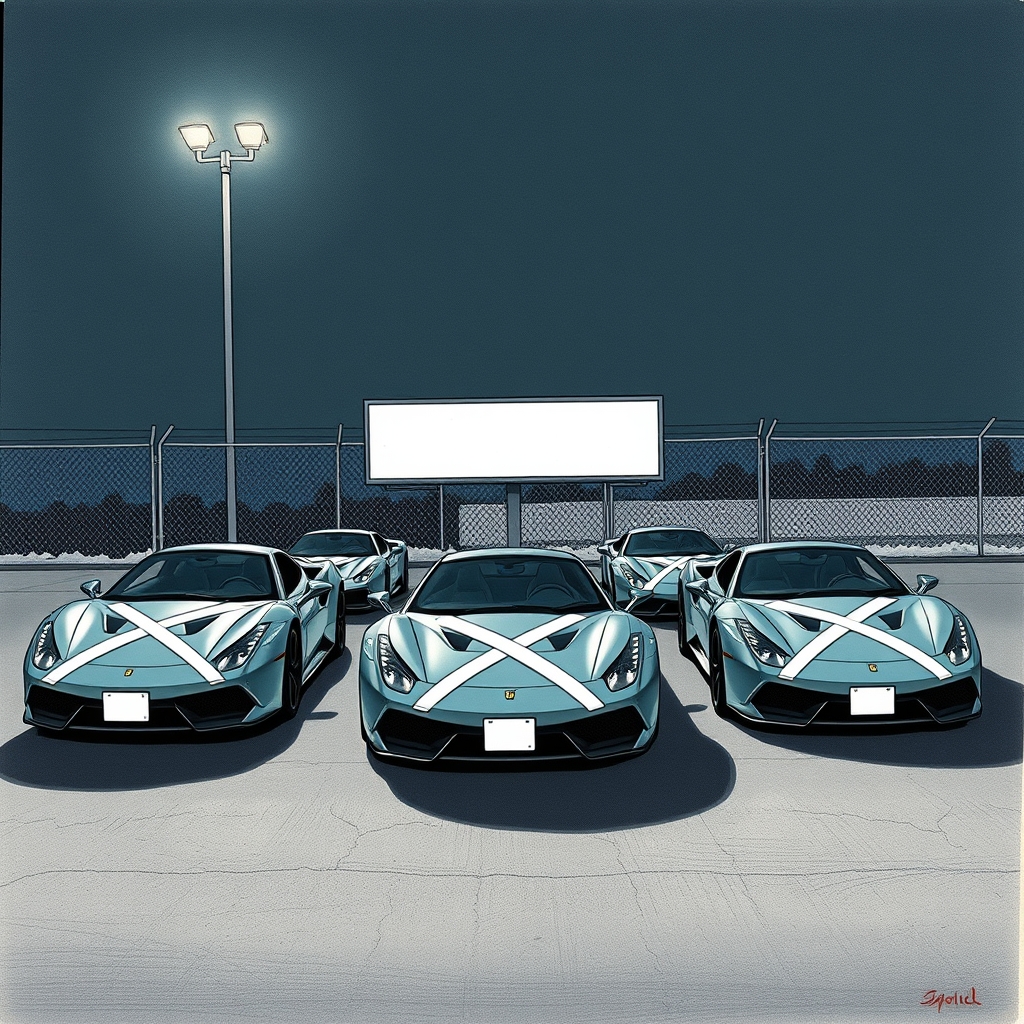
The Cars
Police departments rarely stage a car show. Nagano Prefectural Police did.
On July 28, 2026, investigators lined up six luxury vehicles — Ferraris and Porsches among them — and opened them to news cameras. The cars had been seized from parties connected to what police describe as a set of four cabaret clubs operated in Nagano City for roughly four years without a license. Their combined value is put at about ¥91 million, or a little over $600,000. One imported car in the group is valued at more than ¥30 million on its own.
According to the Shinano Mainichi Shimbun, the vehicles were registered in the name of a company tied to the operation. Police say the money that bought them came out of an illegal business.
The display was the point. Seizure notices are paperwork; a Ferrari on a lot is a photograph. Four Nagano broadcasters and the prefecture's main daily carried the images the same week.
The Case
The underlying prosecution is a licensing case.
Three men were arrested on suspicion of violating the Businesses Affecting Public Morals Regulation Act (fuei-hō) — the statute that governs Japan's nightlife and adult-entertainment trades — specifically its prohibition on operating without a license. Among them, according to broadcasters NBS Nagano Broadcasting and abn Nagano Asahi Broadcasting, are two company executives, both 40: one from the Sakurashinmachi area of Nagano City, the other from Matsumoto. None of the reports reviewed for this article published the men's names.
The charged conduct is narrow and specific. At an establishment in the Kamichitose district of Nagano City, police say, the men had employees entertain customers — sitting with them, pouring, keeping company — without a license from the Nagano Prefectural Public Safety Commission.
That word carries the case. Under the fuei-hō, serving drinks is ordinary food-and-beverage business. Settai — attending to customers in a personal, companionable way — is what converts a bar into a regulated "entertainment business" requiring a license, a vetted operator, an approved location and fixed operating hours. A cabaret club, or kyabakura, is the archetype. Running one without the permit is not a paperwork lapse; it is unlicensed operation, and since the fuei-hō was revised in 2025 it carries penalties of up to five years' imprisonment or fines up to ¥100 million, with corporate fines reaching ¥300 million.
The arrests were made between late June and July 2026, abn reported.
| Detail | As reported |
|---|---|
| Assets displayed | July 28, 2026, by Nagano Prefectural Police |
| Seized | Six luxury vehicles, roughly ¥91 million combined |
| Notable | Ferrari and Porsche models; one imported car valued above ¥30 million |
| Registration | Held in the name of a company linked to the operation |
| Arrested | Three men, on suspicion of fuei-hō violation (unlicensed operation) |
| Identified by role | Two company executives, both 40 — one from Nagano City, one from Matsumoto |
| Charged conduct | Employees entertained customers without a Public Safety Commission license, at a Kamichitose, Nagano City establishment |
| Arrest window | Late June to July 2026 |
| Scale alleged | Four cabaret clubs, 2022 through June 2026 |
| Sales | Reported variously as more than ¥150 million and as "several hundred million yen" |
| Status | Police investigating further unlicensed venues and other uses of the proceeds |
How Big
The revenue figure is the one number the coverage does not agree on.
NBS reported that the four clubs took in more than ¥150 million between 2022 and June 2026. SBC Shin-etsu Broadcasting and abn both put the figure at "several hundred million yen" — sūoku-en — a materially larger estimate. The gap is not necessarily a contradiction. Police often confirm a floor early and revise upward, and investigators have said openly that they believe there is more: they are examining whether the same group ran additional unlicensed venues, and where else the proceeds went.
What is not in dispute is the pattern. This was not a single back-street bar. It was four establishments, operating for about four years, generating enough surplus that ¥91 million could sit in a parking lot.
Why the Cars Matter
Japanese police have spent the past two years shifting the target in nightlife enforcement from the premises to the money.
The logic is straightforward. A fuei-hō conviction for unlicensed operation can be absorbed as a business expense if the business was profitable enough — the shop closes, someone takes a suspended sentence, and the earnings remain. Seizing the earnings changes the arithmetic. It is the same reasoning behind the 2025 fuei-hō revision that criminalized "scout-back" referral kickbacks outright, behind prefectural public-safety commissions suspending shops that paid them, and behind the organized-crime proceeds cases prosecutors have brought against nightlife operators in Fukuoka and elsewhere this year.
Nagano's contribution is presentational. Most asset forfeiture is invisible to the public — a line in a court record, a number in an annual report. Six supercars parked in a row is a message aimed past the courtroom at everyone else in the trade: the calculation that made an unlicensed club worth running has changed.
What Remains Open
Nothing here has been tested in court. The men are under arrest on suspicion, not convicted; the accounts of what the clubs earned and what the cars were bought with are the police's. The reports reviewed do not indicate whether the three men have admitted or denied the allegations, and do not identify them by name.
Two questions carry forward. Whether the sales figure settles at ¥150 million or several hundred million will shape how the case is charged and how much money is ultimately at stake. And whether investigators find the additional venues they suspect will determine whether this is a four-club case or the visible part of something larger.
For now, the state of play is six cars, a licensing charge, and four years of business that police say should never have been open.
This article is compiled from July 28–30, 2026 reporting by the Shinano Mainichi Shimbun, SBC Shin-etsu Broadcasting, NBS Nagano Broadcasting, abn Nagano Asahi Broadcasting and TBS NEWS DIG on Nagano Prefectural Police's July 28 disclosure of seized assets and the underlying arrests. Where those outlets differ — notably on total sales, reported both as more than ¥150 million and as several hundred million yen, and on whether two or three of those arrested are company executives — the divergence is stated rather than resolved. The suspects are not named because the reporting reviewed does not name them. All allegations are as described by police; no charge has been tested in court, and arrest is not conviction. Legal glosses: fuei-hō = Businesses Affecting Public Morals Regulation Act, which licenses and regulates nightlife and adult-entertainment businesses; settai = the personal attendance on customers that legally distinguishes a licensed entertainment business from an ordinary bar; kyabakura ("cabaret club") = a hostess bar where staff sit with and entertain paying customers; baishun bōshi-hō = Anti-Prostitution Act, not charged in this case.