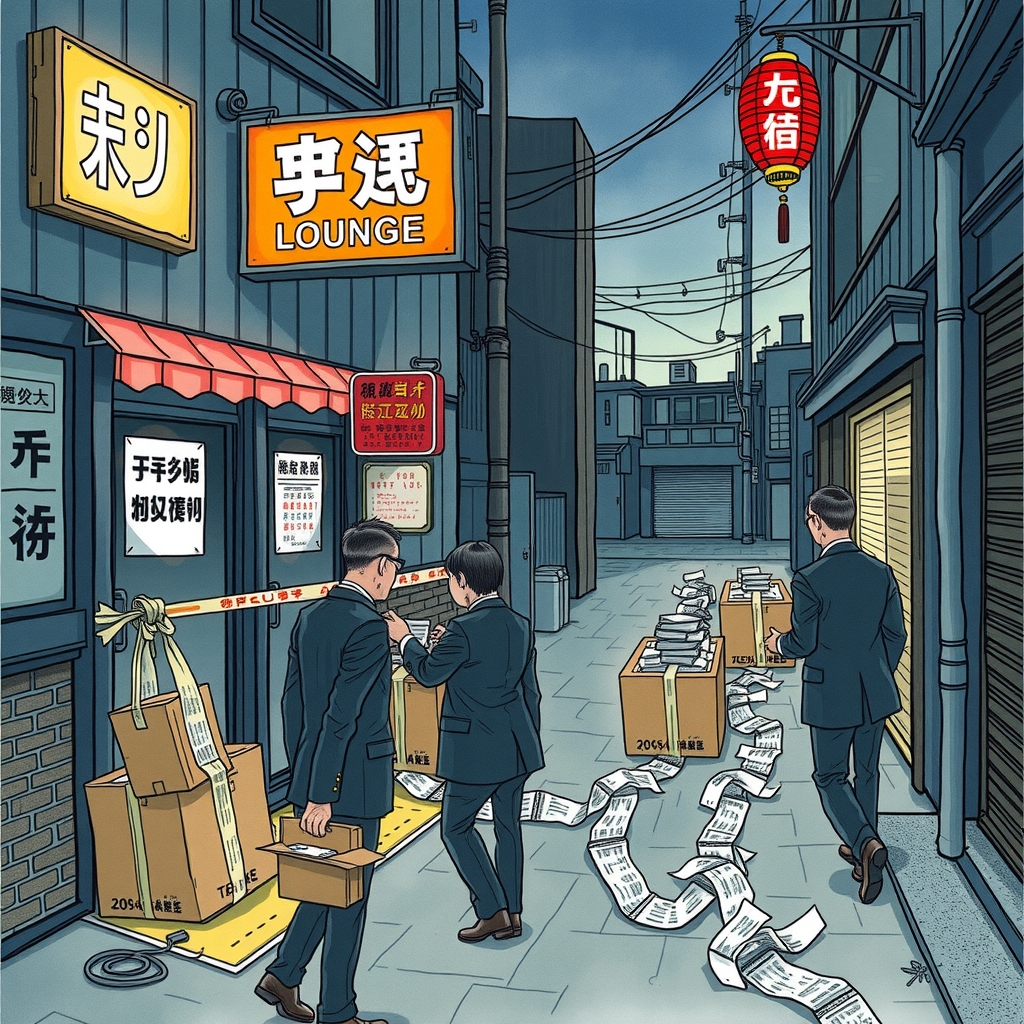
The Arrests
Kochi Police Station arrested three people on August 17, 2026, on suspicion of violating the Businesses Affecting Public Morals Regulation Act (fuei-ho), the statute that licenses and polices Japan's nightlife trade.
Police identified them as Wataru Kitadai, 50, who operates a bar in Takeshima-cho, Kochi City; Takafumi Soen, 35, of no fixed address, an employee of the bar whom police describe as a member of an organization under Goyu-kai, an affiliate of the sixth-generation Yamaguchi-gumi; and Kano Tamura, 28, also an employee, of Takeshima-cho.
The allegation is narrow and, in enforcement terms, routine. At the bar Kitadai runs in Kochi City's entertainment district, police say, female staff sat with customers, entertained them and served alcohol — for more than three years, without the license from the Kochi Prefectural Public Safety Commission that this kind of business requires.
Police have not said whether any of the three admits or denies the allegation, citing the ongoing investigation. Nobody has been charged.
The case was reported on August 17 by RKC Kochi Broadcasting and on August 18 by the Kochi Shimbun, which described the premises as a lounge. This account is drawn from those reports and from the JNN network's coverage.
What "Entertainment" Means Here
The word doing the legal work is settai — "entertainment." Under the fuei-ho, a bar becomes a licensed Type 1 entertainment business the moment staff are assigned to sit with customers and keep them company: pouring drinks, making conversation, singing along. A bar where a bartender serves from behind the counter needs no such license. A bar where a woman is seated at the table to entertain the customer does.
That line is the entire foundation of Japan's hostess-bar, cabaret-club and host-club sector. It is also the line that unlicensed operators cross, in most cases not by accident but because a license was never available to them.
Operating without one carries up to two years in prison, a fine of up to ¥2 million, or both. The prefectural public safety commission that issues the license can also refuse it — and Article 4 of the fuei-ho makes membership in a designated organized-crime group (boryokudan) a disqualifying condition. A gang member cannot hold an entertainment license in Japan. There is no version of the application that succeeds.
Police have not alleged that this was the reason the Kochi bar went unlicensed, and it would be wrong to assume it. But the structural fact is worth stating plainly, because it explains a pattern that keeps producing arrests like this one: where organized crime is present in the night trade, the business is very often outside the licensing system by necessity rather than by choice.
Goyu-kai
Goyu-kai is headquartered in Kochi City. It is a second-tier organization under the Yamaguchi-gumi, Japan's largest crime syndicate, and it has been a fixture of the local landscape for decades — long enough that a Kochi enforcement story involving a nightlife business and a Goyu-kai affiliate reads, locally, as a familiar shape rather than a surprise.
Soen is described in the reporting as a member of a group under Goyu-kai, and as an employee of the bar. That is the extent of what police have said about his role. No allegation has been made publicly about the flow of money from the business to any organization.
Why Police Are Taking the Books
The detail that gives this case more weight than a standard licensing bust is what investigators say they seized: accounting slips and daily operating reports. Police told reporters they intend to work through those documents to establish how the business was actually run and where its money went.
That is the current national playbook, and it has been visible all summer.
On July 9, Fukuoka police arrested a man they identified as a member of an organization under Dojin-kai on suspicion of knowingly receiving criminal proceeds — roughly ¥300,000 traced from an unlicensed cabaret club in Kurume — and searched an affiliated gang office the next morning. On July 28, Nagano Prefectural Police lined up six seized Ferraris and Porsches, worth about ¥91 million together, for news cameras, and said the money had come from four cabaret clubs run in Nagano City for four years without a license.
Neither of those cases is connected to Kochi. What they share with it is a method. Shutting an illegal bar removes a bar. Reconstructing three years of its receipts is how investigators reach the people who were never behind the counter.
The Second Door
There is one more detail in the Kochi reporting that describes how this kind of enforcement now propagates. Police said the bar surfaced while they were investigating a different fuei-ho case. One unlicensed business led them to another.
This is what a sustained crackdown looks like from the inside. Nightlife districts are dense and interlocking — staff move between venues, operators share suppliers and landlords, and a seized phone or ledger from one raid names the next address. Kochi's Takeshima-cho is a compact downtown quarter. Once investigators are inside one set of books, the rest of the street is not far away.
Whether more arrests follow in Kochi is not something the reporting establishes. What it does establish is that police entered this bar through a door opened by another case, and that they left with the paperwork.
Sources: RKC Kochi Broadcasting (August 17, 2026); Kochi Shimbun (August 18, 2026); JNN/TBS News Dig (August 18, 2026). Names and ages are given as police and news organizations stated them. All three arrested individuals are suspects; none has been charged or convicted, and under Japanese law arrest is not a finding of guilt.