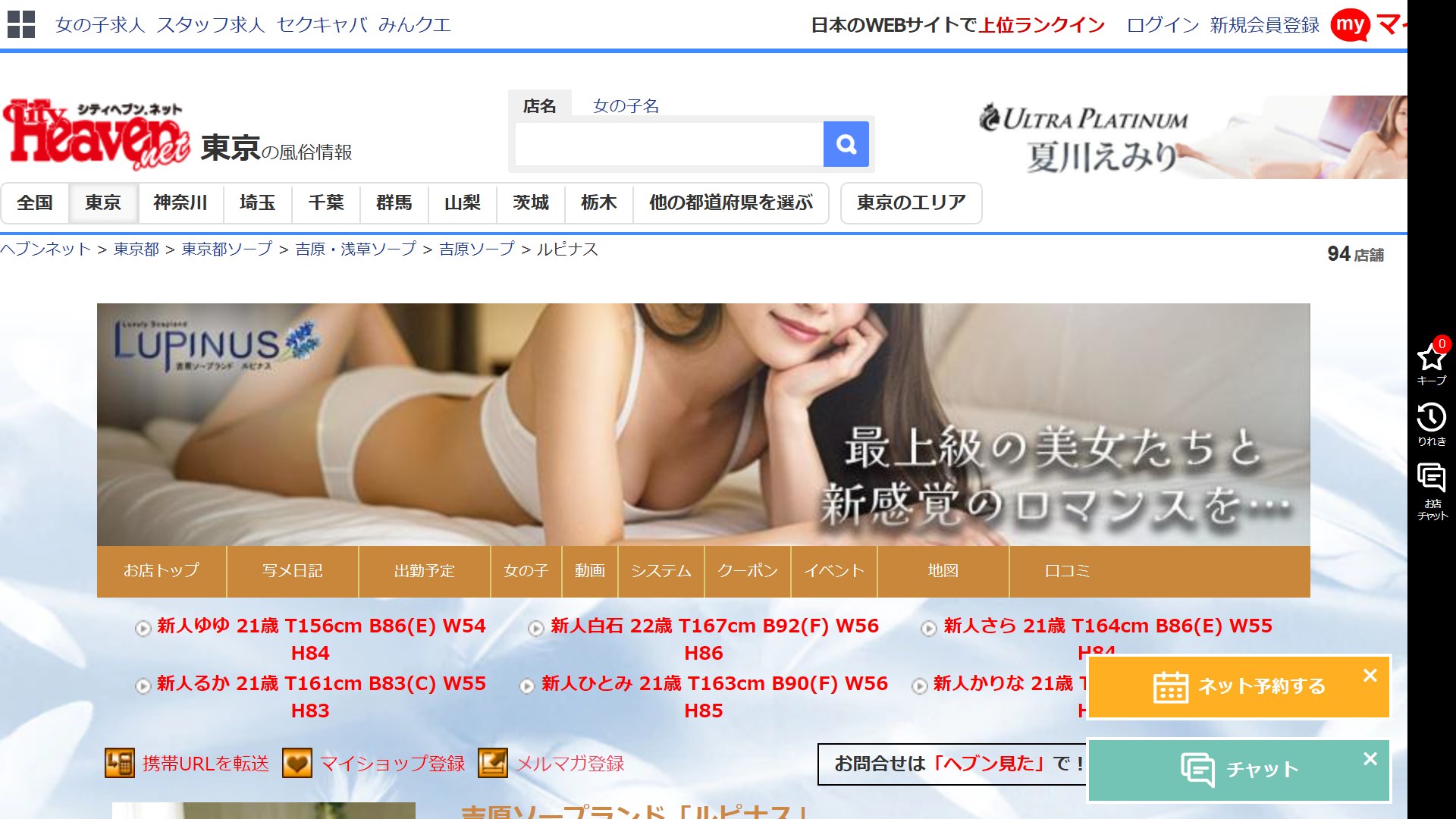

I went at this one backwards. Normally you read the price board, then the roster, then the reviews, and you build a picture from the money outward. With Lupinus I read the roster first, because the roster is so strange that nothing else makes sense until you account for it.
Here's what's on it. Fourteen-odd names on the front page of the shop's own site, ages 20 to 23, and the pitch on nearly every one contains the same word: mikeiken. Untrained. Never done it. One is described as a complete amateur who has steeled herself for her first attempt. Another as a total beginner making her debut. Two more are scheduled to debut tomorrow and the day after, and the shop has published their heights, their measurements and their debut dates while openly stating that their photographs aren't ready yet. The house is taking bookings on women it has not finished photographing.
Now hold that against the other half of the sentence. This is a house that describes itself, in its own words, as the top-tier koibito-kei concept — a luxury super-high-class soapland offering Yoshiwara's most lavish hospitality. Top of the market. Staffed, deliberately, by people on day one.
The Recruiting Page Explains the Whole Business
Most shops tell you what they sell. Very few tell you how they make it, and the place they accidentally tell you is the jobs page, because that one is written for a different audience and nobody edits it for tone.
Lupinus's reads: an all-amateur shop, a rarity among high-end houses — and then comes the sentence that does all the work. There's no difficult training to get through, because the service content is deliberately soft and hygienic, structured so a civilian can start smoothly on her first day. It adds that every deduction from pay under the heading of "expenses" has been abolished, photography included, and that it costs a woman nothing to start.
Read that as an operations document rather than an ad and the shop snaps into focus. They did not hire beginners and then hope. They removed the skill requirement from the product. The service spec was designed downward until the training step could be deleted, and what got put in its place is novelty — the specific, unrepeatable quality of somebody doing this for the first time. That's a coherent thing to sell. It is also, and this is the part I find genuinely interesting, a product that destroys itself in use.
Which Is Why There Are 131 Names and 13 of Them Working
The listing on Fuzoku Japan puts the roster at 131 women. Today's shift board: 13. Roughly one in ten.
At most businesses that ratio would be a red flag — a padded book, ghost entries, women who quit and never got deleted. Here it's the arithmetic working exactly as designed. If your inventory is first-ness, every booking consumes a unit permanently, so you need an enormous bench and each woman has to work rarely. The shop says so out loud on one profile: her working days are limited, so anyone who finds her is lucky. That isn't scarcity theatre bolted onto an ordinary schedule. That's the schedule the model requires.
The proof sits on the individual schedule pages, and it's the best piece of disclosure this shop does. Each woman's dates run back weeks, and the sold-out ones aren't quietly removed — they're printed, in order, reading "reservations full, thank you" straight down the page. One woman's entry lists seven consecutive August dates, all full. Another shows nine across September. It's a public ledger of demand, and it doubles as a warning: the correct reading of "1 slot remaining" on this board isn't marketing pressure, it's a stock level.
The 30,000 Yen That Isn't the Price
Now the money — and be careful here, because the shop is not, technically, telling you anything untrue.
The cheapest figure published anywhere is a bathing fee of ¥30,000 for 120 minutes, and both halves of that matter. It's a bathing fee, which in this trade is one component and not the bill; and the entry-level course is two hours, not the forty or fifty minutes a budget house sells. There is no cheap door. The smallest thing you can buy here is already large.
Then look at what customers report actually spending. Fuzoku Japan sorts its reviews into budget bands, and on this shop the distribution isn't a spread. It's a single bar. One hundred percent of reviewers fall in the ¥50,000-and-above bracket. Every band beneath it — the ¥30,000s, the ¥40,000s — reads zero.
So the honest translation of the price board is: the published floor is a floor nobody has stood on. Budget the top band. Cards are accepted. And note a small, easily-missed line in the shop data — receipts are not issued. Nothing sinister about it, but if you were quietly planning to file this somewhere, that door is shut before you walk in.
One more wrinkle worth knowing. Cityheaven lists the shop's phone as 03-5808-7856 and tells you to mention you saw it there; Fuzoku Japan lists 03-5808-7857 and tells you to mention you saw it there. Two numbers, one shop, one digit apart. They're attribution lines — the house is measuring which listing sent you. Harmless, but it means the number you dial should match the page you read, and if you're comparing listings and find two different numbers, you haven't found a mistake.
The Front Desk Is Doing the Heavy Lifting
If your cast is deliberately untrained, every ounce of reliability has to come from somewhere else. At Lupinus it comes from the process, and the reviews describe that process with unusual consistency — the same choreography, from different men, across five months of 2025.
It runs: confirmation call one hour before, required even of regulars who arranged the booking with the woman directly. Arrive ten minutes early, which staff tell you explicitly on that call. Into a waiting room — one reviewer notes a large aquarium in the corridor on the way — where you're given a drink, plus an energy drink, your photo confirmation is done and payment is settled up front. Then roughly five minutes, and you're called. She's waiting at the foot of the stairs, kneeling. She takes your hand and walks you up; the rooms are on the upper floors, one reviewer's on the third.
The aggregate scores say it lands: across 11 reviews, staff response 4.8, wait time a flat 5.0, photo accuracy 5.0. One reviewer, meeting a woman he'd only seen in her diary photos, coined the best phrase in the entire file — "reverse panel magic," better in person than on the page. That's the inverse of this industry's default failure mode, and on an all-beginner roster it's close to inevitable: nobody has had time to accumulate a flattering photo archive yet.
And here's the honest counterweight, because a five-star wall with no cracks in it is a wall I don't trust. Technique averages 4.8, not 5.0 — the lowest number in the set. Pull that thread and you find the dissenter: a 43-year-old first-timer in January 2025 who scored the shop 4.0 overall, liked the woman a great deal, and put technique at 3.0 and staff at 3.0. That is precisely the risk you are buying. You cannot make inexperience your headline feature and then guarantee polish. The occasional 3 isn't the model failing. It's the model.
The Access Line Two Sources Disagree About
Practical, and worth more than it sounds. The shop sits at Senzoku 4-41-14 in Taito-ku, about six minutes by car from Minowa on the Hibiya line, open 9:00 to 24:00, every day of the year, with no closing day.
The listing states that the shop runs pickups from six stations — JR Ueno, Nippori and Minami-Senju, Hibiya-line Minowa, Tobu Asakusa and Ginza-line Tawaramachi. Three separate reviewers say there wasn't one. "There's no shop pickup, so I went by taxi." "No pickup; they tell you to arrive about ten minutes beforehand." A third says outright that a pickup car would have made the visit perfect. I can't reconcile that from a desk and I won't pretend otherwise. What I'd do is treat the pickup as unconfirmed, budget a cab from Minowa or Uguisudani, and if it matters to your plan, ask on the confirmation call — which you're making anyway, one hour out, because the shop requires it.
The Verdict
- Clarity of concept: ★★★★★ — an all-beginner roster at the top of the price ladder, plus a recruiting page that explains exactly how they made it possible. Very few shops are this legible.
- Price transparency: ★★☆☆☆ — the ¥30,000 headline is a 120-minute bathing fee, not a bill, and 100% of reviewers land above ¥50,000. Technically true, practically misleading.
- Roster disclosure: ★★★★★ — 131 names, published ages and shift windows, and a sold-out ledger running back weeks that most houses would quietly delete.
- Front of house: ★★★★★ — confirmation call, ten-minute rule, drink, payment up front, five-minute turnaround. Wait time scores a flat 5.0 across the file for a reason.
- Consistency of service: ★★★☆☆ — technique is the weakest average and there's a 3.0 sitting in the file. Inherent to a beginner roster, not a lapse.
- Access: ★★★☆☆ — six minutes by car from Minowa, and a pickup service the listing promises and the reviews don't corroborate.
- Going back: ○ — with the top band budgeted, a specific name booked days ahead, and zero expectation of a discount, because there isn't one.
What I keep circling back to isn't the price or the gloss on the website. It's that Lupinus has built an entire luxury operation on the one resource that cannot be renewed, stockpiled or improved — and then arranged everything else around that fact. Hundreds of names on the book so the bench never runs dry. Limited shift days so nobody burns through her own selling point. No coupons, because you don't discount a queue. A soft, training-free service spec so a civilian can start on day one without a disaster. A front desk drilled to five-star smoothness precisely because the person upstairs is brand new. Every one of those choices looks eccentric on its own and obvious in sequence. Whether you want to buy somebody's first day at full freight is a separate question, and an entirely personal one. But I'll give the house this much: it isn't hiding what it sells. It's advertising it in bold.