
9:00 to 24:00, and why those two numbers are the entire business plan
池袋人妻アデージョ — Ikebukuro Hitozuma Adejo — works the east side of Ikebukuro, in Toshima ward, and sells itself as a 人妻専門店: a married-woman specialist. It puts the thesis on the sign without much decoration. 艶やかな大人の女性との運命の出逢い. A fated meeting with a poised adult woman. The line that follows it — 本気で感じ、本気で濡れる — is considerably blunter than the poetry in front of it, and I'd argue the two halves stapled together are an honest summary of the whole genre.
Hours are 9:00 to 24:00. The number is 03-3988-8859. I called at 10:20 on a Tuesday.
That fifteen-hour window is the most informative thing on the page, and nobody reads operating hours as strategy. A shop staffed exclusively by women in their thirties, marketed on the married-woman premise, structurally cannot run a 3 a.m. shift — because the women who make that premise credible are not available at 3 a.m. They're available between the moment a household empties out in the morning and the hour it fills back up. Adejo's clock is drawn around exactly that, and the midnight close is the tell: the shop would rather forfeit the entire drunk-at-one-in-the-morning market than staff it with people who don't fit the concept.
The practical consequence for you is the inverse of my usual advice. The board is at its deepest before dinner, not after it. This is one of the rare Tokyo shops where calling at eleven in the morning gets you a better roster than calling at eleven at night. I have spent years telling men to phone late for an honest read on a place. Here that flips completely.
The price ladder, which quietly refuses to reward you for staying
Adejo's board reads clean. Entry is free. The courses:
| Course | Price | Per minute |
|---|---|---|
| 55 min | ¥12,000 | ¥218 |
| 65 min | ¥13,500 | ¥208 |
| 80 min | ¥17,000 | ¥213 |
| 100 min | ¥21,500 | ¥215 |
| 120 min | ¥26,500 | ¥221 |
| +20 min extension | ¥5,000 | ¥250 |
Run the arithmetic and something unusual falls out. In most of this industry the per-minute rate drops as you climb — that's the entire reason long courses exist, and it's the lever a desk uses to talk you up from sixty minutes to ninety. Adejo's curve is nearly flat, and at the top it turns back up. The cheapest minute on the board is the 65-minute course at about ¥208, and the most expensive course minute is the 120 at roughly ¥221.
So the shop isn't selling duration at a discount. It's selling duration at cost plus a little, all the way up the ladder. That tells you how the house thinks: it does not regard a two-hour booking as a favor you're doing it. Two hours of a woman's shift is two hours, and the price says so out loud.
The extension is where the only real premium sits — ¥5,000 for twenty minutes, ¥250 a minute. But notice where that lands. It's precisely the marginal rate of the 100→120 step, which is also ¥5,000 for twenty minutes. At most shops the extension is a punishment rate engineered to make you regret not booking longer up front; I've written that complaint into a dozen of these pieces. Here it's priced at the top of the shop's own curve and not a yen above it. That's a genuinely fair extension, and it isn't a sentence I get to type often.
The read: if you're new, take 65 minutes. It's the value floor of the board and the shortest course that doesn't feel like a stopwatch. If it's going well, twenty more minutes cost you the same rate the two-hour customer is already paying. There is no trap in this ladder.
Two coupons, and two different "regular prices" on the same page
Here's where I want you to slow down, because it's the one place the shop's paperwork contradicts itself.
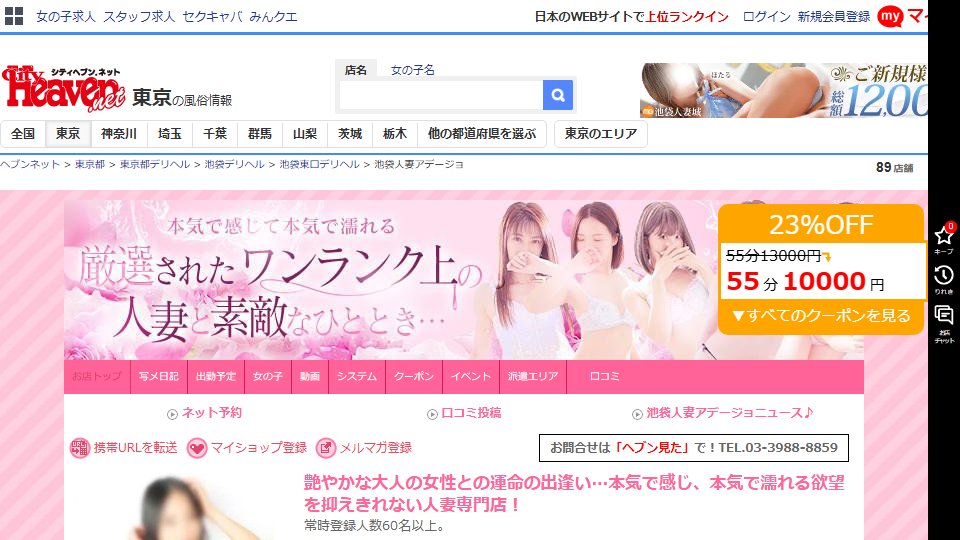
Adejo runs two discounts. There's a Heaven-limited event advertised as 80 minutes, normally ¥18,000, offered at ¥16,000. And there's a 23% off banner reading 55 minutes ¥13,000 → ¥10,000.
Now put those next to the price list above. The price list says 80 minutes is ¥17,000 and 55 minutes is ¥12,000. The coupon copy says the "regular" prices are ¥18,000 and ¥13,000 — a thousand yen higher in both cases. The 23% figure, incidentally, only works off ¥13,000; measured against the ¥12,000 on the price table, ¥10,000 is a 17% cut.
I'm not going to call that a scam, because it isn't one. Two banners on a Cityheaven page drift out of sync with a price table constantly — campaign art gets written once and the board gets updated later, and the discounted numbers themselves (¥16,000 and ¥10,000) are the ones that actually matter. ¥10,000 for 55 minutes is a real and aggressive entry price for a thirties-only specialist shop in Ikebukuro, whichever "before" price you measure it from.
But it changes what you say on the phone. Don't ask "do you have a discount." Say the number: fifty-five minutes at ten thousand, is that available today. Name the course and the price you read, and the desk either confirms it or tells you the condition you missed. Never let a coupon exist as a vague hope. Make it a figure somebody agrees to before a woman is dispatched.
¥1,000 to choose, and what that does to a 60-woman board
The designation structure at Adejo is unusually cheap, and it has a knock-on effect most men don't think through.
- Entry fee: free
- Net designation (ネット指名): ¥1,000
- Direct designation (本指名): ¥2,000
- Hotel: from ¥3,100
A thousand yen to pick a specific woman off the board. Against a ¥13,500 course that's under 8% — a rounding error, functionally free. Compare it to the shops that charge ¥3,000 or ¥5,000 to designate and you can see two completely different philosophies of how a customer should behave.
When designation is expensive, the house is steering you toward お任せ — let us choose — because that's how a desk balances a roster and keeps the less-requested women working. When designation is a thousand yen, the shop is telling you it would rather you looked at the board and picked. With 60-plus women registered, all of them in their thirties, that's the correct call: a roster that deep is worthless if the pricing discourages you from using it.
The ¥2,000 direct designation is the second half of the same thought. Doubling the fee to request a woman you've already met is standard, and at this level it's still cheap enough that becoming a regular carries almost no toll. Some shops price 本指名 high enough that loyalty is a subscription. Adejo prices it like a handshake.
Options are similarly restrained: an electric massager at ¥2,000, lingerie, pantyhose or a bodystocking at ¥1,000–¥1,500, an onahole at ¥1,000. That's the whole paid menu. When a shop's option list is four cheap items and nothing else, it means the service itself is in the course price and the house isn't running a side business selling you back the experience piece by piece. Long option lists are a warning sign. This one is a shrug, and I mean that kindly.
What isn't printed, and therefore has to be asked
I want to be straight about the limits of what the page tells you, because the gaps here are the ones that cost money.
Transport fee isn't stated. The hotel figure — from ¥3,100 — covers a room in the Ikebukuro east dispatch area, not the ride. Whether a call to a hotel further out carries a dispatch charge is not something the page answers, and I won't invent it.
Cancellation policy isn't stated. Payment methods and any card surcharge aren't stated. Both of those are routine at Japanese delivery health, and both of them are routinely where a first-timer gets surprised at the door with a number he didn't budget for.
So the phone call has four questions in it, not one: the course and price you want confirmed, the total including hotel, whether cash is required, and what happens if you cancel. Sixty seconds. I asked all four on the Tuesday morning call and got four direct answers from a desk that had clearly been asked before. A shop that answers those crisply at 10:20 a.m. is a shop with its systems in order; one that gets vague on the third question is telling you something you should listen to.
I took 80 minutes, hotel dispatch, east side, and gave him the room.
The door, and what "hitozuma" is actually a claim about
Twenty years in, my position on married-woman shops is unromantic. 人妻 is not a claim about marital status. It's a claim about register — about a woman who walks into a hotel room like an adult with a life outside it, rather than like someone performing availability. Whether there's a ring in her bag is nobody's business and mostly beside the point.
The counterfeit version is easy to spot and extremely common. It's a woman in her twenties dressed in a costume idea of domesticity, running a script about her husband, and the whole thing has the texture of a stage play performed for an audience of one who has been told in advance what he's supposed to feel. It's not offensive. It's just thin, and it evaporates in the first ninety seconds.
What came through the door on a Tuesday before noon was not that. Comfortably inside the shop's stated thirties band, dressed like a woman running errands in Ikebukuro rather than like a genre. She said the shop's name and her own at the door, asked about the air conditioning, took her time with her coat, and spent the opening minutes on the fantastically ordinary subject of the east exit construction and how long it had taken her to get across it.
That's the whole thing, right there. Adult conversation as the default setting, not as a service module deployed at minute five. You cannot train it and you cannot fake it at eleven in the morning, when nobody has had a drink and there's nothing in the room to hide behind.
Eighty minutes, and the strange calm of a daytime booking
The thing I didn't anticipate — the reason this one gets written up instead of filed — is how differently the hour itself ran.
An evening booking in this bracket has a metronome underneath it. Everyone can hear the schedule: the desk has calls stacked, she has somewhere to be at nine, and if you're paying attention you're quietly aware of the appointment behind yours. It's not rushed, exactly. It's just timed, and you can feel it.
Late morning had none of that. The city outside was in the middle of an ordinary working day, which somehow put the room at a lower temperature in the good sense. Nothing about the eighty minutes felt like it was borrowed from anything. The conversation at the front didn't get folded up and put away to make room for logistics, and the conversation at the end — which is the part almost every shop treats as dead time while the customer showers — kept going until the clock actually mattered.
The counterweight, and I'll state it plainly: a daytime booking is not the value play. The 55-minute coupon at ¥10,000 is the cheapest door into this shop, and 55 minutes is a short course that pushes you straight through the sequence. If what you want from a hitozuma shop is the unhurried part — and I'd argue the unhurried part is the product — you need 80 minutes minimum, and you should decide that on the phone rather than at minute sixty. The extension is priced fairly, but the fair price of twenty more minutes is still ¥5,000 you could have spent more efficiently by choosing correctly at the start.
The fine print, which has actual teeth
Adejo's house rules are the standard set, delivered with unusual force. No minors. No violence, no coercion, no recording, no drugs, no organized-crime affiliation. And then the enforcement line, which most shops leave implied: violations carry a stated ¥1,000,000 penalty and a call to the police.
I like seeing that written down. Not because I expect the figure to be litigated, but because a shop that publishes a number for the worst-case behavior is a shop that has thought about the worst case and decided how it will respond. The alternative — vague language about "appropriate measures" — leaves the women working there with nothing behind them but a manager's mood on the day.
The reverse-side reading matters too. This is a shop that will be equally firm about its own terms with you. Don't expect flexibility on a same-day cancellation just because you were polite about it. Ask the policy before you book, not after you've changed your mind.
The verdict
| Item | Rating |
|---|---|
| Coherence of the 9:00–24:00 concept | ★★★★★ |
| Fairness of the price ladder | ★★★★★ |
| Extension pricing (¥250/min, no penalty rate) | ★★★★★ |
| Cost of using the board (¥1,000 net designation) | ★★★★★ |
| Clarity of published terms (transport, cancel, card) | ★★☆☆☆ |
| Consistency between coupon copy and price table | ★★★☆☆ |
| Whether "hitozuma" survives daylight | ★★★★☆ |
| Value of the ¥10,000 55-minute entry coupon | ★★★★☆ |
Ikebukuro Hitozuma Adejo is a shop that has made one large decision and then honored it everywhere else. It picked a demographic — women in their thirties, sixty-plus of them, and nobody else — and then built the hours, the designation fees and the price curve around what that demographic can actually sustain. The nine-in-the-morning open isn't a gimmick, the flat ladder isn't an accident, and the thousand-yen designation fee is what a shop charges when it genuinely wants you looking at its roster instead of taking whatever's free.
Where I hold stars back is entirely on the paperwork. Transport isn't published, cancellation isn't published, payment terms aren't published, and the coupon banners quote "regular" prices a thousand yen above the shop's own price table. None of that is dishonest, all of it is fixable in a phone call, and all of it puts a small tax on the first-time customer who assumed the page was complete. Read the board, do the per-minute math, take 80 minutes rather than 55, and ask the four questions before anyone gets dispatched. Do that and this is one of the more straightforwardly run rooms on the east side of Ikebukuro.