The Ruling
On Wednesday, September 17, 2026, the Osaka District Court convicted a 35-year-old woman of abandoning the remains of two newborn infants she had delivered alone, and suspended her sentence.
Judge Karashima Akira sentenced Yamaji Satomi, a former employee of an Osaka sex-industry business, to two years and six months' confinement, suspended for three years. Prosecutors had asked for two years and six months without suspension. The court granted the term they requested and then declined to make her serve it.
That is close to the statutory ceiling. Abandonment of a corpse under Article 190 of the Penal Code carries a maximum of three years. The sentence, in other words, reflects a serious view of the offense and an equally serious view of the circumstances that produced it.
| Osaka District Court, September 17, 2026 | |
|---|---|
| Charge | Abandonment of a corpse (Penal Code Art. 190), two counts |
| Defendant | Yamaji Satomi, 35, former sex-industry employee |
| Sentence | 2 years 6 months' confinement, suspended 3 years |
| Prosecution request | 2 years 6 months' confinement |
| Statutory maximum | 3 years |
| Plea | Guilty; facts not contested |
| Presiding judge | Karashima Akira |
What the Court Found
The two births were roughly three years apart.
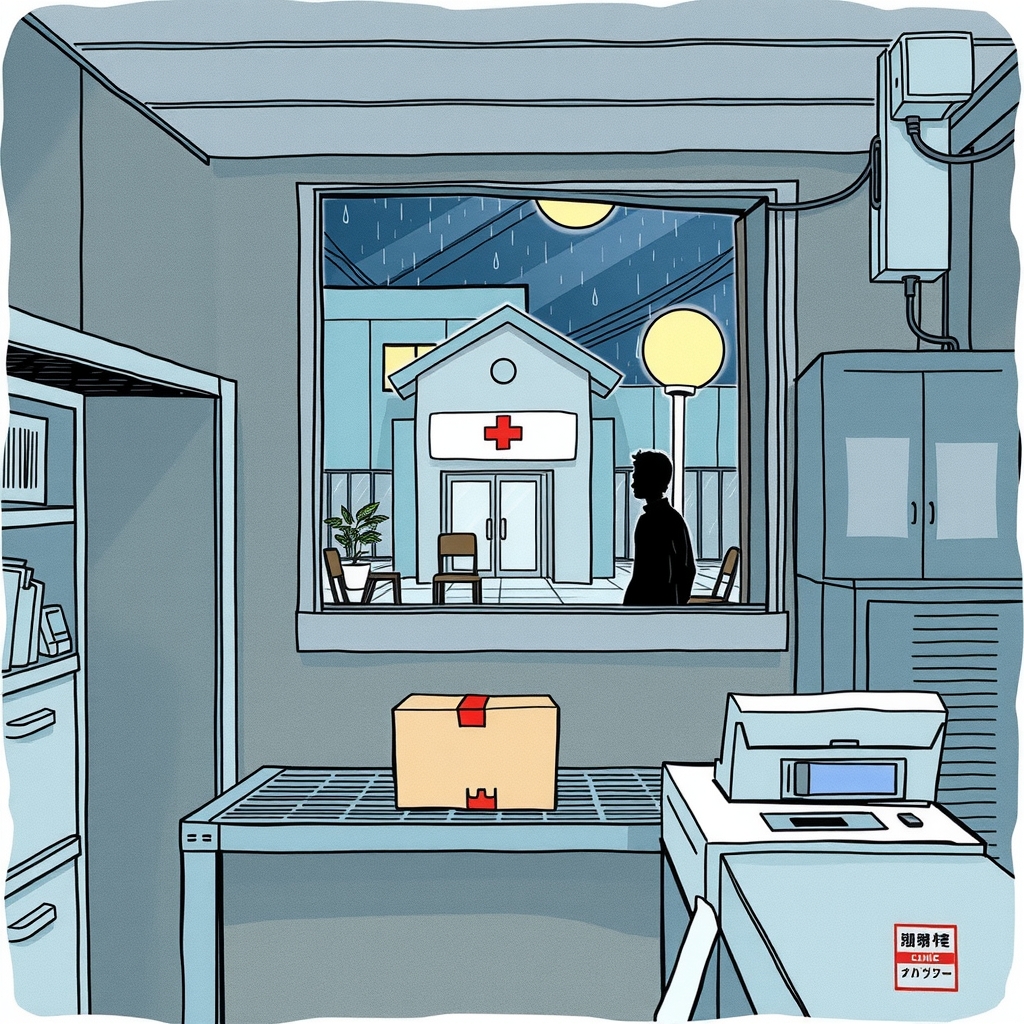
According to the ruling, Yamaji delivered the first infant around 2022 or 2023 and left the body at her home in Osaka's Nishinari Ward. When she moved, the body moved with her. In October 2025 it went into a cardboard box at the office of the sex-industry business where she worked, in Kita Ward, and stayed there until May 12, 2026 — when managers at the office noticed an odor coming from the box and called the police. Officers from the prefectural police's Tenma station found the remains of a newborn wrapped in plastic. An autopsy could not establish a cause of death and found no obvious external injuries. The body had been decomposing for years.
She was re-arrested over that count on June 16, 2026. She had already been indicted for the second: an infant delivered in January 2026, whose body she left at her home in Kita Ward.
Judge Karashima's reasoning was unsparing on the conduct. She had, he said, experienced two unwanted pregnancies and repeated the same abandonment, and had left the bodies to decay. Whatever difficulty she had in confiding in her family, he found, contacting a public agency after the deaths would not have been particularly difficult. There were, he concluded, no mitigating factors in the circumstances under which she committed these crimes.
He suspended the sentence anyway, citing her remorse and the stable household she has returned to. Told from the bench to live quietly from here, she answered, according to reporters in the courtroom, with a single quiet hai — yes.
Why She Did Not Go to a Hospital
The defense case was not that the abandonment was excusable. It was an account of how a woman ends up giving birth twice on her own floor in a city of two and a half million people.
She had no health insurance and no money for a hospital, the defense said, and so she delivered at home both times. She had no one she could trust enough to tell. Asked why she never reported the deaths, she said she did not know how a report was supposed to be made. In her closing statement she said she was sorry and that she could not make them happy.
Prosecutors contested the framing directly. Nothing in the record, they argued, showed her trying to avoid the situation; she had instead repeated the same act while avoiding reality, demonstrating weak regard for legal norms.
The insurance point is the one worth holding onto, because it is checkable and because it is not really about her.
Japan's public health insurance system pays a lump-sum childbirth allowance — ¥500,000 per child since April 2023, raised from ¥420,000 — to anyone enrolled in any public plan. Most hospitals run it through a direct-payment arrangement, so the money goes from the insurer to the maternity ward and the patient pays only the balance. For an ordinary delivery, that transfer covers most or all of the bill. The allowance is also payable for a stillbirth or miscarriage after 85 days of pregnancy.
None of it is available to someone who is not enrolled.
Enrollment in National Health Insurance is compulsory for residents without employer coverage, but it is not automatic: a person has to file at a municipal counter, and the premiums are back-billed from the date eligibility began. Sex-industry workers in Japan are typically engaged as independent contractors rather than employees, which puts them outside employer-based shakai hoken by default and leaves enrollment as something they must initiate themselves, in their own name, at a government window, while owing arrears. Many do not. The court's file records the consequence in one line: no insurance, no money, delivery at home.
The Infrastructure That Exists, and Where
Japan has built a partial answer to isolated childbirth over the past four years. It is thin, and it is in two places.
Confidential birth — naimitsu shussan, in which a woman discloses her identity only to designated hospital staff — has operated at Jikei Hospital in Kumamoto since December 2021. The health and justice ministries issued the first national guidelines covering the practice in September 2022, setting out how hospitals should hold the mother's identifying information and how a child's family register can be created by a municipal mayor. As of this year, 71 women have delivered at Jikei under the arrangement.
A second hospital, San-ikukai in Tokyo's Sumida Ward, began offering it in March 2025. In its first year, through March 31, 2026, seven women used it.
Two hospitals, nationwide. That is the entire system, and neither is in Osaka.
The gap shows up in the mortality data. Of 18 infants who died before reaching one month of age in fiscal 2023, 15 had their bodies abandoned, according to figures compiled by the Children and Families Agency. Specialists have been arguing for a facility in every prefecture. Hasuda Takeshi, the director of Jikei Hospital, has described the pattern he sees repeatedly: women who fear above all that their parents will find out, and who deliver alone rather than risk it. Sato Takuo, who heads the National Pregnancy SOS Network, has pointed to a second group — women for whom the act of asking for help is itself the obstacle.
The Sex-Industry Part
It would be easy to overread the connection here, and the court did not make it. Yamaji's employment was not treated as mitigation and does not appear to have been argued as a cause.
But two facts sit in the record and are not incidental to it. Her stated reason for delivering alone twice was that she was uninsured — a condition that follows predictably from how the industry engages its workforce. And for seven months, the body of her first child was stored in her workplace's office, which is to say that the only place she had to put it was the business she worked for.
Japan spent this year debating how to police the transaction at the center of that industry. A Ministry of Justice panel filed its final report on Thursday recommending that men who solicit sex be made punishable, including online; the cabinet's anti-trafficking Action Plan was agreed in draft the week before. Both documents are about the point of sale. Neither touches the question this verdict raises, which is what happens to a woman inside the industry in the months when she is not working — when she is uninsured, pregnant, and cannot name a single person she can tell.
The Osaka District Court answered the narrow version of that question on Wednesday. Yamaji will not go to prison. The broader version — why the choice available to her was an apartment floor in Nishinari rather than a maternity ward the state would have paid for — was not before the court, and no one has answered it.
Sources: Kyodo News, as carried by the Tokyo Shimbun, the Niigata Nippo, the Kitanippon Shimbun and Daily Sports, for the September 17, 2026 conviction, the sentence of two years and six months' confinement suspended for three years against the prosecution's request for the same term, the defendant's name, age and former employment, the locations and timeline of the two offenses, and Judge Karashima Akira's findings on the repeated pregnancies and the decaying remains; Kansai Television for the defendant's statement that she did not know how a report should be made and for the interval between the two births; MBS News for the prosecution's argument, the defense account of her lack of insurance and money, her statement that she could not make them happy, the judge's finding that contacting a public agency would not have been particularly difficult, and the reasoning behind suspension; Yomiuri Television and ABC News for the court's assessment of remorse and her one-word reply from the dock; the Asahi Shimbun for the movement of the first body from the Nishinari residence to the workplace office; contemporaneous Osaka police reporting for the May 12, 2026 discovery of the remains after office staff reported an odor from a cardboard box, the autopsy finding no determinable cause of death, and the June 16, 2026 re-arrest; the Ministry of Health, Labour and Welfare for the ¥500,000 childbirth lump-sum allowance and the direct-payment arrangement; Jiji Press for the September 2022 ministerial guidelines on confidential birth, the Children and Families Agency finding that 15 of 18 infants who died under one month of age in fiscal 2023 had their bodies abandoned, and the comments of Hasuda Takeshi and Sato Takuo; and the Nihon Keizai Shimbun and the Tokyo Metropolitan Government for the seven confidential births at San-ikukai Hospital in its first year to March 31, 2026. Glossary: naimitsu shussan = confidential birth, in which a pregnant woman's identity is known only to designated hospital staff; kokumin kenko hoken = National Health Insurance, the municipal plan covering residents without employer-based coverage; shakai hoken = employer-based social insurance; kokinkei = the unified "confinement" penalty that replaced imprisonment with and without hard labor on June 1, 2025. Cause of death for both infants was not established, and no charge beyond abandonment of a corpse was brought.