The Verdict
The building in Nishi Ward, Osaka, was searched because of what police believed was inside it: the workings of "Natural," described by investigators as the largest illegal scout organization in Japan, an enterprise that funnels women into sex-industry establishments and takes a cut of what they earn.
On July 29, 2026, the Osaka District Court finished accounting for what the police did once they were inside.
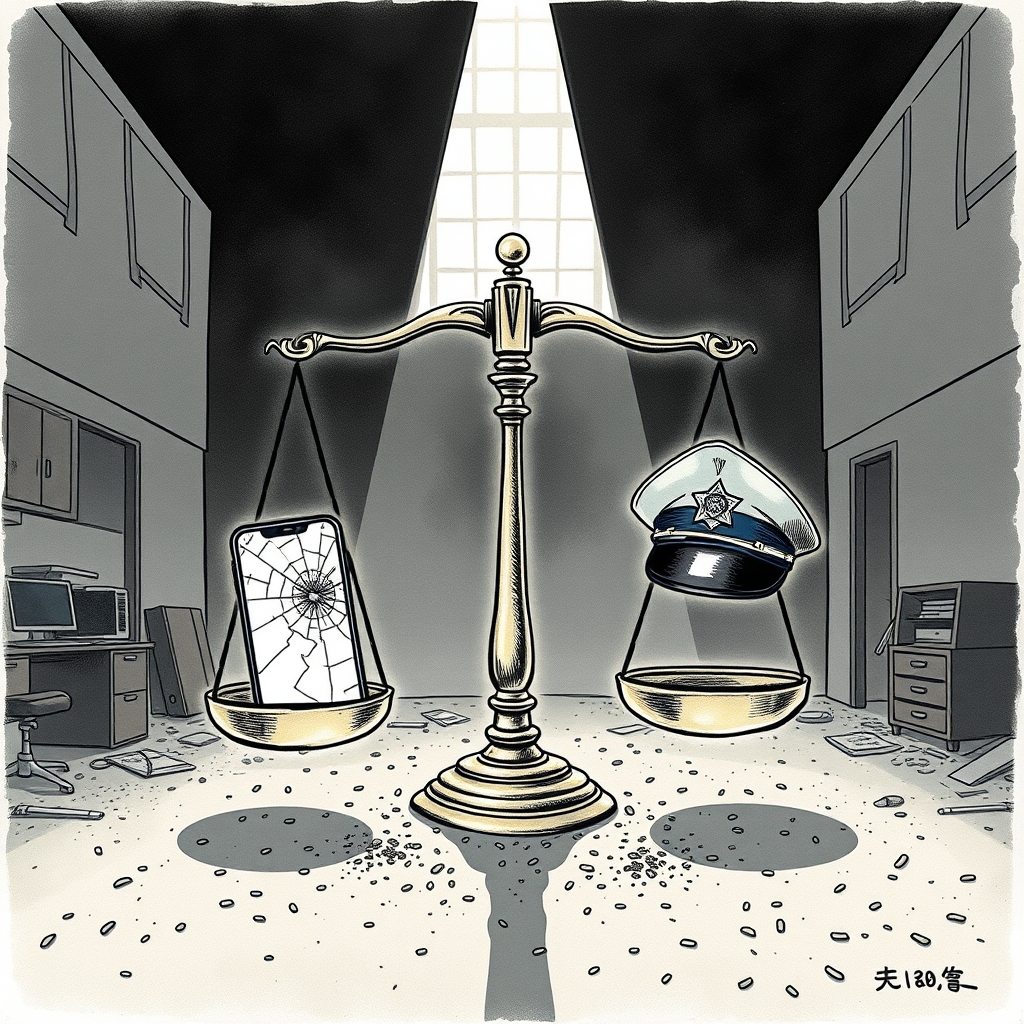
Presiding Judge Mika Araki convicted a 36-year-old former sergeant of the Osaka Prefectural Police's Investigation Division 4 of assault and cruelty by a special public officer, sentencing him to one year's imprisonment, suspended for three years. Prosecutors had sought one year. The verdict was reported by Kyodo News, the Sankei Shimbun, Jiji Press and MBS News.
The finding, as the court set it out: during the search, the defendant took hold of a seized smartphone and tried to get past its lock. The man it belonged to — in his 20s, and a target of the investigation — would not cooperate. Another officer grabbed the man by the hair and pulled. The defendant struck him in the face with the phone, repeatedly.
The defendant had denied any intent to assault. The court rejected that, citing security-camera footage from the premises and the testimony of other investigators who were standing there.
"Conduct that can only be called violence under the guise of investigation," Judge Araki said, "cannot be permitted."
| Detail | As reported |
|---|---|
| Verdict date | July 29, 2026 |
| Court | Osaka District Court, Presiding Judge Mika Araki |
| Defendant | Former sergeant, 36, Osaka Prefectural Police Investigation Division 4 (surname Hitomi, 人見寛大) |
| Charge | Assault and cruelty by a special public officer (Penal Code Art. 195) |
| Sentence | One year's imprisonment, suspended three years |
| Sought by prosecutors | One year's imprisonment |
| Conduct found | Struck a man in his 20s in the face several times with a seized smartphone |
| Date of search | July 15–16, 2025 |
| Location | A building in Nishi Ward, Osaka City |
| Investigation | Premises tied to the scout group "Natural" |
| Key evidence | Security-camera footage; testimony of fellow officers |
| Defendant's status | Six-month suspension; left the force voluntarily in March 2026 |
What Happened Inside
The search ran across July 15 and 16, 2025. Investigation Division 4 — the Osaka force's organized-crime unit — moved on the building as a location connected to Natural.
Six officers assaulted three men who were present, according to the accounts of the case published by Jiji Press. One of the three was injured. The purpose, as prosecutors described it, was consistent across the incidents: the men were being made to give up the passcodes to their phones.
Smartphones are the evidentiary spine of a scout-group case. The referrals, the fee splits, the names of the establishments taking the women — that material lives in messaging apps, and a locked handset in a suspect's pocket is often the difference between a chargeable case and a theory. What the court found on July 29 is that the pressure to open one crossed into the criminal code.
The Statute
The charge is a specific one. Assault and cruelty by a special public officer — Article 195 of the Penal Code — is not ordinary assault. It applies to a defined class of officials: those who perform or assist in judicial, prosecutorial or police duties, and who commit violence or cruelty against a person under their control. The maximum is seven years.
The provision exists because the state hands certain employees a lawful power to seize, restrain and question, and treats abuse of that specific power as its own offense. A police officer who hits a suspect during a search is not charged as a private citizen who hit someone. He is charged with having turned an authority the public granted him into the instrument of the assault — which is close to the language the court used.
The sentences here are kōkin-kei, the unified custodial sentence that replaced Japan's separate penalties of imprisonment with and without labor when the revised Penal Code took effect in June 2025.
Six Charged, Six Convicted
All six officers were charged. This verdict was the last of them.
Two were arrested and indicted: a former assistant inspector, Chikara Tsutanaga, 51, and a former sergeant, Yusuke Sakaguchi, 33. On January 26, 2026, the Osaka District Court convicted both — two years for Tsutanaga, two and a half years for Sakaguchi, each suspended for three years. The court in that case said public confidence in police searches had been badly damaged and described the officers' conduct as rough in character, causing significant physical and mental suffering. Both had already been dismissed from the force, a fact the court weighed in suspending the terms.
The remaining four, including the defendant sentenced on July 29, were indicted without being taken into custody. Each received a six-month suspension internally. This defendant left the force voluntarily in March 2026, according to the Sankei Shimbun.
The administrative reckoning ran wider than the courtroom. On January 23, 2026, Jiji Press reported that the Osaka Prefectural Police punished 35 people over the case: 12 formal disciplinary actions — the two dismissals and the six-month suspensions among them — and 23 internal measures. Those 23 included the officials who had held the posts of criminal investigation department chief and Division 4 chief at the time, cited for supervisory failure.
The Court's Second Finding
Judge Araki did not stop at the individual.
The bench observed that the unit contained a large number of inexperienced officers, and that in a large-scale search staffed by many personnel, an atmosphere took hold in which excessive conduct was difficult to check. Internal guidance, the court said, could have reduced the problem.
That is a finding about an organization, delivered in a case against one man, and it echoes what the prefectural police themselves conceded in January: a gap between command and the investigators on the floor, and insufficient supervision at the scene.
Why It Matters to This Beat
Natural sits at the center of the largest sex-industry enforcement campaign now running in Japan. Investigators describe an organization numbering in the low thousands with annual revenue estimated at no less than ¥5 billion, recruiting women in entertainment districts and placing them into establishments across multiple prefectures. Police in Tokyo and Chiba have spent 2026 taking its leadership apart in stages — brokering charges under the Employment Security Act, then the money, then brokering again — with the chairman and the group's No. 2 re-arrested as recently as July 7.
That campaign depends on two things it cannot afford to lose: the evidence pulled off devices, and the credibility of the people pulling it. A raid that produces both a case file and six criminal convictions of the officers who executed it damages the second, and hands defense counsel a line of attack on the first.
The court's language on July 29 was aimed at a single sergeant with a phone in his hand. Its second finding was aimed at whatever it was in that building, that night, that made six officers think this was how the job is done.
This article is compiled from July 29, 2026 reporting by Kyodo News (distributed via the Kanagawa Shimbun and Hokkaido Shimbun), the Sankei Shimbun, Jiji Press and MBS News on the Osaka District Court's verdict against a former Osaka Prefectural Police sergeant. Details of the July 15–16, 2025 search, the January 26, 2026 convictions of two other former officers, and the January 23, 2026 disciplinary actions against 35 personnel are drawn from Jiji Press and Nikkei reporting. Background on the scout group "Natural" — its estimated scale, revenue and the 2026 arrests of its leadership — is drawn from this site's prior reporting on Metropolitan Police Department and Chiba Prefectural Police announcements. The defendant sentenced on July 29 is identified in Japanese reporting as 人見寛大, 36; the romanized reading of his given name is uncertain in English and is not given here. The convictions described are those of the trial court; appeal rights had not been reported at the time of writing. Legal glosses: assault and cruelty by a special public officer = Penal Code Art. 195, applying to officials engaged in judicial, prosecutorial or police duties, maximum seven years; kōkin-kei = the unified custodial sentence in force since June 2025; Employment Security Act = shokugyō anteihō, the statute barring placement of workers into occupations harmful to public health or morals, the principal charge used against scout groups.