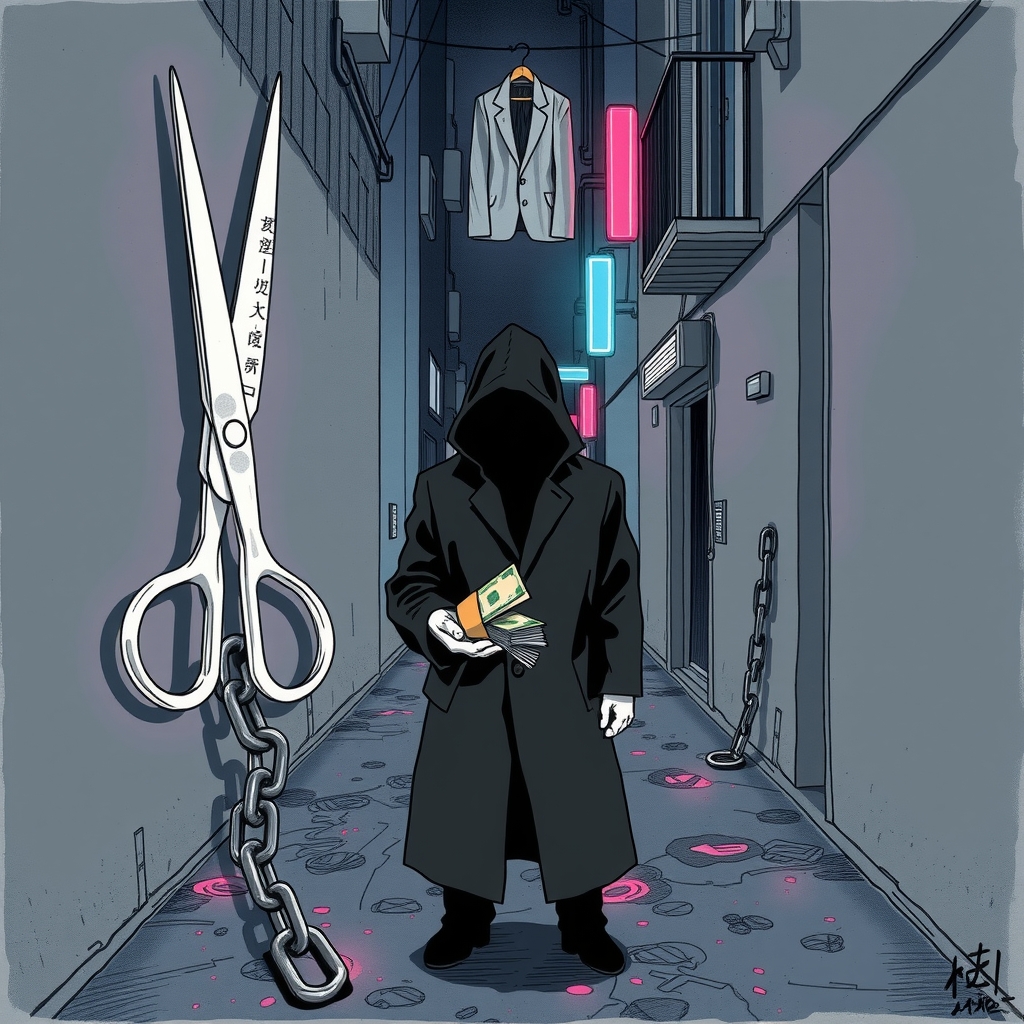
A Ban That Raised the Price
Japan outlawed the recruiter's kickback in June 2025. Fifteen months later, operators in the sex trade say the kickback costs more than it did before the ban.
That is the claim at the center of reporting published on September 11, 2026 by FRIDAY Digital, in an article by Ikoma Akira, and echoed the same day in an independent analysis by Kanten Kantaro on coki, a Japanese business-and-society outlet. Neither is a police announcement, and the figures come from industry operators rather than from the state. But the two accounts converge on the same structure, and what they describe is a textbook case of a prohibition rearranging a market rather than closing it.
The practice at issue is the scout-back — sukauto bakku — the fee a sex business pays a street or online recruiter for delivering a woman to work there. Under the revised fūei-hō, the Businesses Affecting Public Morals Regulation Act, paying it is now an offense.
According to the industry sources FRIDAY spoke to, the going rate was roughly 15 percent of a woman's monthly earnings before the ban. It is now near 20 percent. In absolute terms, operators put the payment at 30,000 to 50,000 yen a month per woman, and around 100,000 yen a month for a high earner. The payment is not one-time. Under what the trade calls the permanent-back system, it continues for as long as the woman stays at the shop.
| The mechanism | As described |
|---|---|
| What a scout-back is | A referral fee paid by a sex business to a recruiter for supplying a worker |
| Legal status | Prohibited under the revised fūei-hō, in force June 28, 2025 |
| Rate before the ban | About 15 percent of the woman's monthly earnings |
| Rate now | Near 20 percent |
| Typical monthly payment | 30,000–50,000 yen per woman; about 100,000 yen for a top earner |
| Duration | Continues as long as the woman remains employed |
| Payment form | Cash, per FRIDAY's sources — leaving little financial trail |
Why the Ban Was Written
The prohibition was not arbitrary. It was written to break a specific chain.
The chain ran from host clubs to sex shops. A young woman runs up a tab at a host club under the urikake credit system; the debt becomes unpayable; a recruiter appears with a solution; she is placed in a sex business; the recruiter collects a percentage of her earnings indefinitely. Because the recruiter's income depended on her continuing to work, the recruiter had a durable financial interest in keeping her there. The scout-back was the hinge of that machine, and the legislature went after the hinge.
The bill moved fast and drew no opposition. It was submitted by the Cabinet on March 7, 2025, passed the House of Councillors on April 9 and the House of Representatives on May 20, both unanimously, and was promulgated on May 28, 2025. It took effect on June 28, 2025. Coki traces its origin to a five-member expert panel on malicious host clubs convened on July 31, 2024 and chaired by Yamada Hiroshi, professor emeritus at Hitotsubashi University.
The same amendment raised penalties sharply elsewhere in the statute. Unlicensed operation went from a ceiling of two years' imprisonment or a 2 million yen fine to five years or 10 million yen for an individual, and from 2 million yen to 300 million yen for a corporation.
The Vacuum and Who Filled It
The mechanism FRIDAY's sources describe is straightforward, and it is the oldest result in regulatory economics: when a prohibited transaction still has demand behind it, the law does not eliminate the supplier — it selects for the supplier least deterred by law.
Established scouting companies, the ones with offices and registrations and something to lose, stopped referring women to sex businesses rather than risk enforcement. Demand did not stop. Shops still needed workers, and a shop without women closes.
What moved into the gap, according to FRIDAY, were tokuryū groups — tokumei ryūdō-gata hanzai gurūpu, the "anonymous, fluid" criminal networks that recruit disposable participants online and leave no fixed organizational trace for police to seize. The named examples are familiar ones: Natural and Access, both targets of major police operations, with Tokyo investigators having pursued Natural's leadership through a chain of arrests running into 2026.
The bargaining positions inverted. Under the old arrangement, recruiters competed to place women at shops. Now, FRIDAY's sources say, shops depend on the remaining recruiters — and the remaining recruiters are the illegal ones. Operators told the magazine that in Tokyo, more than half of shops maintain a relationship with a tokuryū group, and that in Osaka, nearly all shops outside the major chains do. Some groups have begun charging additional sums billed as advisory fees.
One executive at a large national chain put the complaint bluntly to FRIDAY: the law was changed, so enforce it — what are the police doing?
It is worth being precise about whose grievance this is. The operators quoted are not disinterested reformers. They are buyers in a labor market complaining that their input costs rose, and their preferred remedy is more aggressive policing of their suppliers. That does not make their price data wrong. It does mean the story they tell is about margins, and the women whose earnings are being skimmed at 20 percent instead of 15 are not the ones being quoted.
Enforcement Has Been Thin
The structural problem for police is evidentiary. Scout-back payments are made in cash. There is no invoice, no transfer record, no counterparty statement. FRIDAY reports that most cases surface not through financial investigation but through a complaint from a woman — which means enforcement depends on the willingness of the person with the least power in the arrangement to walk into a police station.
The public record of enforcement is correspondingly thin. Tokyo's first administrative penalty for a scout-back payment came a full year after the ban: in June 2026, the Metropolitan Public Safety Commission ordered a 120-day business suspension against an Ikebukuro sex-entertainment shop whose employees had paid a recruiter for referring a woman. That it was reported as a first, twelve months in, is itself the measure.
The broader enforcement picture from the National Police Agency — in its annual report on adult-business policing, published in April 2026 and covering calendar 2025 — shows a licensed sector shrinking and enforcement volume falling with it.
| National totals | 2021 | 2025 |
|---|---|---|
| Fūei-hō violations, all types (cases) | 936 | 662 |
| — Unlicensed operation (cases) | 148 | 170 |
| — Prohibited-area operation (cases) | 167 | 118 |
| Premises-based sex businesses on file | 7,215 | 6,474 |
| Delivery-type sex businesses on file | 22,021 | 22,792 |
The one line that rose is unlicensed operation — businesses police say never entered the regulatory system at all. That is the same direction of travel the scout-back reporting describes: activity moving from the part of the industry that files paperwork to the part that does not.
The Warning Is in the Record
What makes this more than an industry gripe is that the failure mode was named in the Diet before the vote, by members who then voted for the bill anyway.
Coki reviewed the record of the House of Representatives Cabinet Committee session of May 16, 2025, four days before the chamber passed the bill. It reports that Itō Nobuhisa of the Japan Innovation Party warned that vulnerable young women and the economically precarious would be pushed further underground by the ban; that Ogata Rintarō pressed for a commitment to review the regulation once its effects were visible, and supported the bill only after the government indicated it would revise flexibly in light of conditions after implementation; and that Sakai Manabu, then chair of the National Public Safety Commission, undertook to monitor the situation with relevant agencies without committing to a timetable.
Fifteen months on, no such review has been announced.
Coki also gathers outside criticism. Usami Noriya, a former Ministry of Economy, Trade and Industry official, argues that regulating a market without addressing the demand behind it drives the trade underground and routes its money to criminal organizations. Kurushita Yoshiyuki, a former Tokyo Metropolitan Assembly member, contends that legislators prioritized the appearance of action over consultation with the people the rule would actually govern.
Those are contested political judgments, not findings. The unanimous votes in both chambers reflected a real and documented harm — women buried in host-club debt and funneled into sex work by recruiters with a permanent claim on their income. Nothing in the current reporting suggests that harm was imagined.
What Is Actually in Dispute
The open question is narrower than "did the law work." It is whether a prohibition aimed at the payment can hold when the payment is cash, the parties are mutually incriminated, and the only likely complainant is the woman whose debt made her dependent on both sides.
On the available evidence, the ban has removed the compliant intermediaries and left the non-compliant ones with more pricing power. If the operators' numbers are right, the transfer from women's earnings to recruiters is larger now than it was when the transfer was legal — with the difference accruing to groups that are harder to identify, harder to charge, and unreachable by the administrative penalties that the fūei-hō uses on licensed businesses.
The government retains the tool the Diet was promised: a review. The reporting of September 11 is an argument that the conditions triggering one have arrived.
Sources: FRIDAY Digital reporting of September 11, 2026 by Ikoma Akira for the scout-back rate rise from about 15 percent to near 20 percent, the 30,000–50,000 yen and roughly 100,000 yen monthly figures, the permanent-back structure, the withdrawal of established scouting firms, the entry of tokuryū groups including Natural and Access, the Tokyo and Osaka market-penetration estimates, the advisory-fee charges, the cash-only payment practice, the reliance on worker complaints for enforcement, and the quoted national-chain executive; coki reporting of September 11, 2026 by Kanten Kantaro for the July 31, 2024 five-member expert panel chaired by Yamada Hiroshi, the account of the House of Representatives Cabinet Committee session of May 16, 2025 and the statements attributed there to Itō Nobuhisa, Ogata Rintarō and Sakai Manabu, and the criticism from Usami Noriya and Kurushita Yoshiyuki; the House of Councillors bill record for the March 7, 2025 Cabinet submission, the April 9 and May 20, 2025 chamber passages and the May 28, 2025 promulgation; Bloomberg for the May 20, 2025 enactment; the National Police Agency Community Safety Bureau report "Current status of adult-entertainment businesses and enforcement of related offenses in 2025," published April 2026, for all national case counts and notification figures; NHK, TBS NEWS DIG and Yomiuri Shimbun reporting of June 26, 2026 for Tokyo's first scout-back administrative penalty and the 120-day suspension; and published legal analyses of the June 28, 2025 amendment for the revised penalties. Figures on scout-back rates and market penetration are claims by industry operators reported by FRIDAY Digital, not official statistics. Glossary: fūei-hō = the Businesses Affecting Public Morals Regulation Act, which licenses and polices nightlife and adult-entertainment businesses; sukauto bakku = "scout-back," a referral fee paid by a sex business to a recruiter, banned under the 2025 amendment; tokuryū = "anonymous, fluid" criminal groups that recruit members online without a fixed structure; urikake = the credit tab a host club extends to a customer; baishun bōshi-hō = the Anti-Prostitution Act, which penalizes third parties to prostitution rather than the seller or the buyer.