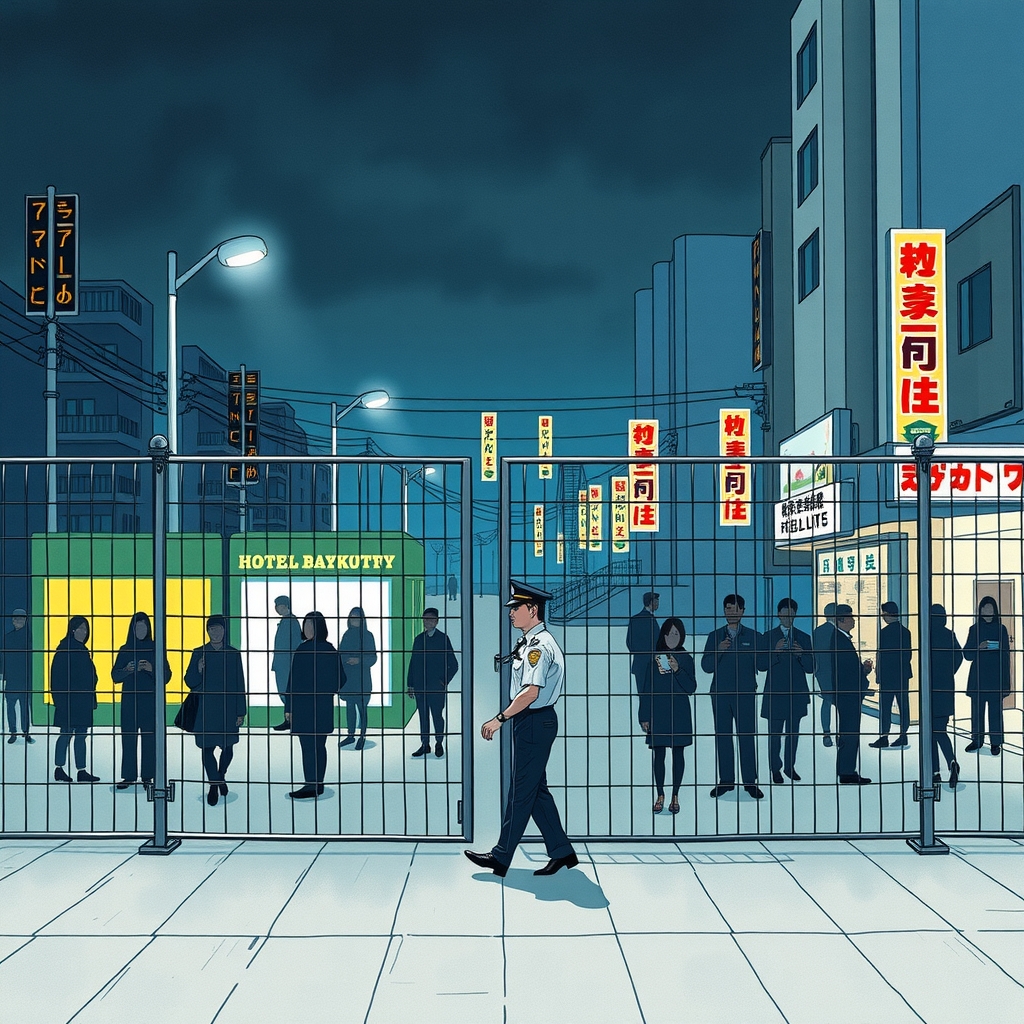
The Corner That Went Quiet
For roughly three years, a strip of pavement beside Okubo Park in Shinjuku Ward served as the most photographed piece of evidence in Japan's argument with itself about prostitution. Women stood along it after dark waiting for paying customers — the practice Japanese calls tachinbo, literally "standing around." Foreign visitors filmed it. Domestic outlets ran it weekly. Politicians cited it.
This week two Japanese outlets went back and reported that it is largely gone.
Shueisha Online published the first installment of a field report on August 14, based on a visit in July. Its reporter described a park area conspicuously quiet compared with previous summers — quiet enough that foreign tourists who had come with cameras, expecting the scene they had watched online, were visibly let down. A staff member at a restaurant near the park told the outlet that two to three years ago roughly 50 women would be standing in the area, and that "for about a year now, I've hardly seen them at all."
A separate field report by Nikkan SPA!, written by Ayo Takanashi, a former adult-video performer turned freelance writer, reached the same finding by a different route. Acting on a tip that the activity had moved, she walked the surrounding blocks and summarized the result in four words: basho o kaeta dake — the location simply changed.
The Numbers Behind the Quiet
Metropolitan Police Department arrest figures for soliciting around Okubo Park, as reported by Shueisha Online, run as follows:
| Period | Arrests for soliciting / waiting for customers |
|---|---|
| 2023 (full year) | 140 |
| 2024 (full year) | 97 |
| 2025 (full year) | 112 |
| Jan–Jun 2024 | 35 |
| Jan–Jun 2025 | 75 |
| Jan–Jun 2026 | about 40 |
The half-year figures for 2024 and 2025 come from Tokyo Shimbun, which reported the January–June 2025 total of 75 as more than double the 35 recorded in the same months of 2024. The January–June 2026 figure of roughly 40 was disclosed by the Metropolitan Police Department on July 6 and carried by NHK and Nippon TV.
Set side by side, the columns tell a more specific story than the annual totals alone. If 75 of 2025's 112 arrests fell in the first half, only about 37 fell in the second — and the roughly 40 recorded in the first half of 2026 is close to half the first-half figure from a year earlier. The enforcement peak appears to have arrived in the first half of 2025, and the drop-off to have begun immediately after it.
The charge in every one of those cases is violation of the Anti-Prostitution Act (baishun boshi-ho), the 1956 statute that criminalizes soliciting or waiting for customers for the purpose of prostitution. It is worth restating what the law does not do: it does not criminalize the act of selling sex itself, it does not criminalize buying, and it reaches brokers and premises providers rather than transactions. Enforcement at Okubo Park therefore has one available target — the person standing on the sidewalk.
Where It Went
Both reports place the trade within a short walk of the park it left.
Shueisha Online found women in hotel entrances, in the area near Okubo Hospital, and in the gaps between buildings. It described the adaptations: sitting inside hotel grounds rather than standing on public pavement, moving frequently, holding a phone and presenting as someone waiting for a friend. Accounts from people who document the district on social media, cited in the same piece, matched — the women are still nearby, but they no longer hold still long enough to be a scene.
Nikkan SPA! found the same pattern at a different set of coordinates: near a batting center, outside boutique hotels, along apartment blocks in central Shinjuku. Takanashi logged the rhythm across an evening. At 4 p.m. there was little to see. After 6 p.m., as the district filled with people coming off work, transactions were plainly under way. After midnight the numbers thinned but did not vanish. Her reporting identifies the smartphone as the organizing instrument — the thing that has replaced standing in a line where a customer can find you.
That last point connects to reporting that predates this week. In April, Japan Today described Kabukicho streetwalkers converging on the rows of streets fronted by the district's love hotels, with customers arranging meetings through X and naming a specific hotel in advance. A worker quoted in that piece put typical monthly earnings around ¥1 million. The pavement in front of Okubo Park was never the market. It was the market's display window, and the display window is what enforcement closed.
The Ward's Account
Shinjuku Ward does not dispute that the women moved, and does not concede that this is all that happened.
Its Crisis Management Division told Shueisha Online that local neighborhood associations, the Metropolitan Police Department, the Tokyo Metropolitan Government and contracted private security all run patrols in the area, that police enforcement has continued on a systematic basis, and that the absolute number of people engaged in street solicitation has fallen compared with two to three years ago. Guards with SECURITY printed across their backs now work the park and the blocks around it — a visible, standing presence rather than a periodic sweep.
The claim is narrower than a declaration of victory and, on the arrest data, defensible. What the ward is asserting is that the total has come down, not merely that it has relocated. What neither the ward nor the police have offered is a count of the hotel doorways.
The Buyers
Shueisha Online followed its August 14 report with a second installment on August 15 examining the other party to the transaction: the men who buy.
That is the half of the exchange Japanese law has never reached, and the reason the Okubo Park enforcement record reads the way it does. A woman standing on the sidewalk commits an offense. The man who approaches her does not, unless she is a minor, in which case the Act on Punishment of Activities Relating to Child Prostitution and Child Pornography applies. Every one of the 140, 97 and 112 arrests in the table above fell on one side of a two-person deal.
A Ministry of Justice study group has been examining whether to introduce penalties for buyers since March 2026. A social-affairs reporter quoted by Shueisha Online argued that revision of the Anti-Prostitution Act is essential if the object is deterrence rather than dispersal — a view that has moved from the margins of the debate to something close to its center over the past year.
The demand side at Okubo Park also acquired a particular character during the peak years. Tokyo Shimbun reported that the park's reputation spread on overseas social media and drew foreign sex tourists; a woman arrested there told investigators she could find more customers on the street than at a licensed sex business, and that roughly 70 percent of them were foreigners. The tourists with cameras whom Shueisha Online found wandering the emptied park in July are the residue of that publicity cycle, arriving after the thing they came to see had moved.
Why the Women Were There
The motive data has been consistent across three years of enforcement, and it points away from the park.
Tokyo Shimbun reported that roughly 40 percent of those arrested cited money owed to or spent on hosts, and that support-organization staff believe the true share is higher, because some women conceal the reason to protect a particular host. The paper described one defendant who had run up more than ¥48 million in debt to a single host over three years. In the Metropolitan Police Department's July disclosure covering the first half of 2026, about 70 percent of those arrested attributed their solicitation to host-club bills or oshikatsu — spending on a favored performer or streamer — and 11 of the roughly 40 were referred to welfare offices rather than simply processed.
Japan has legislated against that pipeline directly. The June 2025 amendment to the Businesses Affecting Public Morals Regulation Act (fuei-ho), which licenses and regulates the adult-entertainment trade, added prohibitions on using manufactured romantic attachment to drive customer spending, on intimidation to collect payment, and on demanding that a customer engage in prostitution to clear a bill. Those rules attach to host clubs. They took effect fourteen months ago. The share of arrested women citing host debt has not fallen.
What Displacement Settles
The reporting published this week supports two conclusions that sit awkwardly together, and both are load-bearing.
The first is that sustained, visible enforcement worked on the thing it was aimed at. A specific patch of Shinjuku that held around 50 women on a summer night three years ago now holds almost none, the ward attributes that to patrols and arrests, and the arrest curve is consistent with a real contraction rather than a bookkeeping artifact.
The second is that two reporters working independently, from different tips and along different streets, each found the trade within a few minutes' walk — reorganized around phones, hotel lobbies and the spaces between buildings, harder to count and harder to photograph. Neither found it gone.
What remains unmeasured is the quantity that would settle the question: how many transactions now happen without anyone standing anywhere. Arrest statistics cannot capture a market that has moved onto messaging apps, and the outreach that reached 11 women through a welfare referral last year works because someone can find them. A trade conducted in doorways by appointment is not more visible to the services meant to reach it. It is only less visible to everyone else.
This article is compiled from: Shueisha Online, August 14, 2026, for the July site visit, the restaurant employee's account of roughly 50 women two to three years ago, the Metropolitan Police Department arrest totals of 140 (2023), 97 (2024) and 112 (2025), the relocation to hotel entrances, the area near Okubo Hospital and the spaces between buildings, the evasion tactics, the SECURITY-marked patrols, the Shinjuku Ward Crisis Management Division statement and the social-affairs reporter's call for revision of the Anti-Prostitution Act, and August 15, 2026, for the second installment on buyers; Nikkan SPA!, reported by Ayo Takanashi, for the independent field observation that the activity relocated to blocks near a batting center, boutique hotels and apartment buildings in central Shinjuku, the hourly pattern across an evening and the role of smartphones; Tokyo Shimbun for the January–June 2025 total of 75 arrests against 35 in the same period of 2024, the overseas social-media attention and foreign sex tourism, the arrested woman's statement that about 70 percent of her customers were foreigners, the approximately 40 percent of arrestees citing host-related spending and the account of a defendant with more than ¥48 million in host debt; Japan Today, April 2, 2026, for the convergence on love-hotel streets, arrangement of meetings via X and the roughly ¥1 million monthly earnings reported by one worker; and the Metropolitan Police Department's July 6, 2026 disclosure as carried by NHK and Nippon TV for the approximately 40 arrests in January–June 2026, the roughly 70 percent citing host-club or oshikatsu spending and the 11 welfare referrals. The second-half derivations for 2024 and 2025 are arithmetic from the reported annual and half-year totals and are not separately published figures. No individual is named here; those arrested have not been convicted and are presumed innocent unless found guilty. Legal gloss: the Anti-Prostitution Act (baishun boshi-ho) criminalizes soliciting or waiting for customers for prostitution, along with brokerage and the provision of premises, but does not penalize the purchase of sex from an adult; the Businesses Affecting Public Morals Regulation Act (fuei-ho) licenses and regulates adult-entertainment businesses, and its June 2025 amendment barred host clubs from using manufactured romance to drive spending, from intimidating customers over payment and from demanding prostitution to settle a bill.