The Complaint That Started It
The case that Shizuoka Prefectural Police announced on August 8, 2026, did not begin with a tip from an informant or a police stakeout. It began with tenants who could not figure out who kept coming to the building.
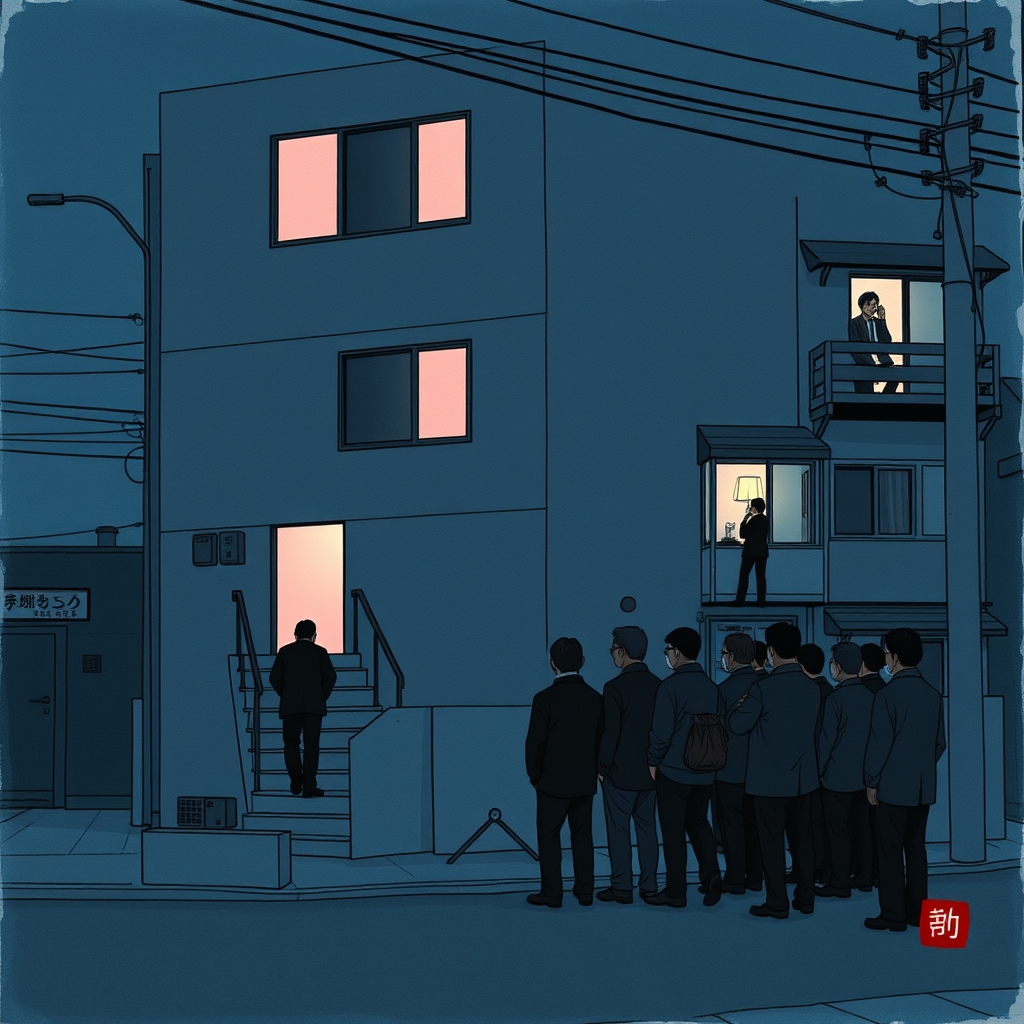
According to police, residents of an apartment building in Hamana Ward, Hamamatsu, went to the property's management company with a complaint that was more about traffic than about vice: "An unspecified number of people are coming and going." "Strangers come by in the middle of the night." The management company took the complaint to police, Shizuoka Broadcasting System reported, around April 2026.
Four months later, officers from the prefectural police's Tenryu station arrested three women on suspicion of violating the fūei-hō — the Businesses Affecting Public Morals Regulation Act, the statute that licenses, zones and polices Japan's nightlife and adult-entertainment trade.
Police identified them only by nationality and age: a 48-year-old Chinese woman described as the operator, a 44-year-old Chinese woman, and a 31-year-old Vietnamese woman, both described as employees. Investigators allege that on May 11 and 12, 2026, the three ran a business out of a single apartment unit in Hamana Ward that called itself a men's esthe — a men's massage salon — and provided sexual services in a district where storefront sex businesses may not operate at all.
Police say the operator had the two employees perform the services. They have declined to say whether any of the three admits or denies the allegation, citing the fact that the case involves alleged co-conspirators, and say the investigation is continuing, including into possible additional offenses.
What the Zoning Rule Actually Says
The charge here is worth reading precisely, because it is narrower and stranger than "running a brothel."
Under the fūei-hō, a store-type sex-related special business (tenpo-gata seifūzoku tokushu eigyō) — the licensed category that covers soaplands, fashion health shops and similar premises-based operations — is barred outright from operating within 200 meters of schools, libraries, child welfare facilities and other sites designated by prefectural ordinance. Prefectures may go further and designate whole districts as off-limits by ordinance, and most do. In practice, that leaves storefront sex businesses legal in a small number of grandfathered entertainment quarters and illegal nearly everywhere else, including in ordinary residential neighborhoods.
Hamana Ward is one of those ordinary neighborhoods. It is a suburban district of roughly 160,000 people, created on January 1, 2024, when Hamamatsu consolidated seven administrative wards into three, absorbing the former Hamakita Ward and most of the old Kita Ward. It is not a nightlife district. It is apartment buildings, and the alleged shop was in one of them.
That is the offense police describe: not operating without a license, but operating in a place where no license is available. The distinction matters for how these cases get made. There is no permit to check and no premises inspection to fail. What there is, instead, is a room in a residential building whose only visible anomaly is the number of people going in and out of it.
The Fourth Arrest
Several hours after announcing the three arrests, police disclosed a fourth, at the same address.
A 30-year-old Vietnamese woman whose occupation police listed as unknown was arrested at the scene on suspicion of illegal overstay under Japan's immigration law. Her permission to stay in Japan expired on August 4, 2022, police said, and she is alleged to have remained in the country unlawfully through August 7, 2026 — a span of roughly four years. She had entered Japan on a two-year student visa.
Police said officers found her inside the men's esthe premises during the August 8 enforcement action and checked her identification, at which point the expired status came to light. Prefectural police believe she was also working at the shop, and are continuing to investigate. As with the other three, police have not disclosed whether she admits or denies the allegation, citing suspected links to other cases.
She is a different person from the 31-year-old Vietnamese employee arrested on the fūei-hō charge; police described the two separately.
| Detail | As reported |
|---|---|
| Announced | August 8, 2026, by Shizuoka Prefectural Police (Tenryu station) |
| Location | Apartment unit, Hamana Ward, Hamamatsu, Shizuoka Prefecture |
| Business | Operated under the name of a men's esthe (men's massage salon) |
| Arrested (fūei-hō) | Chinese woman, 48, alleged operator; Chinese woman, 44, employee; Vietnamese woman, 31, employee |
| Alleged conduct | Provided sexual services on May 11 and 12, 2026, in a zone where store-type sex businesses are prohibited |
| Arrested (immigration) | Vietnamese woman, 30, occupation unknown — alleged overstay from August 4, 2022 to August 7, 2026 |
| Entry status | Two-year student visa |
| How it surfaced | Tenants complained to the building's management company about constant, unfamiliar visitors; the company contacted police around April 2026 |
| Plea | Not disclosed — police cite alleged co-conspirators and links to other cases |
| Status | Investigation continuing, including into possible additional offenses |
Shizuoka's Year of Apartment Shops
This is not an isolated bust, and Shizuoka police have said so themselves.
In March 2026, the Shizuoka Shimbun reported that the prefecture had seen a run of enforcement actions against illegal sex businesses operating behind the men's esthe label: seven cases in the current fiscal year, with 17 operators and others arrested. A senior investigator quoted in that report was blunt about what the numbers represent. "The tip of the iceberg," the official said. "The methods are cunning, and getting more sophisticated."
The paper described the pattern investigators had assembled: no signage, an apartment unit rather than a storefront, and a shop name changed again and again so the operation can present itself online as a brand-new establishment each time. Earlier prefectural cases fit the same outline — in Numazu, police arrested a woman in February 2026 accused of running a shop that posed as a men's salon, and a 39-year-old Chinese woman in a separate prohibited-zone case.
The commercial logic is not complicated. A storefront in a legal quarter requires a filing, a landlord willing to host a registered sex business, and a fixed address that regulators can find twice. A rented apartment requires a lease. The men's esthe label, which in its lawful form describes a non-sexual massage service outside fūei-hō licensing entirely, supplies the cover story, and online booking supplies the customers without a sign on the street.
What it cannot supply is anonymity from the people who live on the other side of the wall.
Why the Nationality Detail Sits in Every One of These Stories
All four women arrested in Hamamatsu are foreign nationals, and that is the norm rather than the exception in Japanese reporting on illegal men's esthe cases. It deserves a careful reading rather than a loud one.
Japanese outlets report nationality because police release it, and because the immigration exposure is often part of the case — as it plainly was here, where a woman's status violation surfaced only because she was standing in a room officers had come to raid. What the reporting does not establish, in this case or most others, is the relationship between the operator and the workers: whether the employees were recruited abroad, what they were told, what they were paid, or what leverage anyone held over them.
Those questions matter because they determine whether a case like this is a zoning offense with four defendants or something closer to labor exploitation with two of them. Japanese enforcement has produced both. On August 6, prosecutors in Tokyo demanded six years for the former operator of a Yushima massage shop where a 12-year-old Thai girl was made to serve customers. In other prefectural cases this year, foreign women found in raided shops have been treated primarily as immigration violators.
Police in Hamamatsu have not characterized the arrangement either way. The 30-year-old's four-year overstay — accrued after a student visa lapsed in 2022 — is the kind of detail that, in some cases, turns out to be the mechanism by which someone becomes unable to leave a job. In others it is simply a person who overstayed. Nothing released so far distinguishes the two, and it would be irresponsible to guess.
What Is Unresolved
Three things are open.
The first is evidentiary: police say they are pursuing possible additional offenses, and the two-day window in the charge — May 11 and 12 — is the sort of narrow, provable allegation investigators build a first arrest around, not a description of how long the shop ran. The complaint to the management company predates it by weeks.
The second is whether the case reaches beyond the four women. The fūei-hō charge names an operator, but nothing released so far addresses who leased the unit, who took the revenue, or whether the shop was part of a chain rotating through apartments — which is exactly the pattern Shizuoka police described in March.
The third is the one enforcement statistics keep circling. Seven cases and 17 arrests in a fiscal year is real activity, and it is also, by the prefecture's own investigator's description, the visible fraction of something larger. The Hamamatsu shop was not found by any of the tools built to find sex businesses. It was found because tenants got tired of buzzing strangers at night and called the property manager.
This article is compiled from Japanese reporting on the August 8, 2026 arrests in Hamana Ward, Hamamatsu: Shizuoka Asahi Television and Shizuoka Broadcasting System on the arrests of three women — an alleged operator and two employees — on suspicion of violating the fūei-hō by providing sexual services at a self-described men's esthe in a district where store-type sex businesses are prohibited, on the tenants' complaints to the building's management company, and on the police statement declining to disclose the suspects' responses; TBS NEWS DIG carrying the same account; Shizuoka Asahi Television on the separate arrest of a 30-year-old Vietnamese woman on suspicion of illegal overstay; and the Shizuoka Shimbun, March 2026, on the prefecture's seven fiscal-year cases, 17 arrests, and the investigator's assessment of the pattern. Police have released the suspects' nationalities and ages but not their names, and this article does not name them. No allegation described here has been tested in court, and an arrest is not a conviction. Legal glosses: fūei-hō = the Businesses Affecting Public Morals Regulation Act, which licenses and zones Japan's adult-entertainment businesses; tenpo-gata seifūzoku tokushu eigyō = store-type sex-related special business, the premises-based category barred from operating near designated facilities and inside districts that prefectural ordinance places off-limits; "men's esthe" in its lawful form is a non-sexual massage service that falls outside fūei-hō licensing, which is what makes the label useful as cover.