
The entire company fits on one screen
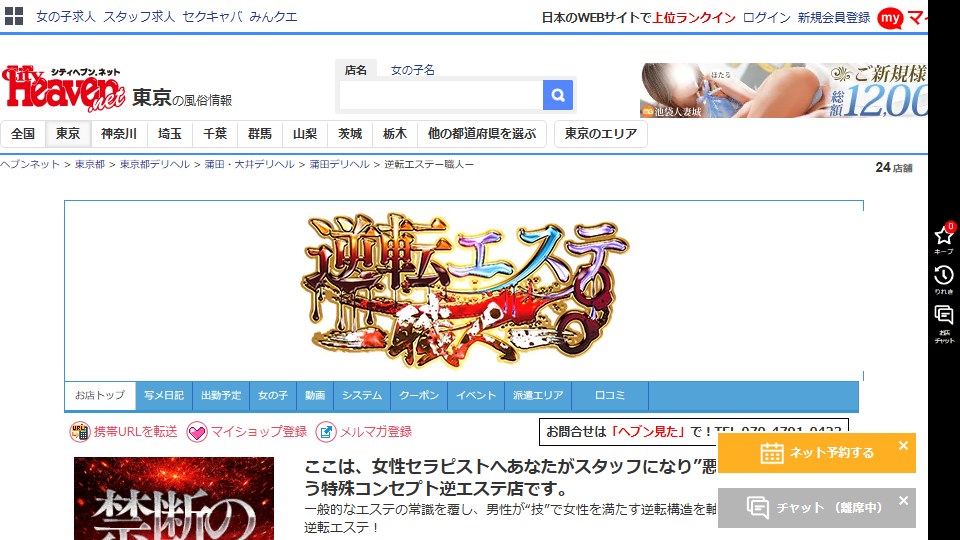
Pull up the cast page for 逆転エステー職人ー — Gyakuten Esthe Shokunin — and the site tells you, in the flat administrative way these sites tell you everything, that it is showing you members 1 through 3 of 3.
That's the roster. Not "three available tonight." Three, full stop. There's a No.1, twenty-four years old, with a photo diary and a handful of reviews under her name. There's a No.2, twenty-five, also keeping a diary. And there's a third profile carrying the little 本日出勤 flag — working today.
I want to be precise about why I opened with this instead of the price ladder, because it isn't a knock. A three-woman roster at a shop this specific is a completely rational outcome. Gyakuten Esthe Shokunin sells a reversal: the shop's own copy says you become the staff and run a session on the therapist, with the woman playing the client. Its term for what you're conducting is 悪質趣味講習 — roughly, "malicious hobby instruction," which is the kind of phrase that tells you this shop is not embarrassed about itself. The point is that the format needs a woman who can hold the receiving-client role for ninety minutes without it quietly collapsing into a normal session with the labels swapped. That is a narrow skill. A shop that keeps three women who can genuinely do it is in better shape than one keeping thirty who can't.
But it changes how you book. Completely.
A mobile number is a fact about the business
You call 070-4791-0423, and the hours are 12:00 to 6:00 the following morning, seven days a week.
The 070 prefix is a mobile line, and I'd rather people read that correctly than sneer at it. At a shop with a thirty-woman board, a mobile number is a warning — it means there's no desk, no dispatcher, nobody whose entire job is the phone, and you're competing for the attention of a man who is also driving. At a shop with three women, a mobile number is just an accurate description of the payroll. Nobody staffs a call center for a bench that size. The person who answers is, in all likelihood, the person who runs the whole operation.
Which turns out to be the advantage, and it's the first thing I'd tell anyone considering this place. There is no layer between you and the decision-maker. Every question I asked was answered by someone with the authority to answer it, on the spot, without the "let me check with the shop" ritual you get from a big network house. On a concept this specific — where the only honest question is can she actually do the thing you're advertising — talking directly to the guy who does the casting is worth more than a polished phone manner.
The eighteen-hour clock is the other half of it. Noon to six in the morning covers the after-work wave, the last-train-missed crowd stranded in Kamata's hotel blocks, and the genuinely nocturnal. Kamata is the last big station in Ota Ward before Tokyo hands off to Kawasaki — unpretentious, thick with rooms, cheap to operate in. But a long clock over a three-person bench means the shop is open eighteen hours and any individual woman is not. Availability is the binding constraint here, not hours.
¥1,000 to point, ¥3,000 to remember
Now the designation fees, which is where a small roster does something genuinely strange to the economics.
- ネット指名料 (net designation): ¥1,000 — booking a specific woman off the web listing.
- 本指名料 (repeat designation): ¥3,000 — asking for one you've already met.
On a standard board, that ladder is a filter. Forty faces, most customers arrive without a preference, so the cheap tier absorbs the undecided and the ¥3,000 taxes the loyal. Fine. Standard.
On a three-woman board the ladder stops being a filter, because there is nothing to filter. You aren't choosing from forty. You're choosing from three — realistically from whoever is actually on shift, which the night I looked was one. The ¥1,000 "net designation" is, at this scale, close to a booking fee wearing a different name, because naming someone and reading the entire roster are the same act.
The ¥3,000 I'll defend, though. At a big shop the repeat fee buys continuity you might have stumbled into anyway. Here it buys the only thing that's actually scarce. If one of three women turns out to be the one who can run the client role the way you need it run, ¥3,000 is the price of never rolling the dice again. That isn't a surcharge. It's insurance, and at this roster size it's cheap insurance.
The option sheet, read as a document
The add-on list is unusually legible, and one pair of numbers on it is doing something interesting:
| Option | Price |
|---|---|
| Bring-your-own cosplay (持ち込みコスプレ) | ¥2,000 |
| All nude (オールヌード) | ¥4,000 |
| Photo/video, no face shown | ¥10,000 |
| Photo/video, face shown | ¥20,000 |
| 30-minute extension | ¥12,000 |
The recording pair is the honest one. Ten thousand yen to record, twenty to record with her face in it — a flat ¥10,000 premium on identifiability, priced as its own line item rather than buried or refused outright. Most shops in this trade ban recording entirely, which is a defensible policy and also a convenient way of never having to put a number on it. Shokunin puts a number on it, and the number says something clear: her face is not part of the base product, it's a separate thing she's being compensated for releasing. I'd rather see that priced than pretended away. Bring your own costume for ¥2,000 and the shop is likewise admitting it isn't in the wardrobe business and won't bill you as if it were.
Do the extension math before you dial
This is the part that will actually save you money, so I'm going to be tedious about it.
Two ladders. Soft course: 70 min ¥16,000 / 90 min ¥24,000 / 120 min ¥30,000. Hard course: 70 min ¥19,000 / 90 min ¥28,000 / 120 min ¥38,000 / 180 min ¥50,000.
And the extension, again, is ¥12,000 per 30 minutes.
Run it:
- Soft, 90 → 120 booked up front: +¥6,000 for thirty minutes. The same thirty minutes bought in the room as an extension: ¥12,000. You pay exactly double for changing your mind.
- Hard, 90 → 120 up front: +¥10,000 for thirty minutes. Still cheaper than extending, but the discount has thinned to almost nothing.
- Hard, 120 → 180: +¥12,000 for a full extra hour. That is sixty minutes at the price of one thirty-minute extension. It's the cheapest hour in the building by a wide margin, and the only place on either ladder where the cost per minute falls off a cliff.
Two conclusions. First, the extension is the most expensive product this shop sells, and it's expensive on purpose — it's a decision-tax, and every yen of it is avoidable by deciding on the phone. Second, that ¥50,000 three-hour hard course, which reads like the indulgent top-shelf item, is arithmetically the best-value slot on the menu. It exists on the hard side only, and that's the shop quietly telling you where the concept lives. A reversal in which you're supposedly the practitioner running the session does not pay off in a hurried seventy minutes. Seventy minutes is the sample. Three hours is the product.
The gap between the two ladders widens as the clock runs, too — ¥3,000 at seventy minutes, ¥8,000 at a hundred and twenty. The shop isn't charging you for intensity so much as for intensity sustained, which is at least a coherent thing to charge for.
There was a ¥4,000-off promotion on the 90- and 120-minute hard courses posted over the summer, with a stated run through the end of July. It's lapsed. Ask whether anything has replaced it before you assume list price is the price — at a shop this small, promotions come and go with whoever is answering the phone.
What isn't on the page
Being straight about the gaps, because this is where a small operation differs most from a big Shibuya or Yoshiwara house.
The listing carries the concept, the hours, both ladders, the options and the designation fees. It does not publish a transport or dispatch fee, a free-delivery zone, a cancellation schedule, or whether cards are taken and at what surcharge. I'm not going to invent those. What I'll say is that at every shop I've ever dealt with, unpublished means negotiable-or-variable, and both of those mean ask on the phone and get a number before you are standing in a room. Specifically: what does dispatch cost to your hotel, what happens if you cancel same-day, and is it cash only. Three questions, ninety seconds, and the entire information gap is closed.
The one hard rule the shop does publish is the industry-standard one: no minors, no high-school students, eighteen and over.
The verdict at this size
| Item | Rating |
|---|---|
| Clarity of the concept, and willingness to name it | ★★★★★ |
| Roster depth | ★★☆☆☆ |
| Reaching someone with actual authority | ★★★★★ |
| Transparency of the option sheet | ★★★★☆ |
| Published terms (transport, cancellation, payment) | ★★☆☆☆ |
| Value of the 180-minute hard course | ★★★★★ |
| Cost of changing your mind mid-session | ★★☆☆☆ |
| Suitability for a same-night impulse booking | ★★☆☆☆ |
I came back to Kamata to put a number on the thing I'd waved at in the summer, and the number is three. Everything follows from it. The phone is a mobile because a three-woman shop has no use for a switchboard, and that turns out to be a feature. The repeat-designation fee is insurance rather than a tax, because continuity is the genuinely scarce good here. The long hard course is the value buy, not the splurge. And the one real cost of a bench this thin is that Gyakuten Esthe Shokunin is not a shop you book on a whim at eleven at night — it's a shop you call ahead of, around a specific woman's shift, the way you'd arrange anything where the person is the product rather than the room.
If you want the reversal — and it is a real reversal, not a costume draped over a standard menu — plan it. Ask who's on before you ask anything else. Pick your length on the phone and never in the room. And if you're going to do it properly, three hours costs less per minute than ninety, which is the rarest sentence I ever get to write about this industry.