Nine in the morning is a real price signal
Okubo Seifuku Kojo Iinkai opens at 9:00 a.m. and runs to midnight. That alone is not unusual in Tokyo. What's unusual is that the shop puts a hard line at 11:59.
Morning, 9:00–11:59: 45 minutes ¥12,000, 60 minutes ¥16,000, 75 minutes ¥20,000, 90 minutes ¥24,000, and a 120-minute block at ¥32,000. From noon to close: 45 minutes ¥14,000, 60 minutes ¥18,000, 75 minutes ¥22,000, 90 minutes ¥26,000. Two thousand yen a course, across the board — and the 120 sits in the morning column only.
Two thousand yen isn't a headline discount. But that's the point. A shop cutting deep in the morning is trying to buy traffic it can't otherwise get. A shop cutting exactly ¥2,000 is doing inventory management: it has girls on shift from nine, it knows the room is dead until lunch, and it prices the dead hours to move. That's an operation with its hand on the dial, not one panicking.
So I took the 9 a.m. opening. Forty-five minutes, ¥12,000.
Shin-Okubo, and a hotel three seconds out the door
The address is Haguro Building 2F, Room B, 2-24-1 Hyakunincho, Shinjuku-ku — about five minutes on foot from Shin-Okubo. This is hotel health (hoteheru): you meet at the shop's room, then move to a nearby love hotel for the session. The shop advertises the hotel as three seconds away.
"Three seconds" is marketing. But walk the block and it isn't a lie by much — the point is you are not doing a ten-minute walk through Hyakunincho at nine in the morning with a girl in a coat, past the Korean grocery deliveries and the guys hosing down the sidewalk. In this format, the walk is the failure point. Every meter of it is a chance for the mood to evaporate. Shrinking that walk to nothing is worth more than most paid options on the board.
Hyakunincho at 9 a.m. is also just a good place to be. The night crowd is gone, the street smells like fryer oil and detergent, and nobody is looking at anybody. For a first-timer nervous about being seen, morning in Shin-Okubo is about as low-exposure as central Tokyo gets.
Four scenarios, two formats — and the format is the interesting half
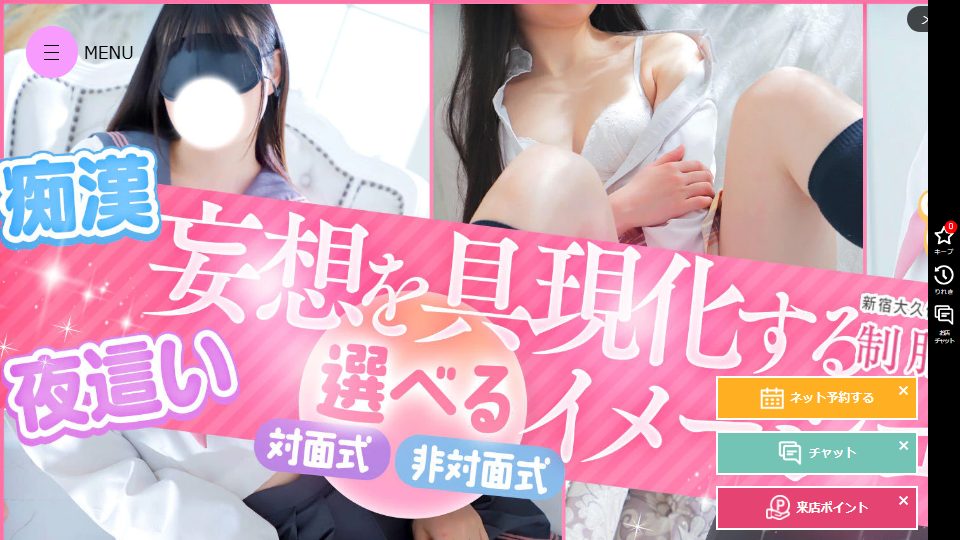
The concept line is blunt: "Uniforms! Amateurs! We're sticklers for image club!" Image club — imekura — means the play is framed as a scene, not just a service.
The scenario menu lists four: lover, molester, night-crawl, and workplace-harassment. Standard imekura vocabulary; you'll see the same four at half the shops in Tokyo. What's not standard is the second axis. You also pick a format: face-to-face, or non-face-to-face.
That second choice is the one that tells you whether a shop understands its own genre. Face-to-face is conventional — you meet, you talk, the scene starts. Non-face-to-face means the girl's identity stays obscured for the opening stretch; the blindfold on the free-option list stops being a novelty item and becomes the actual staging equipment. It's the difference between a costume shop and a shop running a premise.
I ordered the non-face-to-face format at reception, deliberately, in a flat voice, at nine in the morning — which is the least atmospheric moment imaginable to say something like that out loud. The staffer didn't blink, didn't over-explain, and confirmed the scenario back to me in one sentence. That was the whole test, honestly. A shop where the scenario menu is decoration reacts to a scenario order with a half-second pause. There wasn't one. It was handled like a size request at a shoe store.
Read the free column, not the paid column
Everybody scans the paid options. I read the free ones.
Free here: stockings, handcuffs, glasses, blindfold, and socks — white high socks, navy high socks, loose socks. Look at what that is. Every one of those items is scene equipment. Blindfold and handcuffs are the non-face-to-face format's hardware. The three sock variants are the uniform silhouette, and a shop that stocks navy high socks and loose socks as separate free items knows those two read as different decades to the customer who cares.
The paid column is priced sanely and where you'd expect: ¥1,000 for oral finish and for a second costume; ¥2,000 for underwear takeaway, sock takeaway, pink vibrator, viewing, three photos, black tights; ¥3,000 for the electric massager, the vibrator, and urination play.
Note what got monetized and what didn't. The staging is free. The extras are paid. That's the correct way around, and it's rarer than it should be — plenty of costume shops charge ¥2,000 to change into a second outfit and hand you nothing free but a pair of stockings. A double costume at ¥1,000 here is genuinely cheap for what it does to a 60-minute session.
What "100-plus costumes" actually buys you
The banner claim is over 100 costumes. Big numbers on a costume rack usually mean a warehouse of unwearable polyester in one size.
The honest read: a hundred-item rack matters less for breadth than for condition. With that much inventory, individual pieces get worn less often, which means less shine on the fabric and fewer stretched seams. What I saw was consistent with a rack that gets rotated rather than one where the same six popular outfits do all the work. For a shop whose entire name is about uniforms, that's the baseline requirement, and it was met.
Nomination by photo is free, which for a first visit is the number that matters — you can pick from the board without paying to be picky. Repeat nomination (honshimei — asking for the same girl again) is ¥2,000.
The real arithmetic
Here's the total, because the course price is never the price.
Membership ¥2,000, one time. Transport ¥2,000 within Okubo, Shin-Okubo, and Kabukicho. Photo nomination free. So a first-timer on the morning 45 at ¥12,000 is actually looking at ¥16,000 out the door, and a second visit with a repeat nomination lands at ¥16,000 again — the membership drops off, the nomination fee replaces it.
That is a slightly annoying structure and I'd rather it were rolled in. But ¥16,000 for a 45-minute image club session in Shinjuku ward, with staging equipment free and a hotel across the street, is not a shop taking advantage of anybody. Go 60 in the morning and it's ¥20,000 all-in, which is the slot I'd actually recommend. Forty-five minutes is tight once you've committed to a scenario with a setup phase — the premise needs room to breathe or you're just paying for a costume.
The verdict
| Item | Rating |
|---|---|
| Reception's handling of a scenario order | ★★★★★ |
| Free options as actual staging equipment | ★★★★★ |
| Distance to hotel (the format's weak point) | ★★★★★ |
| Morning rate as value | ★★★★☆ |
| Costume condition and rotation | ★★★★☆ |
| Transparency of add-on fees | ★★★☆☆ |
| Would I go again | ◎ — but on the 60, not the 45 |
Okubo Seifuku Kojo Iinkai is a shop that put its scenario menu on the board and then actually staffed for it. The tell wasn't the costume count or the concept copy — it was that ordering the non-face-to-face format at nine in the morning produced zero friction at the desk. In a genre where most operators treat the premise as ad copy, being able to take the order is the whole game.
If you've bounced off image clubs before because it felt like a normal session with a schoolgirl outfit stapled to the front, the problem may have been that you never ordered. Here, order.