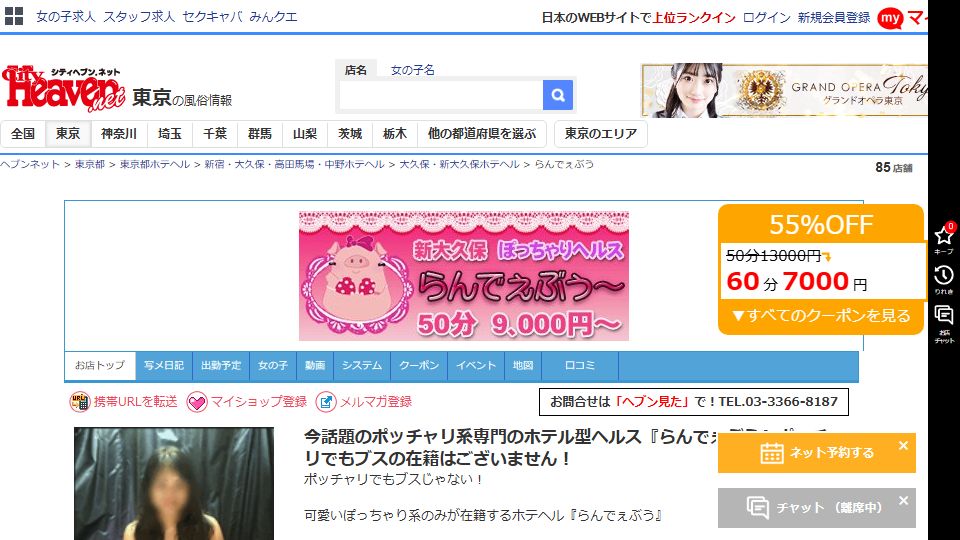

Every once in a while you find a shop in this business that isn't hedging. Most of them lead with fog — soft adjectives, lighting tricks, a concept so vague it could describe a dentist's office. Randebu does the opposite. It is a hotel health in Shin-Okubo built, top to bottom, around one thing: cute plus-size women. The Japanese trade calls it pocchari, and the shop doesn't bury that under a euphemism. It puts it on the marquee. I'm 38, I've spent sixteen years circling this industry, and I've learned that a shop willing to be specific about who it casts is usually a shop that actually delivers what it advertises. Vague is what you sell when you've got nothing. Specific is a promise. I booked 70 minutes to find out if Randebu keeps it.
The Walk In
Shin-Okubo is Tokyo's most honest neighborhood, in a way. It's Koreatown crossed with a working-class grind, narrow streets stacked with restaurants and karaoke and the kind of love hotels that exist for exactly this. Randebu sits over near Hyakunincho, five flat minutes from the JR station, and like most hotel health operations there's no flashy storefront — the model is simple, you call, you get sent to meet your companion, the hotel does the rest. The reception ran the way good ones do: efficient, unbothered, no theater. Open noon to midnight, every day, which is the schedule of a place that catches the lunch-break crowd and the after-work crowd both. That's a workingman's window, not a tourist's.
The 70 Minutes
Here's where the named pitch gets cashed. The woman who turned up matched the category the shop advertises — soft, full-figured, and, the part that actually matters, comfortable in her own skin in a way the slim-by-default rooms often aren't. There's a thing that happens in pocchari shops when they're run right: the women aren't performing apology for their bodies, they're leaning into the appeal of them, and the whole tempo changes because of it. This was that. Unhurried, warm, a little playful. The fundamentals of the format were all there and handled without a wasted motion, but the texture was the selling point — a kind of enveloping, low-pressure ease that the shop's whole concept is implicitly promising and that a thinner room simply can't sell you. Seventy minutes was the right call. Fifty would have felt clipped; seventy let the thing breathe.
Reading the Price Board Cold
Let me be straight about the numbers, because that's the only honest way to cover a place this direct. The board runs ¥9,000 for the 50-minute course, ¥11,000 for 70, ¥14,000 for 90, and ¥18,000 for the two-hour. There are long courses too — ¥32,000 for three hours, ¥42,000 for four — and a 70-minute 3P option listed at ¥20,000, though I booked solo and won't invent claims about a course I didn't sample. The hotel fee runs from ¥2,000 and a 30-minute extension is ¥5,000, so budget for the room on top of the course. What I can tell you is that ¥11,000 for 70 minutes, plus the room, is genuinely cheap for central Tokyo — this is not a high-end price for a high-end fantasy, it's an accessible price for a specific one, and the value lands precisely because the shop isn't pretending to be something it's not.
Bottom Line
| Item | Rating |
|---|---|
| Truth in advertising | ★★★★★ |
| Casting matches the concept | ★★★★☆ |
| Service execution | ★★★★☆ |
| Comfort / ease in the room | ★★★★★ |
| Value for money | ★★★★☆ |
| Going back | ◎ Will go again |
Randebu isn't trying to be all things to all men, and that's the whole reason it works. It picked a lane — cute, plus-size, no apologies — and it stayed in it from the front page to the final minute. If you want the slim, polished, GFE-template experience, this isn't your address and the shop would be the first to tell you so. But if the pocchari niche is the thing you actually want, Shin-Okubo just gave you a cheap, honest, easy place to want it. I walked in expecting a label and found a specialty. In this trade those are not the same thing, and Randebu is the rarer one.