
Most guys book this kind of place in the gap between work and the last train — six, seven, eight in the evening, the safe window. I came back to Randebu at twenty to eleven on a weeknight, deliberately late, because a hotel health that closes at midnight is a different animal in its last ninety minutes than it is at dinnertime. I'm a New Yorker; I learned a long time ago that you find out what a place is made of near closing, when the easy money's already gone home and what's left is whoever still cares about the work. Randebu's a Shin-Okubo plus-size shop — pocchari, cute, soft, advertised with zero euphemism — and I'd been once before. This was the return visit, and I went in with one question: does the late call cost you, or does it pay?
The Last-Call Math
Here's the gamble nobody explains. A shop that runs noon to midnight isn't sending anyone out at 11:50 for a fresh course — the math doesn't close. So a genuinely late call narrows your roster to whoever's still on shift and still has a full block of time left in the night. Fewer choices, sure. But the women who are left late are, in my experience, the ones who actually want to be there, not the ones counting minutes to the door. I called, the reception handled it the way the good ones do — quick, flat, no upsell theater, just "here's who's available, here's the time you've got" — and because I was going long they steered me clean instead of trying to wedge me into a fifty that wouldn't fit before close. That's a shop reading the clock for you instead of against you. I booked the 90.
Ninety Minutes, Shin-Okubo at Night
Shin-Okubo after ten is its own city. The Korean barbecue smoke's gone thin, the karaoke crowd's hit its second wind, and the love hotels around Hyakunincho light up like they're the whole point of the neighborhood — which, for the purposes of a hotel health, they are. Five flat minutes from the JR station and you're inside. The woman who came matched the category the shop sells and then some: full-figured, soft, and carrying that specific late-shift calm that you only get from someone who isn't watching the clock. This is the thing about the pocchari lane done right — there's no performed apology for the body, just an easy lean into the appeal of it, and at this hour, with ninety minutes on the board, the whole tempo loosened into something I genuinely don't get on a rushed seventy. The extra twenty minutes over my last visit weren't filler. They were the difference between a transaction and an evening. Unhurried, warm, a little funny, and not once a glance toward the exit.
The Numbers, From the Long End
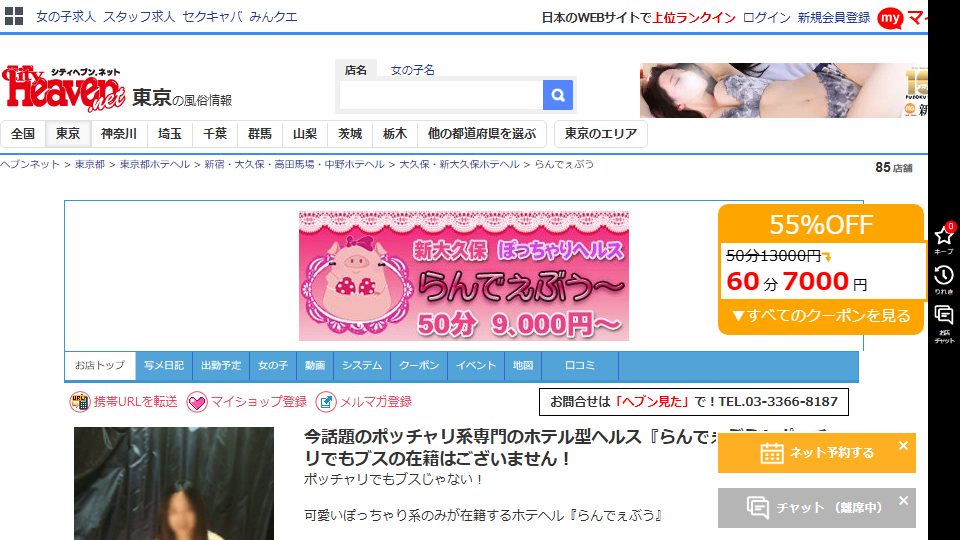
Last time I read the board cold on the short courses. Let me cover it from the other end, because the long courses are where this shop's value actually sharpens. The 90-minute course I took runs ¥14,000. Step back and you can see the whole ladder: ¥9,000 for 50 minutes, ¥11,000 for 70, ¥14,000 for 90, ¥18,000 for the two-hour, then ¥32,000 for three hours and ¥42,000 for four. Hotel fee runs from ¥2,000 on top, and a 30-minute extension is ¥5,000. Do the per-minute arithmetic and the 90 is quietly the sweet spot — you're paying ¥3,000 more than the 70 for twenty extra minutes and a completely different gear of evening. For central Tokyo, fourteen grand plus a room for an unhurried ninety is not a premium number. It's an honest one. I won't quote the longer blocks from experience because I didn't book them, but the ladder tells you the shop wants you to stay, not to churn you.
Verdict: The Second Look Holds
- Late-call handling: ★★★★★ — steered me to the right course instead of cramming me into the wrong one.
- The 90-minute gear: ★★★★★ — the unhurried length is where this shop is actually best.
- Casting vs. concept: ★★★★☆ — matched the pitch, late shift and all.
- Value, long-course end: ★★★★☆ — ¥14,000 for 90 is the smart pick on this board.
- Going back a third time: ◎ — and next time I'm calling late again on purpose.
I came back to test a hunch, and the hunch held: Randebu near closing isn't a discount version of itself, it's arguably the better one. The roster's thinner but truer, the tempo's slower because the night's slower, and the 90-minute course turns a fine shop into a genuinely good evening. If you've only ever done the safe dinnertime call, try the late one — book the 90, let Shin-Okubo do its 11 PM thing, and find out what an honest shop looks like when nobody's rushing. First visit I learned what Randebu advertises. Second visit I learned what it's made of. Those aren't the same lesson, and the second one's the one that brings me back.