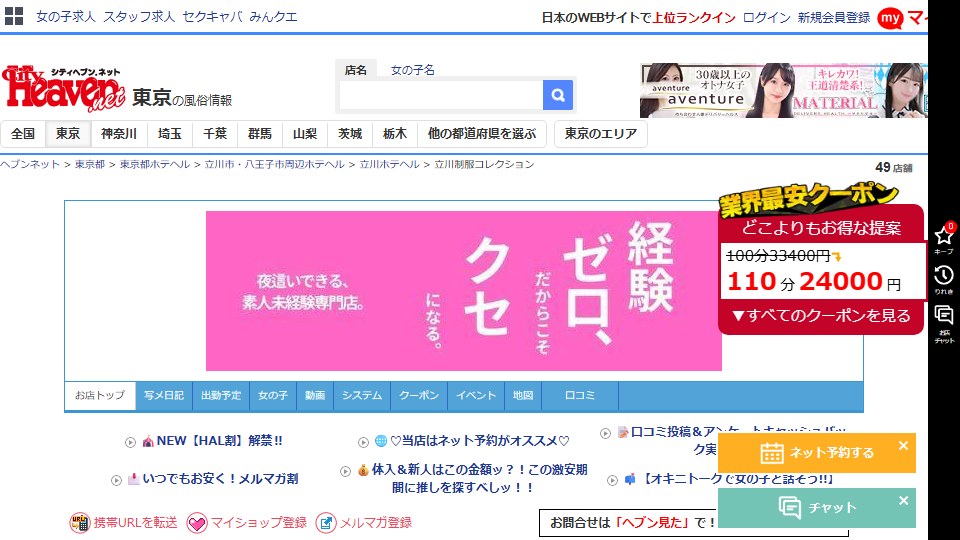

The shop is 立川制服コレクション — Tachikawa Seifuku Collection, "the Tachikawa uniform collection." It's a hotel health working Tachikawa City, open 10:00 to 24:00, no closed days, run out of a third-floor room in the New Tachikawa Building in Akebono-cho, ten minutes on foot from the station on the side of town where the department stores give out and the karaoke signs start. Fourteen hours a day, 365 days a year, from a door you can stand in front of.
I went in expecting to write about costumes. I came out writing about a number, and then about the two places that number stops applying.
The Name and the Banner Disagree
First thing worth noticing, and the shop makes no effort to hide it: the sign and the headline are selling different products.
The name says wardrobe. The banner across the top of the page says 「経験ゼロ、だからこそクセになる。」 — zero experience, and that's exactly why it gets under your skin — over the line 「夜這いできる、素人未経験専門店。」, a specialist house of amateurs with no experience. So the name promises a collection of uniforms and the masthead promises the opposite of polish.
That's not a contradiction so much as a division of labor. The costume is the setting; the inexperience is the casting. A uniform on someone practiced reads as a prop — I've written that complaint about half the themed shops in this city. A uniform on someone who hasn't learned the moves yet reads as a situation. Whether the roster delivers on that is the one thing a price sheet can never tell you, and I'm not going to pretend otherwise. What I can tell you is that the shop has decided which half it charges for, and the answer is neither.
The Thing You Came For Is the Free Thing
Here's the line that reorganized my reading: cosplay is ¥0. Sixty-plus outfits by the shop's own count, and the entire premise — the word in the name — is complimentary. So is the entry fee, currently waived on campaign. So is designation for a first-time customer, normally ¥1,100. Lotion, vibrator, and electric massager come included depending on the course.
Understand how unusual that is. In a uniform house the wardrobe is the moat: expensive to buy, expensive to launder, expensive to store, and the only reason a customer picks a themed shop over the generic one two floors down. The standard move is to charge for it — costume fees, "special outfit" tiers, a surcharge on anything with a pleated skirt. The Akihabara houses build whole ladders on it.
This one gives it away and bills you for time instead. That tells you where management thinks the value lives, and it isn't in the closet.
A Line Through Zero
The official sheet, eight cells:
60 min ¥16,500 · 80 min ¥22,000 · 100 min ¥27,500 · 120 min ¥33,000 · 140 min ¥38,500 · 160 min ¥44,000 · 180 min ¥49,500 · 1,440 min ¥550,000.
Divide the first seven. Sixteen-five over sixty is ¥275 a minute. Twenty-two thousand over eighty: ¥275. Twenty-seven-five over a hundred: ¥275. Out to three hours: ¥275, ¥275, ¥275, ¥275.
I've read plenty of flat meters. What I almost never see is this one's second property: the line passes through zero. No base fee buried in the first cell, no admission amortized across the hour, no on-ramp. Price equals two hundred seventy-five times minutes, and the constant term is nothing. Most shops — good ones included — run price = rate × minutes plus a door fee, and the door fee is where a shop hides its opinion of you. This grid has no opinion. It has a clock.
And ¥275 is a strange-looking number only until you back the consumption tax out: ¥275 is ¥250 plus ten percent. The business underneath is a flat quarter-thousand a minute, pre-tax. Every figure on the page is a round number wearing a tax coat.
Everything Is Four Minutes
This is where it stopped being a price list and became a language. ¥1,100 buys exactly four minutes at ¥275. Once you see that, check what else on the official sheet is a multiple of ¥1,100.
All of it.
- Star Class ¥1,100 → 4 minutes. Platinum ¥2,200 → 8. Diamond ¥3,300 → 12. Black ¥4,400 → 16 minutes. The entire class ladder, bottom to top, costs less than a third of the shortest course.
- Designation ¥1,100 → 4 minutes (free your first visit). Repeat designation ¥2,200 → 8 minutes.
- Pantyhose, panty takehome, holy water, masturbation viewing: ¥1,100 → 4 minutes each.
- Facial, lotion bath, vibrator, clothed play: ¥2,200 → 8 minutes.
- Bukkake, electric massager: ¥3,300 → 12 minutes.
- AF ¥8,800 → 32 minutes, the dearest item on the page and still barely half an hour of clock.
- The courses too: ¥16,500 is fifteen bricks, ¥49,500 is forty-five, ¥550,000 is five hundred.
No ¥1,500 anywhere. No ¥3,000, no ¥800, no ¥12,000. The shop has one atomic unit — four minutes — and quotes the whole operation in it. That isn't tax rounding; tax rounding leaves stray numbers behind and there are none. Somebody built this on purpose.
The Extension Doesn't Punish You
Extension: ¥5,500 per 20 minutes, plus the rank fee. Divide: ¥275 a minute. Identical to the meter.
That's the line I'd underline if I got only one. Nearly every shop in this city taxes the late decision — a Hachioji outcall I read recently charges a 33% premium to change your mind in the room, and that's normal, not predatory; the shop lost the chance to sell the slot to someone else. Here, twenty more minutes decided at minute fifty-eight costs precisely what it would have cost decided at minute zero. The rank fee gets charged again on each extension — that's the catch, and at ¥1,100 to ¥4,400 it's real — but the time itself is at par.
So the correct play here inverts the usual advice. Don't over-book defensively. Start short, extend if you want to, and indecision costs you one more class fee. On a Star booking that's ¥1,100. Four minutes.
The Cell That Lies
Then 1,440 minutes for ¥550,000 — the twenty-four-hour course, and the one place the meter stops telling the truth.
At ¥275 a minute a full day should run ¥396,000. It's listed at ¥550,000: ¥381.94 a minute, a 38.9% premium, ¥154,000 over the line — and ¥154,000 is itself another multiple of ¥1,100. Even the exception is denominated in bricks.
Cleaner the other way: ¥550,000 buys five hundred bricks. Five hundred times four minutes is two thousand minutes — thirty-three hours and twenty minutes of meter, for twenty-four hours of calendar. You pay for a day and a third and receive a day.
I don't read that as a gouge. A 24-hour booking isn't a long session, it's a different product — it takes one person off the roster for two full rotations of a fourteen-hour shop, and it has to be priced to be declined by anyone who hasn't seriously thought about it. Every long-duration cell in this industry is partly a filter. This one just sits next to seven cells of perfect arithmetic, which makes it the only number on the page that has to be argued for instead of checked.
The Coupons Are Written in Round Thousands
Now the part that undid my tidy theory, and improved the shop's offer considerably.
The coupon page runs on ¥1,000s, not ¥1,100 bricks — and that mismatch is the tell. The main sheet is the meter; the coupons are marketing, and marketing rounds.
The new-customer coupon: 110 minutes, ¥24,000, all-in — entry, designation, and course included, first-timers only, quote it at reception, valid on a designated hotel, and dark from Dec 28 to Jan 5. Against the meter, 110 minutes should be ¥30,250. So it's ¥218 a minute — about 21% under the flat rate, and it hands you more time than the ¥27,500 hundred-minute cell for less money. It's the cheapest minute in the building and it lives in a cell the main grid doesn't list.
The struck-through comparison price is ¥33,400 for 100 minutes, itemized as ¥2,000 entry + ¥2,000 designation + ¥27,500 course + ¥1,900 other. Note that ¥2,000, ¥2,000, and ¥1,900 are not bricks, and that the main sheet currently shows entry free and first-visit designation free. That rack rate is assembled from non-campaign figures — a number built to be crossed out. The ¥24,000 is real; treat the ¥33,400 as scenery.
The review coupon is subtler and worth actual arithmetic: ¥1,000 off 60 minutes, ¥2,000 off 80, ¥3,000 off 100 and up, for posting a review, plus a free coin option. Because the discount stops growing at 100 minutes while the course keeps growing, the per-minute rate makes a U:
60 min ¥258/min · 80 min ¥250 · 100 min ¥245 · 120 min ¥250 · 140 min ¥254 · 160 min ¥256 · 180 min ¥258.
The trough is exactly the 100-minute cell at ¥245 a minute. On a sheet where duration is otherwise irrelevant to your rate, this coupon is the only thing in the building that makes one specific length correct — and it's the hundred.
The Verdict
- Grid legibility: ★★★★★ — one rate, one unit, no constant term. You can rebuild the entire official list from ¥275 and a multiplication table.
- Rate structure: ★★★★☆ — ¥275/min isn't cheap for the Tama side, and list price never discounts for duration. What you buy is the absence of a door fee, which on a short booking is a genuinely good trade.
- Best cell in the building: the new-customer 110 minutes at ¥24,000, all-in — ¥218 a minute, the only number here that beats the meter outright. If you're not new, the review coupon at 100 minutes, ¥24,500 (¥245/min).
- Worst cell: the 24-hour at ¥550,000, not close. Everything else obeys the meter; this is 39% above it.
- Concept execution: ★★★★☆ — sixty-plus costumes at ¥0 in a shop named for its collection, with the casting concept doing the other half of the work. Premise free, clock billed. Right way around.
- Fee discipline: ★★★★☆ — extension at par is the standout, and the four-minute brick makes every add-on instantly comparable. Watch the rank fee re-charging on each extension, and don't take the struck-through ¥33,400 seriously.
- Going back: ○ — as a Tachikawa hoteheru with a real door, a fourteen-hour clock, and a sheet you can verify standing on the sidewalk, yes. Go on a first visit while the coupon and the designation are both free, take the costume you actually want because it costs nothing, book short, extend at par.
I walked into Akebono-cho to write about uniforms and spent the ride home doing long division. Seifuku Collection gives away the thing its name is about, sells nothing but minutes at a rate that never wavers across seven of eight cells, and then quietly keeps its best price on a different page in a different currency. That last part is the most ordinary thing about the shop, and the only part I'd call a trick — the meter is honest, but the honest meter is not where the deal is.