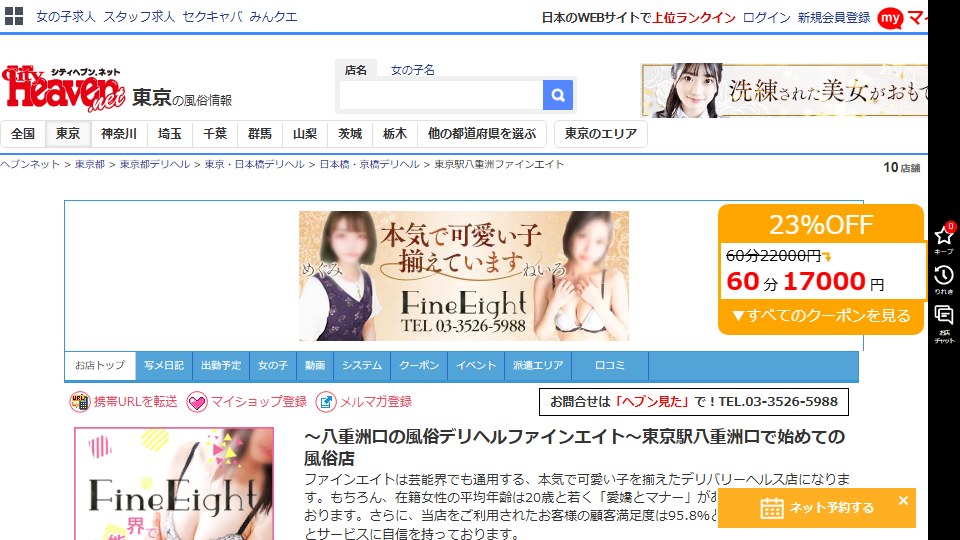

Here's the setup. Tokyo Eki Yaesu Fine Eight is a budget delivery-health shop working the Yaesu side of Tokyo Station — the Nihonbashi–Kyobashi flank, which is to say the office flank. It bills itself as the first adult-entertainment operation to plant a flag at the Yaesu exit, and it sells on faces: 芸能界でも通用する、本気で可愛い子 — girls who'd hold up in the entertainment business. Average age around 20. That's the pitch, and the pitch is ordinary. Every shop in this country claims it has the pretty ones.
What isn't ordinary is the address. Kabukicho is a red-light district. Yoshiwara is a red-light district. Yaesu is a place where men in gray suits eat standing soba and get on the Shinkansen. That's a genuinely strange place to run a deliheru, and strange placement is the most interesting thing a shop can do, because it means somebody looked at a map and saw demand that nobody else was serving.
The Clock Is the Whole Story
Look at the hours: Monday through Saturday, 10:00 to 05:00. Sunday, 10:00 to 24:00.
Read that twice. A 10 AM open is early — most Tokyo shops don't lift the shutter until noon or later, because the trade is nocturnal everywhere else in this city. A 10 AM open in an office district is a shop catching the man who came in on the 7:30 Shinkansen with a 2 PM meeting and four hours to kill. And that 5 AM close, six nights a week, is the other end of the same commuter: the last train's gone, the hotel's booked, and there's nothing to do until the first train but wait.
Then Sunday snaps shut at midnight — five hours earlier. Not because Sunday is holy. Because on Sunday, Yaesu is empty. The offices are dark, the Shinkansen is running families, and there is no 3 AM trade to serve. A nightlife shop wouldn't cut Sunday's tail; Sunday night is when nightlife eats. This one cuts it because its customers are commuters, and commuters go home. The clock told me more about this business than the concept page did.
The Ladder Runs Backwards, and That's a Compliment
Now the money, and this is where I want you to pay attention, because this shop's price ladder does the opposite of what most do.
The board reads: 45 min ¥16,000 → promo ¥13,000. 60 min ¥20,000 → promo ¥17,000. 75 min ¥25,000 → promo ¥22,000. 90 min ¥29,000. 120 min ¥39,000.
One footnote before the math, because I'd rather flag it than smooth it over: the site's own numbers don't fully agree with themselves. The pricing table lists the sixty at ¥20,000, while the coupon banner up top advertises the same sixty as 23% off ¥22,000, landing at ¥17,000. Both roads end at seventeen, so the number you actually pay is not in dispute — but the "was" price is, and a discount is only as meaningful as the figure it's measured against. Take the ¥17,000 as real and the strike-through as decoration.
Do the division instead of reading the headline. On the promotional rates, forty-five minutes runs about ¥289 a minute. Sixty runs about ¥283. Seventy-five runs about ¥293. Then the promo stops and ninety comes in around ¥322, and the two-hour course sits near ¥325.
That's a ladder that gets worse the higher you climb. The cheapest minute you can buy here is the sixty-minute course, and every rung above it charges you a premium for staying. Most shops build it the other way — cheap entry, generous upper courses — because they want to talk you into a longer booking. Fine Eight doesn't. Fine Eight's best deal is the middle of the short end, and it isn't trying to hide that.
I call that a compliment, and here's why: it's consistent with the address. A man with a meeting at two doesn't want a two-hour course. A man waiting out the first train doesn't want to commit until dawn. The sweet spot being the sixty means the shop priced its actual customer instead of pricing the customer it wished it had. The 120-minute course exists for completeness. The sixty is the product.
The ¥2,000 Rule You Should Budget For
Two add-ons, and they're both the same number, which makes them easy to remember and easy to forget.
Nomination is ¥2,000 — net or phone, same price. And if you want the girl delivered outside the shop's home box, it's ¥2,000 more for the central Tokyo wards. The home box is tight: the shop's own Yaesu rental rooms and the Kanda station neighborhood. That's the zone where the sticker price is the real price.
So run the honest arithmetic on a sixty. Free-pick, Yaesu room: ¥17,000, exactly as advertised. Pick the girl you actually came for: ¥19,000. Pick the girl and have her come to your hotel across the ward line: ¥21,000 — which is the original pre-discount rate, arrived at by a different road.
That's not a trap, but it is a fork, and you should take it deliberately. The Yaesu rental room isn't a consolation prize here — it's the shop's home field, it's a two-minute walk from the ticket gates, and it's the one route where the budget label survives contact with the invoice. A traveler who's already paid for a room across town has a different calculation, and it's a fine one, as long as he does it before he dials and not after.
The one number I'd file under marketing rather than fact is the 95.8% satisfaction figure on the front page. Self-reported, unaudited, no methodology stated — same as every shop that quotes one. I'm not calling it false. I'm saying it isn't evidence, and I don't grade on it.
The Verdict from the Yaesu Exit
- Placement: ★★★★★ — a deliheru in an office district instead of a pleasure quarter is a genuine strategic read, and the whole operation is coherent with it.
- Hours honesty: ★★★★☆ — 10:00–05:00 Mon–Sat with a Sunday cutoff at midnight is a clock built for commuters, and it tells you the truth about the trade without saying a word.
- Price structure: ★★★☆☆ — the sixty at ¥17,000 is real budget value at roughly ¥283/min, but the ladder charges more per minute as you climb, so the upper courses are convenience, not savings.
- Total-cost clarity: ★★★☆☆ — the two ¥2,000 charges are disclosed and fair, but a nominated out-of-zone sixty lands at ¥21,000 and the "budget" framing quietly stops applying.
- Going back: ○ — yes, on the terms the shop is actually good at: a weekday sixty, Yaesu rental room, booked in the daylight hours the rest of this industry sleeps through.
I came out the Yaesu gate expecting a bargain shop that had wandered into the wrong neighborhood, and I left thinking the neighborhood was the entire point. Fine Eight isn't competing with Kabukicho — it's competing with the four dead hours between a man's arrival and his appointment, and against that competition, a 10 AM door two minutes from the platform is a real weapon. Book the sixty, take the house room, know that a nomination makes it nineteen, and skip the two-hour course unless you genuinely want the time rather than the deal. Do it that way and the budget label holds. Do it the other way and you've paid Kabukicho money for a Yaesu experience. First visit logged, on a Wednesday, in daylight — which turns out to be exactly when this place makes the most sense.