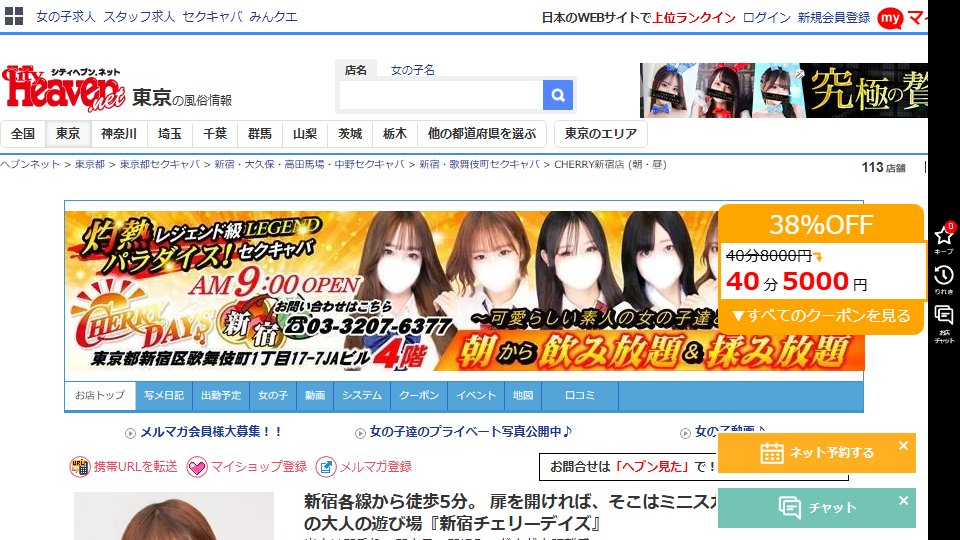

I went at nine in the morning, which is the only honest way to review this place, because the morning is the thesis. CHERRY新宿店(朝・昼) — CHERRY Shinjuku-ten, the Morning/Day branch — is a セクキャバ, a sec-kyaba or "sexy cabaret," on the fourth floor of the JA Building at Kabukicho 1-17-7, about five minutes on foot from Shinjuku Station. It runs 9:00 to last, year-round, no days off. Not a soap, not a delivery health, no hotel at the end of it: you buy a timed set, a drink, and a girl on the clock beside you, with contact that lives in the space between a straight hostess club and anything with a finish line. The branding is 学園系 — school-themed — and the line the shop actually sells is 「大人な青春を取り戻す」, get your adult youth back. Fine. Every themed room in Tokyo has a slogan. What made me write this one up is the price sheet, which is the most quietly sophisticated document I've read in Kabukicho this year.
Three Prices for One Chair
Here is the whole menu, and I want you to look at it as a grid rather than a list:
| 40 min | 60 min | 80 min | |
|---|---|---|---|
| 9:00–12:00 | ¥7,000 | ¥11,000 | ¥15,000 |
| 12:00–15:00 | ¥8,000 | ¥12,000 | ¥16,000 |
| 15:00–LAST | ¥9,000 | ¥13,000 | ¥17,000 |
Same room. Same format. Same forty minutes. ¥7,000 at ten in the morning, ¥9,000 at four in the afternoon. That's a 29% swing on identical inventory, and it exists for exactly one reason: at 10 AM the chairs are empty and at 4 PM they aren't. This is peak-load pricing, the same instrument that runs hotel rack rates and off-peak train fares, dropped into a sec-kyaba with no fanfare at all.
But look closer at how they built the ladder, because this is the part that tells you someone actually thought about it. The premium between bands is a flat ¥1,000 — not a percentage. It doesn't scale with the length of your set. Which means the time-of-day tax lands with wildly different force depending on what you order: on a 40-minute set, ¥1,000 is a 14% jump per band and 29% end to end. On an 80-minute set, that same ¥1,000 is 6.7%, and the full morning-to-evening spread is only 13%.
Translation: the morning discount is aimed squarely at the short set. If you're a short-set customer, coming early saves you real proportional money and the shop knows it will move you. If you're an 80-minute customer, the clock barely matters — you're a high-value booking they'll happily take at any hour, so they don't bother discounting hard to pull you forward. That's demand segmentation done with a single flat number instead of a spreadsheet of coupons, and it's elegant.
The Length Curve Runs Backwards
Now the line item almost nobody checks. Run the per-minute math on the morning band:
- 40 min at ¥7,000 → ¥175/min
- 60 min at ¥11,000 → ¥183/min
- 80 min at ¥15,000 → ¥187.5/min
Longer costs more per minute here. That inverts the near-universal convention in this trade, where the long course is the volume discount and the shop bribes you into staying. CHERRY does the opposite: the first forty minutes are the cheapest minutes you will buy, and every block after that is priced up, at a clean ¥200 per marginal minute for each additional twenty.
Read charitably, and I think charitably is correct, it's a labor argument rather than a greed argument. In a one-on-one cabaret the constrained resource isn't the room — it's the girl's hours. Long sets lock a cast member out of the rotation, so the house prices duration at its true opportunity cost instead of discounting it. The customer-facing consequence is worth internalizing before you sit down: at this shop there is no "buy in bulk and save." The 40 is the value buy on paper. The longer sets are for people who want the longer set, priced honestly as a premium instead of dressed up as a deal. I'd rather have that than a fake bargain.
The Coupon That Erases the Grid
Then you get to the coupon page and the entire structure I just described gets overwritten for one specific customer. The first-timer free-selection discount — フリーご新規様割引, new customers only, no designation, tell them you saw it on Cityheaven, register My Shop, post a write-up afterward — runs like this on the 40:
- OPEN–11:59: ¥7,000 → ¥5,000
- 12:00–14:59: ¥8,000 → ¥5,000
- 15:00–LAST: ¥9,000 → ¥6,000
Look at what that does. The morning and midday bands both collapse to ¥5,000. The ¥1,000 time premium I spent four paragraphs admiring is simply deleted across the entire first six hours of the day, and only the evening band keeps a thousand yen of separation. For a first-timer, the grid isn't a grid — it's two prices, before 3 PM and after.
And the discount depth tracks length in exactly the direction the base menu predicted: 38% off the 40 (¥8,000→¥5,000), 33% off the 60 (¥12,000→¥8,000), 25% off the 80 (¥16,000→¥12,000). The shop discounts hardest where it wants volume and least where it's selling scarce hours. Even after the coupon the per-minute curve stays inverted — ¥125/min on the 40, ¥133 on the 60, ¥150 on the 80 — which tells you the inversion is a genuine pricing philosophy here, not a rounding artifact on the base sheet.
The honest read: ¥5,000 for a 40-minute set in Kabukicho is a genuinely cheap way to find out whether the format is for you, and it costs the shop almost nothing to offer, because a first-timer at 10:30 on a Wednesday is filling a chair that was going to sit empty. Just know exactly what you're trading for it. Free selection means the house seats you — no designation, which is where the ¥3,000 would have gone. And the review requirement is the actual price of admission: you're not just a customer at ¥5,000, you're a marketing input. That's a fair deal, stated up front. It's only a bad deal if you didn't notice you'd agreed to it.
The ¥2,000 Tax on Deciding Late
This is the number I'd actually tattoo on a first-timer's hand. Extensions are priced separately: 20 minutes for ¥6,000, 40 minutes for ¥11,000.
Compare that against buying the same time up front. Booking a 60 instead of a 40 costs you ¥4,000 for the extra twenty. Extending by twenty once you're already in the chair costs ¥6,000. That is a ¥2,000 penalty — 50% more — for making the identical decision twenty minutes later. Go the full distance and it's the same story: booking an 80 over a 40 is ¥8,000 for the extra forty, while extending by forty in the room is ¥11,000. Three thousand yen for hesitating.
So the operating instruction is simple and I'd follow it literally: decide your total time before you sit down. If there's any real chance you'll want the hour, buy the hour at the counter. In-room extension at this shop is the most expensive minute on the entire price sheet — ¥300/min for the 20, ¥275/min for the 40 — and it is designed to be, because it's priced against a customer who has already stopped comparison shopping.
"No Automatic Extension" Is the Best Rule Here
Which is exactly why the next line matters so much: 自動延長なし — no automatic extension.
Understand what that rule prevents. The classic way a cabaret bill gets away from a man isn't a scam; it's a default. The clock hits zero, nobody says anything, the conversation is going well, and twenty minutes later there's a new line on the tab that you technically agreed to by not objecting. Opt-out billing. It's the single most reliable revenue leak-in-your-favor an operator can install, and plenty do.
CHERRY has switched it off. Your set ends when your set ends unless you affirmatively buy more. Pair that with the private-room structure — the shop advertises 完全1対1の空間, a fully one-on-one space rather than an open floor where you're sharing a couch and the lighting with three other tables — and you get a coherent posture: the expensive extension is on the menu in plain sight, and the shop won't sneak you into it. I will take a steep price I can see over a cheap price that renews itself while I'm not looking, every single time. The ¥6,000 extension is aggressive. The fact that it can only happen when you say the word is what makes it fair.
The Nomination Ladder, and Who's Actually Behind It
Two designation fees, and the gap between them is the point. 本指名 (honshimei) — requesting a specific girl you've had before — is ¥3,000. 場内指名 (jōnai shimei) — picking someone from the floor once you're already seated — is ¥2,000. And there are free-selection-only discounts, meaning the cheapest way through the door is to let the house seat you.
That's a three-rung ladder — free < in-house pick < named request — and it's priced to build a habit. Rung one is subsidized to fill the room. Rung two is the cheap upgrade you take in the moment. Rung three is the loyalty tier, and it's the only one that generates a returning customer. A thousand yen is a deliberately small step from ¥2,000 to ¥3,000; the shop is nudging you from I liked her to I'm here for her, which is the transition every cabaret in this city lives or dies on.
The roster is described across the usual four lanes — ギャル系, お姉さん系, 清楚系, ロリ系 (gal, mature, demure, youthful) — which, combined with a free-selection discount, tells you the house is confident enough in its floor-wide average to reward you for not choosing. Shops with two good girls and eight fillers never discount the free seat. On top of the coupon there are morning and mid-day cuts and reservation perks, so the posted grid isn't the last word in either direction. Ask at the counter.
One more thing I'd verify in person rather than take from a banner: the shop's own top visual advertises 「朝から飲み放題」 — all-you-can-drink from the 9 AM open. If that's the actual set term and not a promotional flourish, it changes the value calculation considerably, because the runaway drink tab is the classic way a cheap cabaret set stops being cheap. I couldn't get the system page to load past the age gate to confirm the fine print, so treat it as the one number on this whole sheet I can't vouch for. Ask what the set includes before the first glass lands — which is good practice at any sec-kyaba in this city, coupon or no coupon.
The Verdict on the Machine
- Price architecture: ★★★★★ — a real time-of-day grid with a flat ¥1,000 band premium that self-targets the short-set customer. Deliberate work, not guesswork.
- Length pricing: ★★★☆☆ — inverted curve before and after the coupon, so no bulk discount exists anywhere on the sheet. Defensible under a one-on-one labor model, but it costs the long-stay customer.
- First-timer value: ★★★★★ — ¥5,000 for 40 minutes any time before 3 PM is a legitimately cheap entry, paid for with a review and free selection.
- Extension honesty: ★★★★☆ — steep (¥6,000/20 min), but disclosed up front and never auto-applied. The ¥2,000 late-decision gap is the trap, and it's a trap in daylight.
- Anti-dark-pattern posture: ★★★★★ — 自動延長なし plus 完全1対1. No silent renewals, no shared-floor bait.
- Best buy: first visit, the coupon 40 at ¥5,000 before noon. After that, the 9:00–12:00 40 at ¥7,000 — with your total time decided at the counter, not in the chair.
- Going back: ○ — for a nine-in-the-morning Kabukicho room where the bill is knowable before you sit, yes. Just don't extend on impulse.
The 9 AM door is the thing I keep circling back to. A shop that opens at nine in Kabukicho isn't chasing the salaryman — it's catching the people whose day is ending at nine, the ones coming off a night shift into a district that's still exhaling, plus the early wanderers with a gap before anything else opens. That's an underserved hour, and CHERRY didn't just open for it, it priced for it: the cheapest chair in the building is the one nobody else wants. The school theme is the wrapper and "getting your adult youth back" is the poetry, and you can take that or leave it. What I came away respecting was the arithmetic underneath — a shop that knows precisely what a Tuesday morning is worth, charges accordingly, and then refuses to restart your clock without asking. Morning run out of Kabukicho logged, and the grid held up.