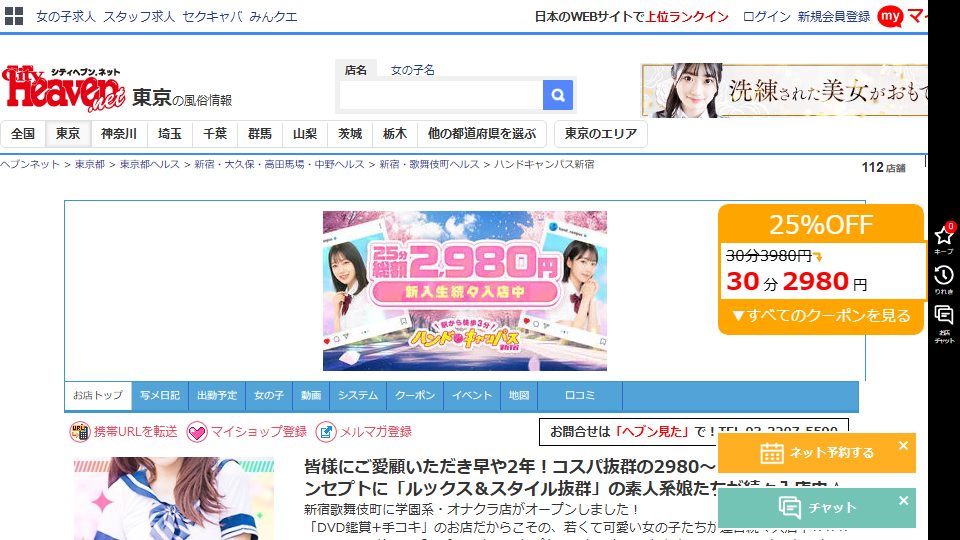

Let me tell you what Hand Campus Shinjuku actually is, because the category confuses first-timers and the price confuses everyone. It's an オナクラ — an onakura, a hand-service club — sitting on the ninth floor of a building in Kabukicho, five minutes on foot from the JR Shinjuku East Exit, three from Seibu-Shinjuku. It's a storefront operation, not delivery: you go to them, into a private room in the building, and the whole event is exactly one thing. Hand service. That's the product. No penetration, no full-service theater, no elaborate ritual. The name says "campus" and leans on a cute, young, lover-next-door frame, but the branding is the wrapping paper. The actual business is the most ruthlessly unbundled format on the entire street.
The ¥2,980 Number Is a Thesis Statement
Here's what stopped me. The entry course — they call it A — is ¥2,980 for 25 minutes. Read that number twice. In a district where the soaplands are pricing courses in the tens of thousands and the deli-heru floor sits around eleven grand an hour, this shop opens the bidding at under three thousand yen. From there the ladder is short and legible: the B and C courses run ¥3,980 to ¥4,980 for 30 minutes, and the premium D course is ¥9,980 for 35 minutes with a shower, a costume, and a ¥2,000 option folded in. There are couple courses from ¥5,980 to ¥8,980, designation fees of ¥1,000 to ¥2,000, and an options list stretching ¥500 to ¥3,000. But the headline is that ¥2,980 door, and that number isn't a discount. It's a thesis. The thesis is: if you delete everything except the core sensation, you can price the core sensation at what it actually costs to deliver, and a whole population of customers who were priced out of the room can finally walk in.
What Gets Deleted, and Why That's the Point
Think about everything a full-service shop has to build and staff and insure. The elaborate finish, the extended time blocks, the risk profile, the pricing that has to cover all of it. An onakura takes a scalpel to that entire stack. The service is bounded, the courses are short, the room is in-house so there's no hotel logistics or dispatch fuel, and the whole thing runs on high throughput instead of high margin. Hours are 7:00 in the morning to 23:59, no closing days — a window that only makes sense if your model is volume: the salaryman before work, the guy killing forty minutes between trains, the customer who wants exactly one specific thing and resents paying for the ninety percent of a full course he was never going to use. Deleting the rest isn't stinginess. It's the entire value proposition. You're not buying a cheaper version of the big experience. You're buying a different product that happens to cost a tenth as much because it is a tenth of the surface area.
The Location Tax, Paid in Reverse
Now factor in where this sits. Kabukicho, ninth floor, a few minutes from two different Shinjuku stations. Prime real estate in the densest nightlife district in the country. A shop paying that kind of address usually passes the rent straight to you in the headline price — that's the location tax, and in Kabukicho it's brutal. Hand Campus does the opposite. It uses the location as a throughput multiplier instead of a pricing excuse. When you're steps from a station moving millions of people a day, you don't need a fat margin per customer; you need a steady stream of them, and the ¥2,980 door is precisely how you keep that stream flowing. The address that would justify a premium at a full-service shop instead subsidizes the volume model here. Same real estate, inverted economics. That's not an accident of the format — it's the format working exactly as designed.
The Ladder Is Built So You Can't Overpay by Accident
I want to flag the course structure, because it's cleaner than most. You enter at ¥2,980 and every step up is a legible upgrade you actively choose — more minutes at B and C, and at the D tier a genuine change in kind: shower, costume, a bundled option, for ¥9,980. Nothing is smuggled in. The designation and option fees are printed and modest. There's no mystery surcharge waiting at the door, no "the price you saw was the starting bid" trap that makes budget shops feel like a shakedown. A well-built value ladder does one thing above all: it makes it impossible to overpay by accident. You get exactly the scope you selected, and if you want more you climb one rung and know precisely what the rung costs. For a first-timer to the whole category, that legibility is worth as much as the low floor.
The Verdict on the Format
- Price floor: ★★★★★ — ¥2,980 for 25 minutes is about as low as a real, staffed, private-room experience goes in central Tokyo.
- Scope honesty: ★★★★★ — one job, bounded and clearly stated; you know the shape of the whole thing before you climb the stairs.
- Ladder legibility: ★★★★☆ — short, clean tiers with printed fees and no ambush surcharges.
- Location leverage: ★★★★☆ — Kabukicho address used as a volume engine instead of a pricing excuse.
- Going back: ○ — if you want exactly the thing this shop sells, nothing else on the street competes on cost-per-scope.
I walked in half-expecting the ¥2,980 headline to be the usual bait — the number that gets you through the door before the real bill materializes. Wrong read. The number is the product. Hand Campus Shinjuku isn't a discount version of something bigger; it's a company that took the standard adult-entertainment menu, deleted everything except the single component most of its customers actually came for, and priced that component at the floor. Where the big shops sell you a full stack you half-use, this one sells you one clean function and refuses to charge you for the rest. That's not the shop for the man who wants the elaborate all-night experience; he has a hundred other numbers to dial. It's the shop for the man who knows exactly what he wants, has forty minutes and a few thousand yen, and is tired of paying for ninety percent he never ordered. Scope selected, price honored, nothing smuggled in. The delete key, it turns out, is the sharpest tool in the whole district.