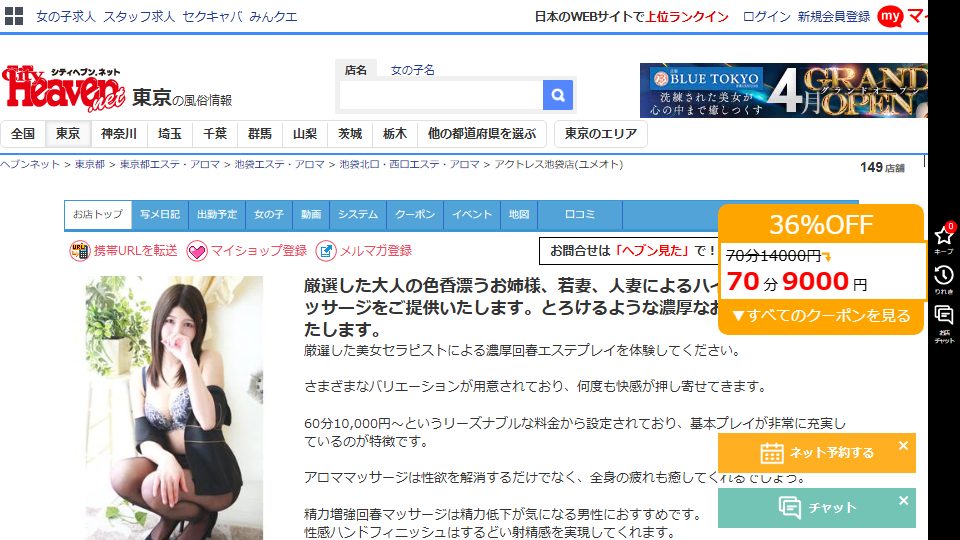

Let's get the category straight first, because the word "esthetic" does a lot of load-bearing work here. Actress Ikebukuro is a fuzoku esthe — an aroma-massage house — running out of the Ikebukuro north/west exit side, part of the sprawling Yumeoto group. It is not a soap, not a store-front you swagger into. The pitch is narrow and deliberate: "sophisticated older women, young wives, and married women" delivering high-end sensual massage. That's a casting decision, not a slogan, and it's the first thing I wanted to test — because a shop that segments on maturity is aiming at a customer the volume houses can't be bothered to serve.
The Two-Rung Ladder
Here's the whole business in two lines. There's a Massage Pleasure course, clothed — 60 min ¥10,000, 90 min ¥16,000, 120 min ¥22,000 — and above it an Intense Intimacy course, all-nude — 70 min ¥14,000, 100 min ¥20,000, 130 min ¥26,000. Read those two rungs side by side and the shop's entire strategy falls out. The clothed course is the door — a low, honest entry price that lets a first-timer test the water without committing. The nude course is the destination, and notice they didn't just strip the clothes off the same 60 minutes; they added ten minutes and roughly four thousand yen at every tier. That extra ten minutes is the tell. They're not selling you skin, they're selling you room to arrive — a slower runway so the escalation feels earned instead of transactional. A cheap house would've priced the nude course at the same clock. Actress lengthened it. That's a shop that understands its own product is pacing, not friction.
Why the Gap Between the Rungs Matters
The spacing on a price staircase is never random. From ¥10,000 clothed to ¥14,000 nude at the entry tier is a ¥4,000 step — big enough to mean something, small enough that the man who came for the ¥10,000 door can talk himself up one rung without a gut-check. That's textbook: make the first step cheap, make the upgrade the real product, and keep the gap climbable. And the top of the ladder — 130 minutes, ¥26,000 — isn't priced for the walk-in at all. That's a regular's number, the repeat customer who already knows the cast and is buying time, not novelty. One menu, two completely different customers, and the ladder quietly routes each of them to the rung that fits. Most reviewers see "two courses" and move on. The two courses are the business model.
Selling Maturity as a Category
Now the casting. "Older women, young wives, married women" reads like flavor text until you clock what it's actually doing: it's anti-competition. Ikebukuro is wall-to-wall with houses selling youth — the twenty-year-old panel, the schoolgirl cosplay, the fresh-faces churn. Every one of those shops is fighting the same price war for the same customer. Actress walked to the other end of the room. Segmenting on maturity means a smaller pool of applicants, sure, but also a customer who isn't shopping on age and won't defect the moment a younger panel opens across the street. That's a defensible position — you don't win the youth war, you decline to enter it. And it dovetails with the whole "esthetic" framing: mature casting plus a massage-first product signals skill over spectacle, a slower, competent experience aimed at a man who's done with the churn. The catchphrase sells sophistication. The strategy underneath it sells defensibility.
The 1,500-Cast Machine Behind the Room
Here's the part the single-shop reviews never surface: Actress isn't a lone room, it's a node on the Yumeoto network — a membership brand tying together some 40-plus partner shops and roughly 1,500 registered cast across affiliated groups, with a ¥5,000 point bonus just for signing up. Read that as loyalty economics, not decoration. A ¥5,000 welcome credit is a customer acquisition subsidy — the network is buying your membership because it knows a member spends across shops, not just this one. And 1,500 pooled cast means the recruiting funnel, the point ledger, the booking system are all shared cost, amortized across forty houses instead of carried by one room near the north exit. That's how a boutique aroma house can afford to segment on mature women — a lone shop couldn't fund that narrow a niche, but a node on a 40-shop network can, because the expensive machinery is somebody else's fixed cost. The membership is the moat. The points are the switching cost. The room is just where you spend them.
The Verdict on the Ladder
- Course design: ★★★★★ — a clean clothed-to-nude staircase with a deliberately longer nude runway; the pacing is the product, and it's priced like the shop knows it.
- Price-gap discipline: ★★★★☆ — a ¥4,000 entry-to-upgrade step is a climbable, well-engineered acquisition ladder; the ¥26,000 top rung is a regular's number, not a walk-in's.
- Market positioning: ★★★★☆ — segmenting on mature/married-woman play is a defensible flank away from Ikebukuro's youth price-war; skill-over-spectacle, and it holds.
- Network economics: ★★★★☆ — Yumeoto's 40-shop, ~1,500-cast membership and ¥5,000 welcome credit fund a niche a lone house couldn't, and quietly lock in the repeat.
- Going back: ○ — for a slower, competent night with someone who isn't selling youth, the door rung is honestly priced and the ladder up is built to feel earned.
I came to read the menu, and Actress Ikebukuro turned out to be a menu worth reading. The clothed course is the door and the nude course is the business; the ten extra minutes on the upgrade tells you they're selling pacing, not skin; the ¥4,000 gap is a customer-acquisition ladder engineered to be climbed. The mature-women casting isn't flavor — it's a decision to skip the youth war entirely and hold a defensible flank. And the Yumeoto network underneath is doing the quiet math that lets a narrow niche pay for itself. Most houses hand you a price list and hope you don't think about it. This one hands you a price list that thinks for you — and if you read the rungs instead of the catchphrase, it tells you exactly what kind of shop it means to be. First read logged, and the ladder checks out.