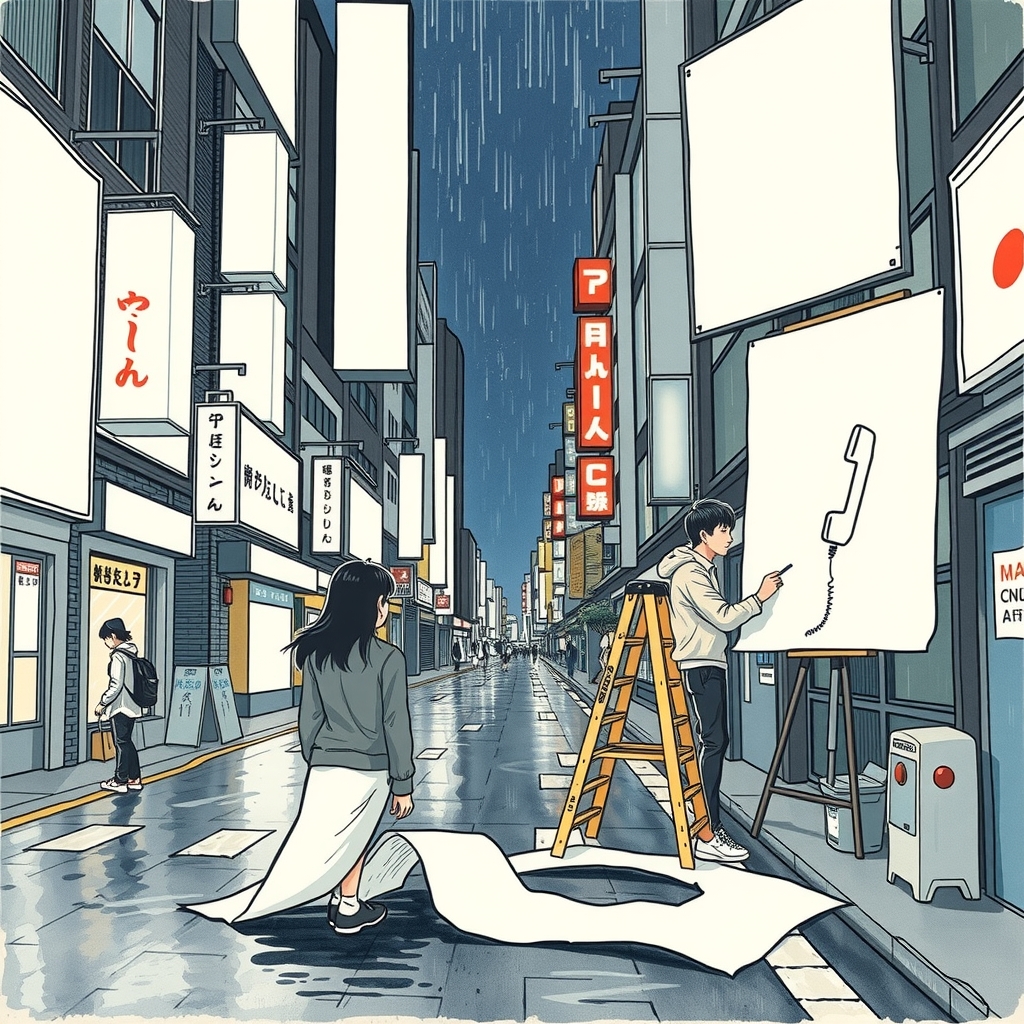
A Helpline and an Advertising Problem
Osaka Prefectural Police opened a consultation desk in April 2026 for women driven into debt by host clubs. This month the force gathered fifteen students and one instructor from a vocational school in the city and gave them letters of appreciation for making the commercials.
The commendation was reported by NHK on September 17 and by MBS on September 19. Both described the same thing: a police service that exists, that is free, that runs an intake form open around the clock — and that had no obvious way of reaching the women it was built for.
The students are enrolled at HAL Osaka, a vocational school near Osaka Station that trains people in IT, computer graphics and game design. Sixteen of them worked on the project. They produced two short videos.
In the first, a woman is quoted a modest opening price at a host club and is then presented with a bill far larger than the one she agreed to. In the second, a woman's phone fills with messages from a host demanding payment.
Neither scenario is invented. Both are halves of the mechanism that Japanese police spent the last two years writing law against.
The videos have been posted to the Osaka Prefectural Police's official YouTube channel and are to be played on digital signage in the city's entertainment districts.
What the Desk Covers
The service is formally the Women's Victim Consultation Desk on Malicious Host Clubs and Similar Businesses, and its scope is narrower and more specific than a general crime line.
| Osaka Prefectural Police consultation desk | |
|---|---|
| Opened | April 2026 |
| Intake form | Online, available 24 hours |
| Telephone | 06-6943-1234, weekdays 9:00–17:45 |
| Closed | Weekends, public holidays, December 29 – January 3 |
| Covers | Host clubs and men's concept cafés |
| Typical complaint | Large debt run up as urikake (tab) or maegari (advance); intimidating repayment demands; being urged into prostitution or into work at a sex business |
| Also refers callers to | Consumer hotline 188; Houterasu legal aid; sexual-violence support centers on #8891 |
Two of the students described the work in terms closer to public health than to advertising. Kusunoki Yuta, 21, said he made his video "hoping people will be careful not to get caught out over money." A 20-year-old classmate said that through the production she had come to see harm from predatory hosts "as a problem close to home."
Suetsugu Takashi, a section chief with the prefectural police, said the videos would "extend a helping hand to women victims suffering alone."
The Machine the Law Was Written Against
The chain the desk is meant to interrupt is short and well documented.
A young woman accumulates a tab at a host club under the urikake credit system, in which drinks are served against a promise to pay later. The balance grows past what she earns. A recruiter — a scout — presents sex work as the only arithmetic that closes the gap. She goes to work at a sex business, and the recruiter takes a cut of what she earns for as long as she stays.
Japan's answer was the revised fūei-hō — the Businesses Affecting Public Morals Regulation Act — which took effect on June 28, 2025. It prohibits irokoi eigyō, sales tactics that trade on a customer's romantic feelings; it prohibits false explanations of price; it prohibits demanding that a woman work at a sex establishment or appear in adult videos to settle a tab; and it prohibits the scout-back, the referral fee a sex business pays a recruiter for delivering a worker.
That last prohibition is the one the trade has been testing. Operators told FRIDAY Digital earlier this month that the kickback rate has risen since the ban rather than fallen, from roughly 15 percent of a woman's monthly earnings to near 20 percent, with licensed scouting firms withdrawing and anonymous groups taking the business.
A Falling Number That Can Be Read Two Ways
The National Police Agency published its 2025 figures on April 23, 2026, and every line moved downward.
| Malicious host clubs, nationwide, 2025 | Change from 2024 | |
|---|---|---|
| People cited or arrested | 143 | −64 |
| Administrative actions against premises | 251 | −456 |
| Consultations to police | 2,369 | −407 |
The NPA's reading, reported by Jiji Press, is deterrence: the June 2025 amendment changed conduct, so there was less conduct to cite.
That is a plausible account of the enforcement figures. It is a weaker account of the consultation figure. Enforcement counts what police do. Consultations count what the public does, and a drop of 407 can mean that fewer women were harmed, or that fewer of those harmed came forward.
Osaka's decision to open a dedicated desk in April, and then to commission advertising for it five months later, is consistent with a force that does not assume the first reading. The prefecture has not published how many consultations the desk has received since it opened, and neither broadcaster asked.
The Rest of the Month
The commendation landed in the middle of a concentrated stretch of activity on the same subject.
On September 15, police in Nagoya held a briefing for host club employees on the revised regulations, telling operators not to run businesses that exploit customers' romantic feelings. The same day, the Cabinet's revised anti-trafficking Action Plan was agreed in draft, naming strict enforcement against malicious host clubs as policy. On September 17, a Ministry of Justice expert panel filed its final report recommending that soliciting to buy sex be made punishable for the first time in the 70-year life of the baishun bōshi-hō, the Anti-Prostitution Act.
Those are national instruments, and they operate on operators, buyers and brokers. The Osaka desk operates on the other end of the same chain, and it only works if a woman in debt knows it exists and calls it.
Which is why a police force in Japan's second city spent part of this month doing something a police force does not normally do: acknowledging, in the form of sixteen letters of appreciation, that building the service was the easier half of the job.
Sources: NHK, reporting September 17, 2026, and MBS, reporting September 19, 2026, for the commendation to fifteen students and one instructor at HAL Osaka, the April 2026 opening of the Osaka Prefectural Police consultation desk, the content of the two videos, their publication on the force's official YouTube channel and planned display on digital signage in Osaka's entertainment districts, and the quoted remarks of Kusunoki Yuta, of a 20-year-old classmate, and of section chief Suetsugu Takashi; the Osaka Prefectural Police's own published page on the Women's Victim Consultation Desk on Malicious Host Clubs and Similar Businesses for the desk's scope, hours, intake form and referral lines, and for its summary of the revised fūei-hō prohibitions; Jiji Press, reporting April 23, 2026 on National Police Agency figures, for the 143 people cited nationwide in 2025, the 251 administrative actions, the 2,369 consultations and the year-on-year changes; FRIDAY Digital, September 11, 2026, for operators' accounts of the scout-back rate since the ban; NHK, September 15, 2026, for the Nagoya briefing for host club employees; and reporting of September 15 and September 17, 2026 for the Cabinet's revised anti-trafficking Action Plan and the Ministry of Justice panel's final report. Glossary: fūei-hō = Businesses Affecting Public Morals Regulation Act; baishun bōshi-hō = Anti-Prostitution Act; urikake = a customer's running tab at a host club; maegari = a wage advance; irokoi eigyō = sales tactics exploiting a customer's romantic feelings; scout-back = a referral fee paid by a sex business to a recruiter. No one is accused of an offense in this report.