The Arrest
The charge is a line on a hotel form.
The Metropolitan Police Department's Organized Crime Control Division announced on August 25, 2026 that it had re-arrested Hiroaki Obata, 41, the chairman of Natural — the organization Japanese investigators describe as the country's largest illegal scout group for the sex trade — on suspicion of forgery and use of a forged private document bearing a signature, an offense under Japan's Penal Code.
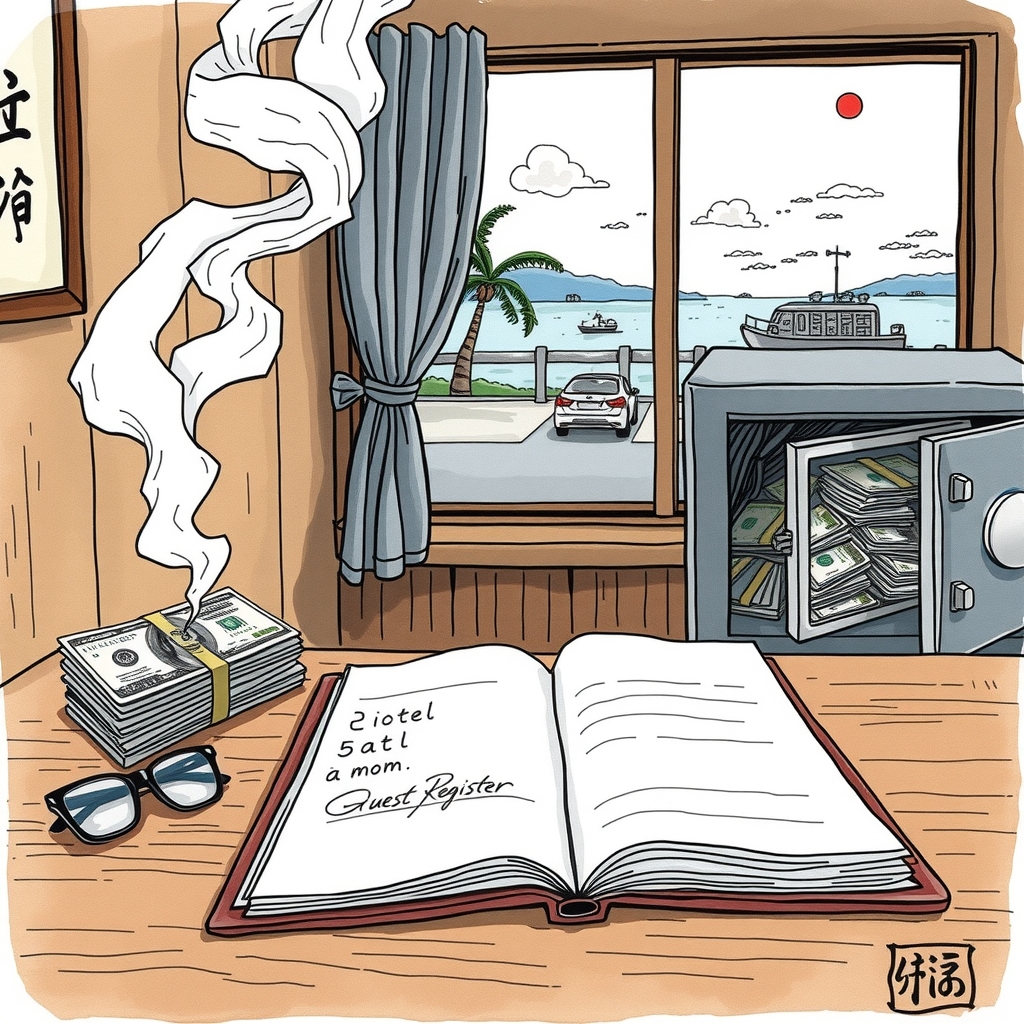
Police say that in December 2025, at a hotel in Amami City, Kagoshima Prefecture, Obata filled out the guest register with the name, address and mobile phone number of a person who does not exist. According to Sankei Shimbun, he checked in as "Kazuya Nakayama." Investigators traced the stay through key-card records and security-camera footage.
Asked about the allegation, Obata told police, in the phrasing carried by Jiji Press: "That is correct." He has admitted it.
It is the ninth time he has been arrested.
What Was in the Room
The Organized Crime Control Division put a number on the stay. Obata had prepaid roughly ¥480,000 in cash for 44 nights — about $3,200 — a figure Jiji Press and Sankei both report and that FNN's Fuji Television network rendered as about half a million yen. No credit card. No installments. Forty-four nights, settled in advance, in banknotes.
When officers took him into custody, he was carrying about ¥130,000. In the safe in his hotel room they found about ¥1.7 million. Police believe that money was there to fund the next leg of his flight.
The detail that gives the case its shape is not the sum. It is the arithmetic of a man who books a room by the month and pays for it the way one buys a train ticket — cash, no name attached, nothing that leaves a record in a bank.
That arithmetic is what eventually caught him. A hotel register in Japan is not a formality; under the Hotel Business Act (ryokan gyo-ho), lodging operators are required to record each guest's name, address and occupation and to keep the register available for inspection. Writing a person into that record who does not exist is not a lie to a clerk. It is, under Japanese law, the manufacture of a document.
The Year He Was Gone
The stay on Amami Oshima was the end of a long absence.
In January 2025, according to the account carried by Jiji Press and Sankei, Obata disappeared days before the Metropolitan Police executed simultaneous searches of sex businesses and premises tied to Natural. He was not found for a year.
On January 21, 2026, Tokyo police issued a public wanted notice for him — a step Japanese police take sparingly. The underlying suspicion, as reported by the Nikkei, was a violation of Tokyo's Organized Crime Exclusion Ordinance: that in July 2023 he paid ¥600,000 to a gang boss in Shibuya as mikajimeryo — protection money — in exchange for permission to run scouting operations there.
Five days later, on January 26, 2026, he was taken into custody at a convenience store in Amami City. He was moved to Tokyo the following day.
The picture investigators assembled of the intervening months, as reported by FNN, is of a man moving through western Japan — the Kansai region, then Kyushu — before settling on an island 380 miles southwest of the mainland. He had grown a beard and was wearing black-rimmed glasses. Jiji Press reported at the time of his capture that he had been at the Amami hotel since December 21, 2025, that his room was paid through roughly February 3, and that he had started in a single room and later moved to a twin.
Sankei reports that earlier this month, Obata was arrested on a similar charge over false information given to a lodging facility in Tahara City, Aichi Prefecture. Friday's case is the second built on a hotel register.
Why the Charge Is Forgery
Obata is already standing trial. The case against him in the Tokyo District Court is a violation of the Employment Security Act (shokugyo antei-ho) — the national statute barring unlicensed labor placement, including placement into work harmful to public health or morals. At his first hearing in May he told the court he did not contest the charges.
That statute is the one that reaches what Natural is accused of doing. It does not reach what he did while police were looking for him.
So the ninth arrest is built out of different material: a Penal Code offense that has nothing to do with the sex industry and everything to do with the year he spent outside it. Forgery of a private document bearing a signature carries up to five years' confinement — a modest exposure next to the charges already filed, and not the point. An arrest resets the clock on detention and gives investigators a fresh window for questioning. Six weeks before an autumn court calendar, that window has value.
Japanese police have used this pattern before against defendants they consider central to a larger structure. The charge is small. The custody is not.
| Detail | As reported |
|---|---|
| Date announced | August 25, 2026 |
| Agency | Metropolitan Police Department, Organized Crime Control Division |
| Suspect | Hiroaki Obata, 41, chairman of Natural |
| Charge | Suspicion of forgery and use of a forged private document bearing a signature (Penal Code) |
| Alleged conduct | Entering a fictitious person's name, address and mobile number in a hotel guest register in Amami City, Kagoshima, in December 2025 |
| Alias | "Kazuya Nakayama" (Sankei) |
| Payment | About ¥480,000 in cash, prepaid for 44 nights |
| Cash recovered | About ¥130,000 on his person; about ¥1.7 million in the room safe, believed to be escape funds |
| Plea | Admits the allegation |
| Arrest count | Ninth |
| Prior case | On trial for violating the Employment Security Act; did not contest the charges at his first hearing in May |
| Flight | Disappeared January 2025 before nationwide searches; publicly wanted January 21, 2026; taken into custody January 26, 2026 |
The Organization Behind the Register
Natural is not a street crew. Police classify it as a tokuryu — an anonymous, fluid-type criminal group, the category Japanese law enforcement created for organizations that recruit and disband online without the fixed membership of a boryokudan.
At the time of the January 2025 searches, the group was reported to have roughly 1,500 members and working relationships with about 4,000 sex-industry businesses nationwide. The Nikkei reported an estimated ¥4.445 billion in revenue for 2022 — around $30 million — drawn from referral fees, which prior reporting by Jiji Press has put at roughly 15 percent of what a referred woman earns, collected for as long as she works.
The prosecutions since have moved down the chart. Obata's deputy was arrested in June, found at a pachinko parlor in Osaka. Three leaders were re-arrested in July, after police disclosed that the group's executives had rotated their meetings through rented conference rooms and karaoke boxes to stay ahead of surveillance. A 24-year-old described by investigators as a productive street recruiter was arrested on August 12.
What It Does Not Settle
The arrest announced Friday tells you where Obata slept in December. It does not touch the transaction the whole enterprise runs on.
Nothing in the forgery charge concerns the women. Not the recruitment, not the referral, not the standing percentage that follows a woman out of the interview room and into every shift she works afterward. Those questions belong to the Employment Security Act case now before the Tokyo District Court, and to the proceeds-concealment case police built in June around ¥39.2 million routed out of a Chiba soapland under falsified receipts.
What the ninth arrest does establish is the texture of the year Natural's chairman spent unavailable to any of it: a paid-through room on an island, a beard, a name that belonged to no one, and ¥1.7 million in a hotel safe.
An arrest is not a conviction, and none of the allegations described here has been tested in court.
This article is compiled from Japanese reporting on the August 25, 2026 re-arrest: Jiji Press, which reported the charge, the Organized Crime Control Division's account of the December 2025 hotel register, the roughly ¥480,000 prepaid for 44 nights, the ¥130,000 carried and ¥1.7 million found in the room safe, the ninth-arrest count and Obata's admission; Sankei Shimbun, which reported the "Kazuya Nakayama" alias, the key-card and security-footage evidence, and the earlier arrest this month over a lodging facility in Tahara City, Aichi; and FNN Prime Online (Fuji Television), which reported the prepaid lodging figure, the escape-fund characterization, and his movements through the Kansai and Kyushu regions in disguise. The Mainichi Shimbun, TBS NEWS DIG (JNN), the TV Asahi network (ANN) and ABEMA TIMES carried the same account the same day. Background on the flight and capture is from Jiji Press reporting of January 26–27, 2026, and on the public wanted notice and the alleged ¥600,000 protection payment from the Nikkei. Figures for the group's membership, partner businesses and 2022 revenue are as reported by Japanese outlets at the time of the January 2025 searches and have not been independently verified by this publication. Legal gloss: the Employment Security Act (shokugyo antei-ho) bars unlicensed labor placement, including into work harmful to public health or morals; the Hotel Business Act (ryokan gyo-ho) requires lodging operators to keep guest registers; the Businesses Affecting Public Morals Regulation Act (fuei-ho) licenses and regulates adult-entertainment businesses; and the Anti-Prostitution Act (baishun boshi-ho) criminalizes solicitation, brokerage and the provision of premises for prostitution.