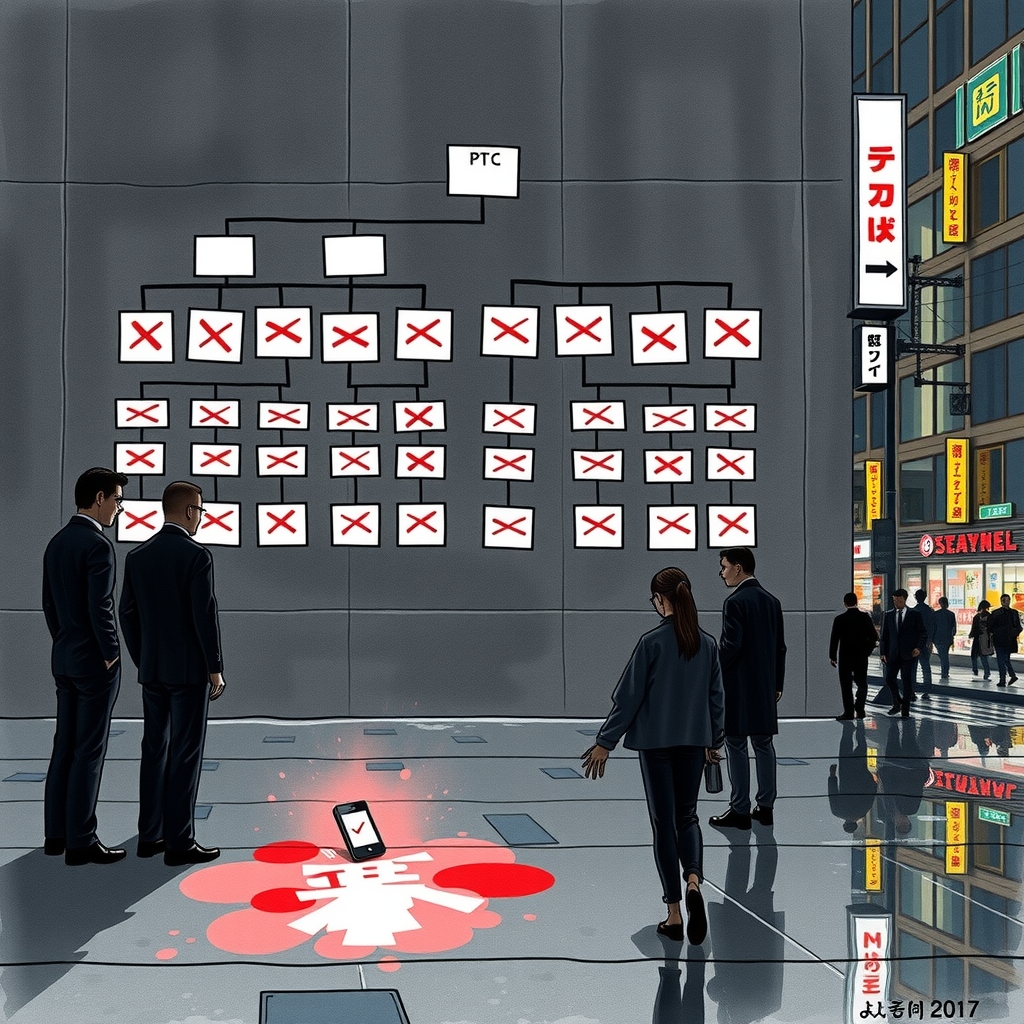
The Arrest
The Tokyo Metropolitan Police announced on August 12 that they had arrested a 24-year-old man on suspicion of violating the Employment Security Act (shokugyo antei-ho) — the national statute that bars unlicensed labor placement and, in the provision at issue here, prohibits placing a person into work harmful to public health or morals.
Police identified him as Yoshimura, 24. His residence and occupation were listed as unknown, according to the TBS network (JNN). He is described as a member of Natural, the organization Japanese police and press routinely call the country's largest illegal scout group for the sex trade.
The allegation is narrow. Between roughly mid-September and mid-November of 2023, investigators say, Yoshimura referred a woman who was then in her 20s to a sex business in Takasaki, Gunma Prefecture, so that she would work there. That is the whole of the arrest warrant as reported.
The characterization is not narrow at all. According to the Metropolitan Police, Yoshimura recruited women himself, over social media, and pushed them to show up at the interview venues the shops used. He had referred enough of them, for long enough, that investigators had a name for him: yarite no pureiya — a skilled player, an operator who closes.
NHK reported that the Metropolitan Police regard him as a central figure among the people who actually did the scouting. The distinction matters, and it is the reason this arrest is different from the ones that came before it.
Eighteen Months at the Top of the Chart
Since early 2025, the case against Natural has been built downward from the executive suite.
The group's chairman, Hiroaki Obata, 41, was arrested on January 26, 2026, on Amami Oshima — roughly 1,200 kilometers from the Kabukicho streets where his organization worked — after a public manhunt. He has been arrested repeatedly since, including in June on suspicion of concealing about ¥39.2 million in referral income routed through a Chiba soapland, and again on July 7 alongside two other leaders. He is on trial.
The group's reported No. 2, Yuto Enomoto, 35, was arrested on June 11, 2026, and described by investigators as the supervisor of the operations division. He had been wanted since April; police found him at a pachinko parlor in Umeda, Osaka.
An executive of what investigators describe as the collection and accounting division was arrested in June. Three leaders were re-arrested on July 7, when police disclosed that Natural's executives briefed each other in rented conference rooms and karaoke boxes, rotating the venue every time to stay ahead of surveillance.
Those are all arrests of men who managed a system. The August 12 arrest is an arrest of a man accused of working it.
What a "Player" Is
Inside Natural, according to Japanese reporting on the group's structure, pureiya — "player" — is a job title, not a compliment. Players are the members who make contact with women and put them into shops. Above them sit divisional layers: recruitment, collection, accounting, and, in the accounts published by the weekly press, an app division that maintained the group's encrypted internal messaging and a unit whose function was monitoring police activity.
The Metropolitan Police classify Natural as a tokumei ryudo-gata crime group — an "anonymous, fluid" organization, the designation Japanese police adopted for networks that recruit disposable labor online, distribute tasks through encrypted apps, and lack the fixed membership rolls that make traditional yakuza syndicates legible to law enforcement.
That structure is precisely what makes a case like Yoshimura's hard to build and worth building. The organization is designed so that the person who touches the woman and the person who takes the money are separated by several layers of app traffic. A player is the point of contact. He is also, in evidentiary terms, the only person in the chain who can be tied to a specific woman on a specific date.
The financial scale police attribute to the whole arrangement is large. Natural is believed to have taken in roughly ¥4.5 billion a year from sex businesses in return for supplying women, according to figures cited by ABEMA TIMES and the Okinawan broadcaster QAB. Jiji Press reported in March 2026 that the referral cut ran to about 15 percent of what a woman subsequently earned — not a one-time finder's fee, but a standing percentage.
Shukan Bunshun, which has reported extensively on the group's internal workings, has put its membership at roughly 2,000 and published accounts of violent discipline imposed on members who broke ranks. Those figures come from magazine reporting rather than from police statements, and should be read as such.
The Takasaki Detail
One element of the August 12 allegation is worth setting beside the record.
Yoshimura is accused of referring a woman in her 20s to a sex business in Takasaki, Gunma, in the autumn of 2023. When the Metropolitan Police arrested Enomoto — Natural's reported No. 2 — in June, the conduct alleged against him was described in the same terms: the referral of a woman in her 20s to a sex business in Takasaki, Gunma, in 2023.
Police have not publicly stated that these are the same referral, and this article does not assert that they are. But the pairing describes the shape investigators appear to be working with: a single provable placement, charged upward against the man said to have supervised the operation and, fourteen months later, downward against the man said to have made the approach.
That is a normal way to build a case against a networked organization. It is also a reminder of how much of the alleged conduct never enters a charging document. Natural is accused of moving women into shops across the country at industrial scale. What the Employment Security Act requires prosecutors to prove is one placement, one woman, one shop, one window of dates.
A Discrepancy Worth Noting
Japanese outlets did not agree on Yoshimura's rank. ABEMA TIMES headlined its report with kanbu — executive — and described him as having handled recruitment and placement for the group. NHK and TBS called him a member, with NHK adding that police view him as a central figure among those doing the actual scouting.
The gap is small but not meaningless. Whether a 24-year-old who recruits over social media is an executive of a 2,000-person organization or its most productive line worker is a question about how Natural was structured, and it is one the investigation has not publicly resolved. The Metropolitan Police have not disclosed whether Yoshimura admits or denies the allegation.
| Detail | As reported |
|---|---|
| Date announced | August 12, 2026 |
| Suspect | Yoshimura, 24; residence and occupation listed as unknown |
| Charge | Suspicion of violating the Employment Security Act (placement into work harmful to public morals) |
| Alleged conduct | Referring a woman then in her 20s to a sex business in Takasaki, Gunma, roughly mid-September to mid-November 2023 |
| Alleged method | Recruiting women himself via social media; directing them to shops' interview venues |
| Investigators' description | Yarite no pureiya — "a skilled player"; a central figure among those doing the actual scouting (NHK) |
| Rank | Reported as "member" by NHK and TBS; as "executive" by ABEMA TIMES |
| Organization | Natural, classified by police as an anonymous, fluid-type crime group (tokuryu) |
| Group's reported income | About ¥4.5 billion a year in referral money from sex businesses; roughly a 15% cut of earnings (Jiji, March 2026) |
| Plea | Not disclosed |
What This Case Tests
Two things are unresolved, and they are the two that matter for whether the campaign against Natural amounts to more than a series of headlines.
The first is durability. Every previous arrest in this case removed someone who could be replaced — a chairman replaced by a deputy, a deputy replaced by whoever briefs the divisions next. A player is the most replaceable person in the structure. The Metropolitan Police have now spent eighteen months dismantling Natural from the top, and the enforcement figures Tokyo released a week ago point in an uncomfortable direction: 49 street scouts arrested in the first half of 2026, more than in all of 2025, ten of them university students. The organization is being taken apart at the same moment the sidewalk is filling with people willing to do the work.
The second is what the statute reaches. The Employment Security Act punishes the placement. It does not reach the arrangement that gives the placement its value — the standing percentage a woman owes on everything she earns afterward, sometimes for years, to a person she met once on a street or in a direct message. Police have described that percentage. No charge in this case has yet been built on it.
A 24-year-old was arrested for a referral he is alleged to have made almost three years ago. The woman he is alleged to have referred is not named in any account, and her account of what happened next is not in the record. Neither is the shop's.
This article is compiled from Japanese reporting on the August 12, 2026 arrest: NHK, which reported the arrest and that the Metropolitan Police regard the suspect as a central figure among those performing the actual scouting; TBS NEWS DIG (JNN), which reported the suspect's age, the listing of his residence and occupation as unknown, the Employment Security Act charge, the mid-September to mid-November 2023 window, the Takasaki referral, and the "skilled player" nickname used among investigators; ABEMA TIMES, which reported his role in recruitment and placement, the social-media recruiting method, the direction of women to shop interview venues, and the roughly ¥4.5 billion in annual referral income attributed to the group; and the TV Asahi network (ANN) and QAB, which carried the same account. Background on the case chronology is from prior reporting by Jiji Press, Kyodo News, the Nikkei, the Asahi Shimbun, Nippon Television (NNN) and TBS (JNN) on the arrests of Natural's chairman and No. 2 and on the July 7 re-arrests, and from Jiji Press in March 2026 for the approximately 15 percent referral cut. Membership and internal-discipline figures attributed to Shukan Bunshun are magazine reporting, not police statements. Japanese outlets give the suspect's name as 吉村隼 and did not publish a reading for the given name; this article uses the surname only. The Metropolitan Police have not disclosed whether he admits or denies the allegation. Nothing described here has been tested in court, and an arrest is not a conviction. Legal gloss: the Employment Security Act (shokugyo antei-ho) is the national statute barring unlicensed labor placement, including placement into work harmful to public health or morals; it is distinct from the Businesses Affecting Public Morals Regulation Act (fuei-ho), which licenses and regulates adult-entertainment businesses, and from the Anti-Prostitution Act (baishun boshi-ho), which criminalizes solicitation, brokerage and the provision of premises for prostitution.