A Second Set of Charges for a Familiar Pair
Tokyo's Metropolitan Police returned on July 22 to a case they first made public three weeks ago, re-arresting two people at the center of a cluster of Ueno "Thai massage" shops—this time not for where the businesses operated, but for who they put to work inside them.
The two, according to reporting on July 22 by the Sankei Shimbun and by TBS NEWS DIG (JNN), were re-arrested on suspicion of violating the Immigration Control and Refugee Recognition Act (nyukan nanmin-ho)—specifically the provision that punishes the facilitation of illegal employment (fuho shuro jocho). Investigators allege that the pair employed foreigners who had no legal right to work in Japan at a string of shops that advertised traditional Thai massage while, police say, selling sex.
The suspects are the same two who anchored the ring in the police account: a 50-year-old Thai national identified in the reporting as the shops' operator, a resident of Tokyo's Edogawa Ward, and a 51-year-old man from Kita Ward who worked as a supervising officer at an organization meant to receive and place foreign technical intern trainees. According to the reporting, the woman has admitted the allegations; the man has denied them.
Students Behind the Massage Tables
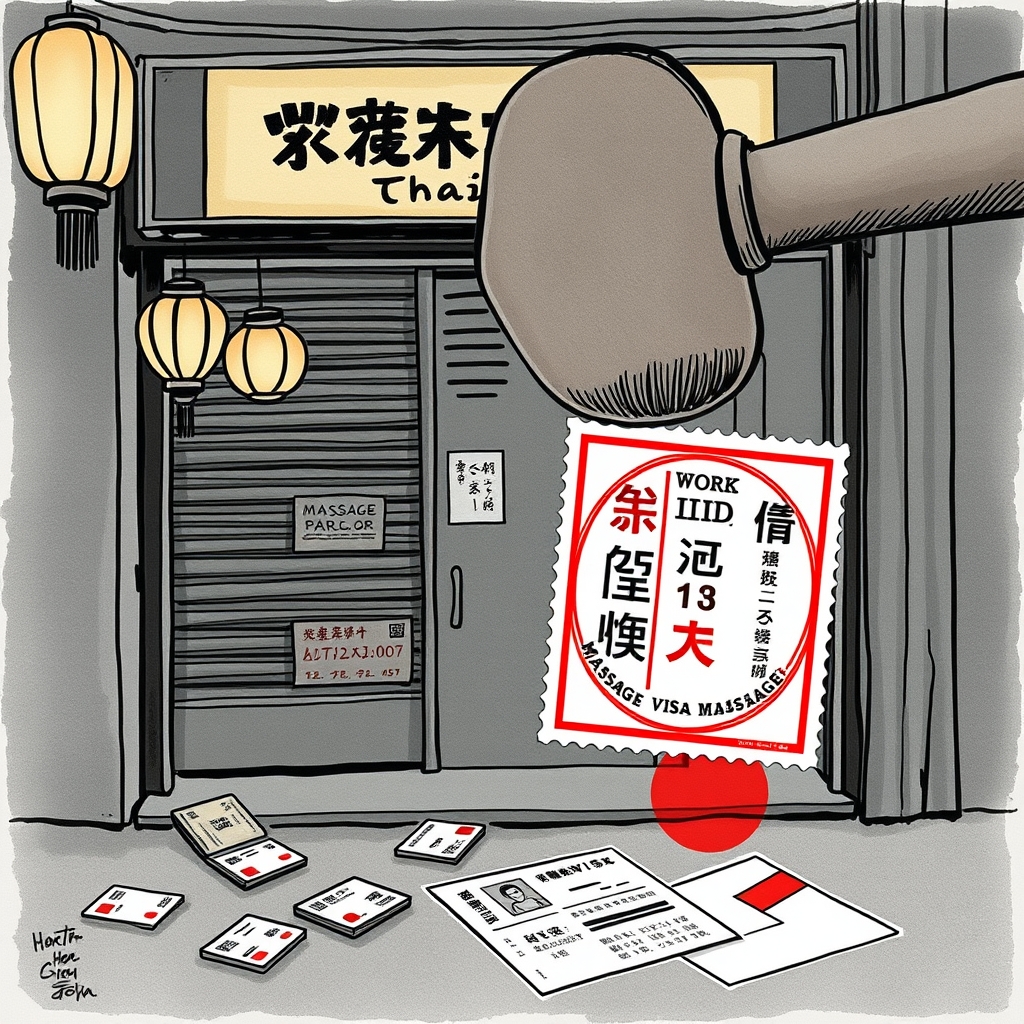
The new charge sharpens a detail that was only implied in the first round of arrests. Police allege that between November 20, 2022 and June 28 of this year, the two conspired to have three Thai nationals—men and women who were in Japan on "student" (ryugaku) and other residence statuses that carry no work authorization—work at four sex-industry establishments in Ueno, in Taito Ward, and three other locations in Tokyo.
A residence status governs what a foreign national may lawfully do in Japan, and a student visa in particular permits only limited, permitted part-time work, never employment in the adult-entertainment trade. Putting such visa-holders to work in a sex shop violates the immigration statute on two counts at once—both for the worker and, more seriously in the eyes of the law, for the employer who arranges it. It is that employer-side offense, the facilitation of illegal work, that the July 22 re-arrest targets.
Across the four shops, police estimate the operation took in roughly ¥343 million (about $2.3 million) over the four years to June 2026. That figure is markedly larger than the roughly ¥136.8 million cited when the case was first announced, reflecting the wider scope now attributed to the ring as investigators pull the full network of shops into a single accounting.
From a Zoning Charge to an Immigration One
The case first surfaced on July 2, when the Metropolitan Police announced the arrest of three people, including the same supervising-organization staffer, on suspicion of violating the Businesses Affecting Public Morals Regulation Act (fuei-ho)—the statute that licenses and polices Japan's adult-nightlife trade. That first charge turned on geography: the shops, one identified in earlier reporting as "Refresh Spa Ueno," allegedly operated a sex business inside a zone where such businesses are prohibited, all under the cover of a massage-parlor sign.
Re-arrests of this kind are a routine feature of Japanese criminal procedure. Prosecutors and police hold a suspect on one set of allegations, then, as an investigation widens, book them again on a fresh charge—resetting the detention clock and allowing officers to build out the larger case one statute at a time. Here the sequence moved from the zoning violation to the immigration offense, each charge illuminating a different way the operation is said to have broken the law: first where it ran, now whom it hired.
The Guardian and the Gap He Was Meant to Close
What has given the case its resonance is the day job of one of the accused. The 51-year-old man served, by the police account, as a supervising officer (kanri sekininsha) at a kanri dantai—one of the nonprofit "supervising organizations" that sit at the heart of Japan's foreign technical intern trainee program, charged with placing trainees at member companies and monitoring their treatment. The program has long drawn criticism at home and abroad for leaving foreign workers vulnerable to overwork and abuse, and the supervising organizations exist precisely to guard against that.
The allegation is that a man positioned to protect foreign workers was instead, off the books, helping run shops that put foreign visa-holders to work in a trade closed to them. The immigration charge frames the case less as a story about one district's sex trade than about the seams in Japan's system for admitting and overseeing foreign labor—and how a person entrusted to police those seams is accused of having exploited them.
Neither the initial fuei-ho case nor the new immigration charge has been tested in court, and one of the two suspects continues to deny the allegations. Investigators have signaled they are working to establish the full reach of the four-shop operation and how the three foreign workers came to be employed there.
This article is compiled from July 22, 2026 reporting by the Sankei Shimbun and TBS NEWS DIG (JNN), carried via Yahoo! News Japan and other outlets, on the re-arrest of two suspects on suspicion of facilitating illegal employment under the Immigration Control and Refugee Recognition Act. Background on the initial July 2 arrests draws on this site's earlier coverage and on reporting by the Sankei Shimbun and TBS NEWS DIG. Names, ages, residence wards, the employment period, the ¥343 million sales estimate and the admit/deny postures are attributed to those sources as published; the allegations have not been proven in court. Legal gloss: nyukan nanmin-ho = Immigration Control and Refugee Recognition Act, whose "facilitation of illegal employment" provision penalizes employers who put foreign nationals to work outside the terms of their residence status; ryugaku = the "student" residence status, which permits only limited authorized part-time work; fuei-ho = Businesses Affecting Public Morals Regulation Act, the law that licenses and restricts where and how adult-entertainment businesses may operate.