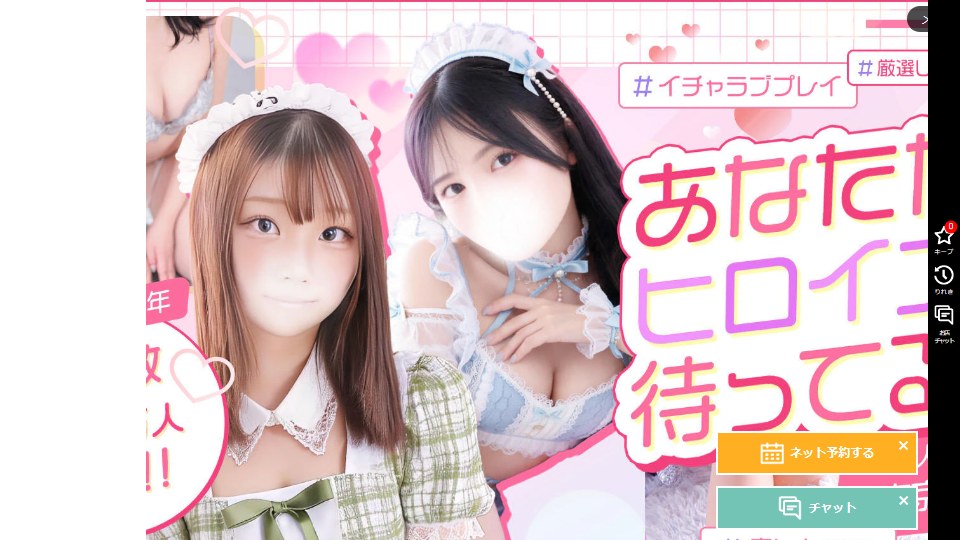

東京リップ秋葉原店 — Tokyo Lip Akihabara — sits in Taito ward at the edge of the electric town, and the line it leads with is a monopoly claim: 秋葉原唯一のホテル型ヘルス, the only hotel-type health in Akihabara. Underneath that runs a second claim about time — 25年営業の老舗店, twenty-five years under the banner — and a third about the roster: 超A級の素人美女, top-grade amateurs, current university students and office workers, working in maid costume. Cityheaven files it as デリヘル (ホテヘル&デリヘル), the hybrid category, which means the room is part of the conversation rather than entirely your problem. Phone's on the listing at 03-5812-0022, and the listing wants you to say ヘブン見た when you call.
Three claims, then. Only one of its kind, a quarter-century old, and dressed in the local uniform. Each one is doing different work, and only one of them is really about the girls.
Geography Is the Product
Every shop tells you where it is. Very few shops are about where they are. This one is, and you can see it in the way the copy leads with the district before it leads with the roster.
Akihabara is the densest concentration of maid-costume labor on the planet, and essentially none of it is sexual in any transactable sense. The maid café is a hospitality format — a two-drink minimum, a photo option, a rigorously enforced no-contact rule that is the actual reason the format survives at municipal scale. The costume is everywhere and the costume is inert. What that produces, over twenty-odd years, is a neighborhood full of men with an extremely specific visual vocabulary and nowhere in the neighborhood to take it.
That's the gap the only hotel-type health in Akihabara line is aimed at, and it's why the claim matters more than the usual "No.1 in the area" throat-clearing. "Only" is a statement about supply, not quality. It doesn't tell you the service is good. It tells you that if you want this particular thing in this particular district, the shop is aware you don't have a second option, and it has been aware of that for a long time. Read the price sheet with that in mind and it gets more interesting, not less.
A Two-Rung Ladder and What Sits Between the Rungs
The course menu is unusually short. Two numbers do nearly all the work:
| Course | Standard | First visit |
|---|---|---|
| 60 min | ¥19,500 | ¥15,500 |
| 80 min | ¥25,500 | ¥21,500 |
Nomination fee is charged separately — that's stated, and it is not optional in practice at a shop where the roster is the product.
Now do the arithmetic the shop is hoping you won't bother with. Standard sixty runs ¥325 a minute. The step from 60 to 80 costs ¥6,000 for twenty minutes — ¥300 a minute at the margin. That's a discount of eight percent for going long, which is one of the thinnest slopes I've seen on a Tokyo ladder; most shops cut fifteen to twenty percent to move you up a tier. And the first-visit column is the tell: it takes exactly ¥4,000 off both rungs, which means the marginal rate between them is still ¥6,000 for twenty minutes. The discount slides the whole ladder down; it never changes the shape.
That is a deliberate piece of design. A shop that wants you buying long courses bends the slope. A shop that's confident about volume just shifts the intercept, keeps the marginal rate flat, and lets you buy whatever length you want at the same underlying price. Combined with the "only one in the district" position, the picture is coherent: this is not an operator competing on the per-minute rate. It's an operator that knows the alternative to booking here is not booking here.
There's a third rung the menu doesn't print, and it's the important one. The net-reservation coupon — ¥2,000 off sixty, ¥3,000 off eighty and up, online booking only — carries an exclusion clause: it does not apply to Gold and Platinum cast. So the roster is tiered, and the tiers are priced. The two-line menu on the front page is the floor, not the range. Whatever the actual spread between a standard listing and a Platinum one, you will find it on the cast page and at the nomination fee, not on the course table. Budget accordingly, and if a specific name is the reason you're calling, ask what she costs before you ask what time she's free.
Nineteen Hours in a District That Closes at Eight
The door runs 10:00 to 05:00 the next morning, last reception 04:00. That's nineteen hours, and in most write-ups it'd be a throwaway line. In Akihabara it isn't, because the surrounding district keeps famously short hours: the electronics floors and the hobby shops and the cafés start pulling their shutters around eight in the evening, and by ten the streets that were shoulder-to-shoulder are a row of dark facades and vending-machine glow. Akihabara is a daytime town wearing a neon costume.
So this shop's clock deliberately does not match its neighborhood's. The hours that matter here are the ones after the district itself has gone home — the stretch from ten at night to four in the morning where the shop is one of very few things still answering a phone within walking distance. And the 10 AM open covers the other tail: the man who came in for the morning, the traveler with an afternoon, the shift worker on the wrong side of the clock. What's left is a genuine five-hour hole between 5 and 10 in the morning. Nineteen hours is not twenty-four, and if your plan involves a dawn train it involves a different shop.
The practical consequence of the ホテヘル&デリヘル hybrid tag is that you have two paths in and they aren't equivalent — the hotel-type route and having her come to a room you've already got. Which one applies to you depends on where you actually are, and the listing does not spell out the room arrangement in enough detail for me to spell it out for you. Sort that at the booking call. It's the single most common way a first visit to a hybrid shop goes sideways, and it takes about nine seconds to prevent.
What Twenty-Five Years Is Actually Evidence Of
The 老舗 claim — long-established shop, twenty-five years — deserves the same scrutiny as the other two.
In this trade, duration is real evidence, but of a narrower thing than the copy implies. It doesn't prove the service is good. It proves the shop has never had the kind of failure that ends a business: no license problem bad enough to close the doors, no reputation collapse, no stretch of empty months it couldn't cover. Twenty-five years means twenty-five years of solved problems. In a district where the retail tenants turn over constantly and the surrounding trade has a brutal mortality rate, an operator that has been running the same format since roughly the turn of the century has demonstrated something specific: it knows how to keep a roster staffed, a phone answered, and the authorities uninterested.
What it also means — and the shop would not put this on the banner — is that the format hasn't needed to change. A two-rung price ladder, a costume theme borrowed from the neighborhood, an amateur-recruitment line, a phone number you're asked to say a magic word into. None of that is 2026 thinking. It's a 2001 shop that works, still working. Whether that reads as reassuring or as complacent is genuinely a matter of what you want out of the evening.
The Verdict
- Positioning: ★★★★★ — "the only hotel-type health in Akihabara" is the single most useful sentence on the listing, and it's a supply claim rather than a quality claim. If the maid register in a hotel room is specifically what you're after in this district, the shop has correctly identified that you don't have a shortlist.
- Price transparency: ★★★☆☆ — the two-rung table is clean and the first-visit column is honest, but the real spread lives off-menu in the Gold/Platinum cast tiers and the separately-charged nomination fee. The published sheet is a floor, not a range, and the listing doesn't say by how much.
- Value: ★★★☆☆ — ¥19,500 for sixty is a firm mid-to-upper Tokyo number, and the ladder only concedes eight percent for going long. ¥15,500 on a first visit is a fair door. You are paying something for the monopoly, and the flat marginal rate is what that surcharge looks like.
- Hours / access: ★★★★☆ — 10:00 to 05:00 with a 04:00 last call, covering both the district's dead late hours and its underused mornings; a real five-hour blackout at dawn.
- Review integrity: ★★☆☆☆ — the +15-minutes-for-a-4.0-or-better coupon is disclosed, which is more than many manage, but it means the aggregate score on the page is a purchased number. Read the individual writeups, discount the average.
- Going back: ○ — yes, and on the 80 rather than the 60, with the cast tier and the room arrangement both settled on the phone before anything else.
I came out of this one thinking about the curb again. Akihabara has spent two decades perfecting a version of the maid fantasy that is immaculate, ubiquitous, and structurally incapable of going anywhere — and the entire economy of the district depends on it staying that way. Tokyo Lip has been standing at the one place that line gets crossed for twenty-five years, charging ¥325 a minute for the privilege and not discounting much for volume, because why would it. That's not a criticism. It's just what a monopoly's price sheet looks like when it's being honest about being one.
Know what you're buying: not the cheapest hour in Tokyo, and not a surprise. A specific fantasy, sold in the one district in the world that manufactures it wholesale and refuses to deliver it, by the shop that has been the exception since before most of that district's maid cafés existed. Go in with the cast tier priced and the room sorted, take the eighty, and skip the star rating on the way past. First visit logged.