The Name Is Doing a Job, and It's Not the One You Think
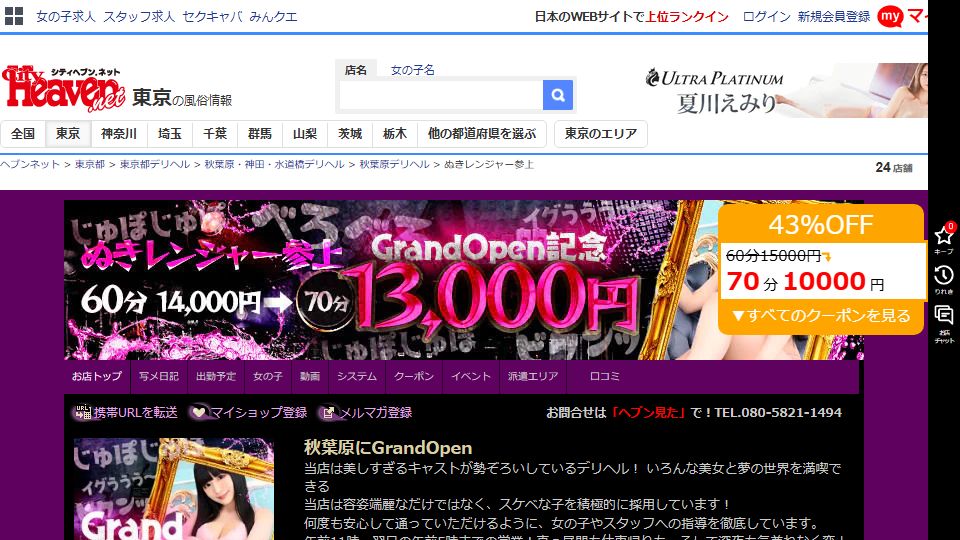
Let's talk about the name first, because Nuki Ranger Sanjou is practically begging you to. It translates, loosely and cheerfully, to something like "The Ranger Squad Has Arrived" — sentai energy, the color-coded superhero-team gag every Japanese kid grew up on, bolted onto a delivery-health shop in the electronics-and-anime capital of the planet. It is exactly the kind of pun that lands harder in Akihabara than it would anywhere else on Earth, and that is not an accident. The name is a location strategy wearing a costume.
So let me frame the genre before the gimmick swallows it. This is a delivery health operation — outcall, no storefront, no room to visit. You call, they dispatch a cast member to your hotel or residence somewhere in the Akihabara–Kanda–Suidobashi stretch, and the course you buy is time and company, not a fixed menu you can point at. Hours run 11 in the morning to 5 the next morning, which is a genuinely wide window for a dispatch shop. The theme is sentai and cosplay-adjacent; the business underneath it is the same phone-and-a-van model that runs every outcall in Tokyo. Read the theme as flavor, and read the model as the thing you're actually paying.
Reading the Price Ladder Like a Grown-Up
The course structure is refreshingly legible: ¥15,000 for sixty minutes, ¥23,000 for ninety, ¥30,000 for a full two hours, ¥48,000 for three, and — for the truly committed — a ¥150,000 all-night rental that stretches up to two days. Walk down that ladder and the math tells its own story. The hour is your sampler. Ninety minutes is where the per-minute rate starts making sense and the session gets room to breathe. The two-hour and three-hour courses are the shop quietly telling you where it thinks the real evening lives.
And in a delivery genre specifically, minutes matter more than they do storefront-side, because a chunk of your first stretch is pure logistics — she's traveling, she arrives, there's a shower, there's the settling-in. Buy sixty and you've spent a real fraction of it on overhead before anything gets going. The ninety is the honest floor for outcall; the two-hour is where the clock stops being the third person in the room. Nobody's hiding this. The price ladder is a recommendation written in yen, and the shop is nudging you up it for the same reason you'd want to go: the longer bookings are simply the better night for both parties.
The Recruiting Copy Tells You Who the Shop Thinks It Is
Every shop prints "beautiful cast," so that phrase carries no information — it's the industry's version of "we value your call." What's slightly more telling on Nuki Ranger's page is the way it leans into recruiting "perverted girls" and advertises thorough staff training. Ignore the wink for a second and look at what those two claims, side by side, are actually broadcasting. One says the shop is selecting for enthusiasm on the cast side. The other says it's trying to standardize the experience so the enthusiasm doesn't turn into chaos. Whether it delivers on either, a page can't prove. But a shop that bothers to say both is at least aware that "fun" and "reliable" are two different promises, and that outcall customers want the second one at least as much as the first.
That's the read I'd trust over any adjective. A delivery shop lives entirely on repeat business — there's no walk-in foot traffic to bail out a bad week — so the operations that survive in a district this crowded are the ones that made enough people comfortable enough to dial the same number twice. The theme gets you to remember the name. The training, if it's real, is what gets you to call it again. In this trade, the second call is the only review that counts, and it's the one metric the marketing copy can never fake for you.
So — Who's It For?
Nuki Ranger Sanjou is for the traveler or the local parked in the Akihabara–Kanda–Suidobashi belt who wants the outcall experience delivered rather than visited, and who gets a small kick out of a shop with a personality instead of a beige three-word name. The near-round-the-clock window — 11am to a 5am close — makes it a live option in the awkward hours when the storefronts have gone dark, which for a district full of all-night arcades and capsule hotels is a genuinely useful footprint. Bring a decent room, buy enough minutes, and keep your head clear about what the theme is and isn't.
Worth it? On the promise it actually makes — a legible-priced, wide-hours delivery-health outcall with a memorable hook, serving one of Tokyo's densest entertainment districts — sure, provided you climb a rung or two up that price ladder and prep a room worth walking into. On the promise a first-timer might imagine — that the sentai gag is a full costumed production guaranteed at the door — pump the brakes and confirm it on the phone, because the page sells a delivery service with a theme, not a theme with a delivery service attached. Get that distinction right and the "Ranger Squad" showing up at your door is a fun night in a fun town. Get it wrong and you've written a check the menu never signed. Ask the questions, book the longer course, bring the room. The squad brings the rest.
Akihabara sells fantasy better than anywhere in Japan — it's the whole point of the neighborhood. A delivery shop that wraps itself in a superhero gag is just speaking the local dialect fluently, and there's nothing wrong with that as long as you remember which half is the costume and which half is the business. Read the price ladder, ask for the all-in number, prep a room the squad would want to walk into, and let the gimmick be the fun bonus it's meant to be — not the thing you mistook for the whole deal.
Summary
| Item | Rating |
|---|---|
| Concept & memorability (the sentai hook) | ★★★★★ |
| Price legibility (clear course ladder) | ★★★★☆ |
| Value once you climb past the 60-min entry | ★★★★☆ |
| Hours & reach (11am–5am, Akihabara belt) | ★★★★★ |
| Outcall convenience (you supply the room) | ★★★★☆ |