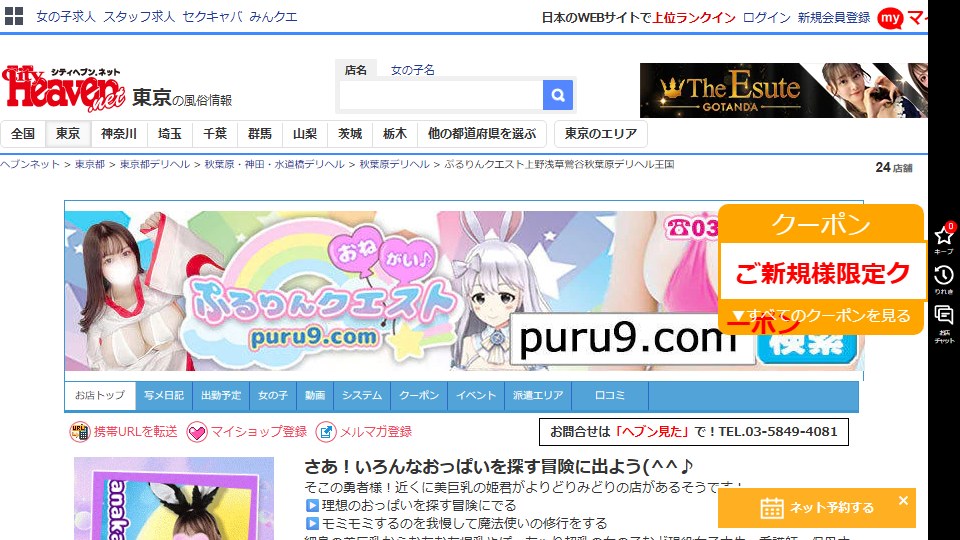
The listing says Akihabara. The dispatch area line says Akihabara, Taito Ward. The genre tag says delivery health, gakuen-kei — the school-flavored end of the market. And then, about two-thirds of the way down its own page, Pururin Quest (ぷるりんクエスト) stops talking about Akihabara entirely and starts giving you a walking tour of the north exit of JR Uguisudani Station, one stop past Ueno. Not a vague nudge. Names of hotels. Flat rates. Which ones still take short stays at 3 AM. I have never had a shop hand me a rival industry's price sheet before, and I've rarely learned more from one page.
The Page Tells On Itself
Right there in the fine print: this is the Akihabara sub-page. The brand runs 24 branches and roughly 1,620 women across its network, and the Akihabara listing is one storefront in that system — a door cut into the wall facing Electric Town. The tell is small but total: the shop's "okini talk" feature, the direct line to a girl you've already seen, isn't available from this page at all. You're told to go open the Uguisudani listing for that. So the Akihabara page is a real booking channel with one hand tied behind its back, pointing east. If you book by neighborhood, this is the moment to notice you aren't buying a neighborhood. You're buying a dispatch radius, and its center is one station away.
The Four Steps, and the One That Trips People
The shop lays out the run in four lines, and the order matters more than it looks:
- Check the shift schedule and reserve.
- At your reservation time, get into the hotel first.
- When she arrives, shower together.
- Then the adventure.
Step two is where first-timers blow it. This is delivery health — nobody is meeting you at a shopfront. You have to be in a room with a key in your pocket before the clock means anything. Turn up at the station at your booking time and you're not early, you're already behind: standing on a sidewalk in Uguisudani picking a hotel under time pressure, which is the single worst condition for picking a hotel. That's the failure mode the shop pre-empts by publishing a hotel guide in the first place.
The Hotel Sheet, Which Is the Real Local Knowledge
Uguisudani's north exit has, by the shop's count, about 60 love hotels, with rates starting around ¥2,500 for two hours. Then it gets specific in a way listings almost never do. The P-Door group flagship is quoted at a flat ¥3,900 for two hours; Legend P-Door and Asian P-Door at ¥3,500. Cheaper still is the place with the orange sign — Savoy — past the izakaya street immediately right of the north exit ticket gate. Le Club, Lux and Station Honten get named as regular favorites.
But the sentence that actually earns its place is this one: late at night, many Uguisudani hotels stop taking short stays and switch to overnight-only, while the P-Door group keeps short rest stays running 24 hours. That is the difference between a 2 AM booking that works and a 2 AM booking where you're paying for a full night you didn't want, or worse, walking. And the closer: if you were considering a hotel in Ueno or Asakusa instead, Uguisudani is the cheaper play. Two stops of local geography, delivered without flourish, worth more than the entire branding effort above it.
What the Checkout Screen Actually Says
The course ladder is straightforward — ¥15,000 for 60 minutes, ¥18,000 for 80, ¥23,000/100, ¥28,000/120, ¥36,000/150, ¥44,000/180, with the shop flagging 80 as its recommendation because costume play is free from 80 minutes up. And the costume rack is not a token gesture: police, maid, bunny, sailor uniform, gym clothes, kimono, apron, pajamas, dress shirt, school swimsuit, micro bikinis in several colors — a couple dozen options.
The line items around it are where the useful surprises hide:
- Photo shimei is free. Picking the specific woman whose photo you're looking at costs nothing. Honshimei — asking for someone you've already seen — is ¥2,000. That's backwards from what you'd expect, and it means loyalty is the thing that carries a fee here, not selection.
- Advance booking costs money going backwards in time: ¥1,000 to book the day before, ¥2,000 two days before. New customers and members can reserve from two days out; honshimei from three.
- An extension is ¥10,000 per 30 minutes. Do this arithmetic before you book, not after. Going 60 and extending twice lands you at ¥35,000 for 120 minutes; booking 120 outright is ¥28,000. Under-ordering is the expensive mistake, and it's the one the clock makes tempting.
- Cancellation is ¥2,000 plus transport. Non-Japanese speakers: there's a ¥3,000 charge and Japanese is required — the shop states it plainly, so don't book expecting English support.
- Options run a tiered ladder from ¥1,000 (glasses, rotor, fishnets, no-bra or no-panty dispatch) up through ¥2,000, ¥3,000, ¥4,000 and ¥5,000 tiers. Nothing is hidden, but nothing is included either.
The Treasure Box Has a Weather Forecast
The brand's promo is a "gold treasure box" on the official site worth ¥1,000 to ¥5,000 off, plus a slot that pays out if the last two digits of your phone number match. Cute, on-theme, standard variable-reward stuff. Except the page adds one line I keep thinking about: the treasure boxes appear more often on rainy days.
That's a shop telling you, in fantasy costume, exactly when its demand dips. Rain empties the streets around Uguisudani, bookings soften, and the discount rate quietly climbs to fill the board. It's dynamic pricing wearing an RPG hat. And it's actionable in the most literal way available to a customer: if you're flexible about which night you go, go on a wet one.
Field Notes
The Akihabara page got me in the door and then, to its credit, told me the truth about itself: the search term is Akihabara, the operation lives in Uguisudani, and the useful part of the listing isn't the fantasy copy at the top but the unglamorous logistics buried near the bottom. Book the 80 at ¥18,000 so the costume is free, or go straight to 120 at ¥28,000 if you know yourself, because extensions at ¥10,000 a pop will overtake the longer course fast. Reserve, then get your key at the north exit before the hour turns over. Check whether your hotel still does short stays if you're running past midnight. And if the forecast says rain, that's not a reason to reschedule — around here it's a coupon.
One page, two neighborhoods, and all the real information sitting under the marketing like a subway line under a tourist map. Follow the instructions, not the address.