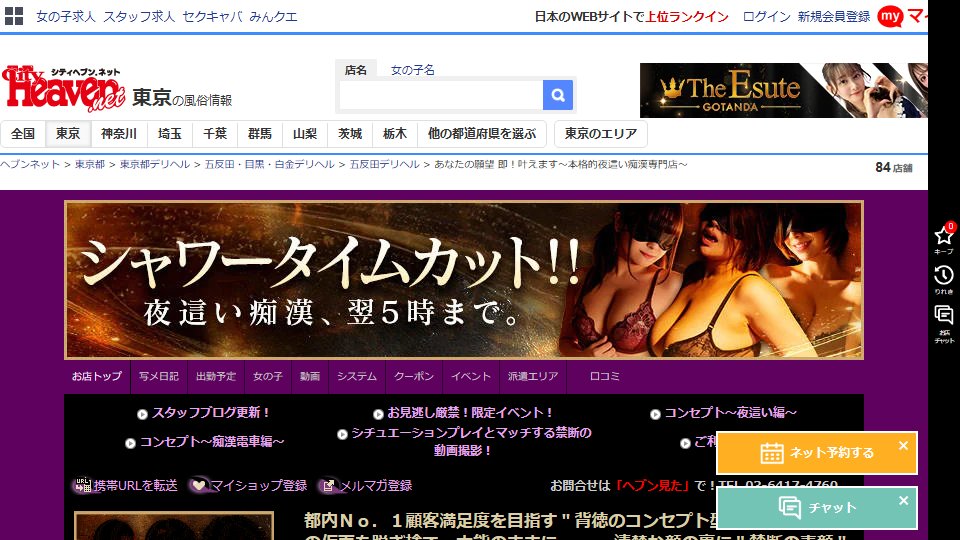

Gotanda is a working man's interchange with a red-light habit. The Yamanote stops here, the Asakusa line stops here, the Ikegami line crawls off toward the residential south, and in between the office towers there's a dense little grid of love hotels that exists precisely because Gotanda is where you change trains and think about not going home yet. It's not Kabukicho — nobody comes to Gotanda for the spectacle. Which makes it a good place to run a shop that sells something specific rather than something loud.
The shop is Anata no Ganbou Soku! Kanaemasu — Honkakuteki Yobai Chikan Senmonten, which translates roughly as "Your Desire, Granted Immediately — Authentic Yobai & Chikan Specialty Shop." It's a deriheru (delivery health — outcall only, she comes to your hotel room) run on an imekura chassis, meaning image club: costume, premise, script. Phone is 03-6417-4760. It runs 10:00 to 05:00 the next morning, 年中無休 — no closed days — with phone reception opening at 10:30. Nineteen hours a day in a neighborhood built around the last train is not an accident.
The shop doesn't sell a girl. It sells a scene.
Two premises, both named on the sign. Yobai (夜這い) is the old rural night-crawl — the man who slips into the room of a sleeping woman. Chikan (痴漢) is the groping scenario, staged as the packed-train tableau that Japanese adult media has been mining for forty years. Both are, in this building, theater: a scripted encounter between consenting adults in a licensed shop, in which one of them has agreed in advance to play asleep or play a stranger on a train. That agreement is the entire product. Strip it out and there's nothing here — no premium body type, no discount war, no house gimmick. Just the script.
Which is why the mechanism that matters most on this shop's page isn't the price ladder. It's the advance request system — you tell them the scenario before dispatch. Where it opens. What she's doing when you come in. What she does when she "wakes." What's out of bounds. Most Tokyo deriheru take a course length and a girl's name and consider the intake complete. This one takes a scene.
I've written before that a concept shop is only as good as its staff's willingness to run their own concept, and the tell is always the phone call. Reception here asks scenario questions the way a restaurant asks about allergies — flatly, procedurally, like it's the tenth time today, because it is. That flatness is the good sign. It means the script is infrastructure, not novelty.
The price sheet is one straight line
Four courses, published as follows.
| Duration | Price | Per minute |
|---|---|---|
| 60 min | ¥17,000 (¥16,000 promo) | ¥283.3 |
| 80 min | ¥22,000 | ¥275.0 |
| 100 min | ¥27,000 | ¥270.0 |
| 120 min | ¥32,000 | ¥266.7 |
Per-minute drifts downward, which looks like an ordinary volume taper until you check the gaps instead of the rates. Every step up is twenty minutes and every step up costs ¥5,000. Exactly ¥5,000, three times in a row. That's a constant marginal rate of ¥250 a minute, and once you have the slope you can back out the intercept:
Price = ¥2,000 + (¥250 × minutes)
Check it against all four cells. 60 → 2,000 + 15,000 = ¥17,000. 80 → 2,000 + 20,000 = ¥22,000. 100 → 2,000 + 25,000 = ¥27,000. 120 → 2,000 + 30,000 = ¥32,000. Four for four, to the yen.
So there is no volume discount here at all. The declining per-minute column is an illusion produced by a flat ¥2,000 door charge getting spread across more minutes. Time itself costs the same ¥250 whether you buy sixty minutes of it or two hours. What you're amortizing when you book long isn't the shop's time — it's the two thousand yen it costs to get the shop to show up at all.
The extension is priced exactly on the line
Extensions run ¥2,500 per 10 minutes. That's ¥250 a minute — the identical slope as the course ladder.
This is rarer than it should be. The standard move in this trade is to price the extension above the line, because a man in a hotel room at minute 55 is the least price-sensitive customer in Japan and everybody knows it. A shop charging ¥300 or ¥350 a minute for in-room extension would be unremarkable. This shop charges the same ¥250 it charges at the booking stage, which means extending is mathematically neutral: book the 60 at list and extend twice, and you've paid 17,000 + 5,000 = ¥22,000 for eighty minutes, which is the eighty-minute course to the yen.
Neutral at list. But the shop is running a discount on exactly one cell — the 60, at ¥16,000 — and that ¥1,000 doesn't get clawed back by the extension rate. So it carries:
| Target length | Book it outright | Promo 60 + extensions | You keep |
|---|---|---|---|
| 80 min | ¥22,000 | 16,000 + 5,000 = ¥21,000 | ¥1,000 |
| 100 min | ¥27,000 | 16,000 + 10,000 = ¥26,000 | ¥1,000 |
| 120 min | ¥32,000 | 16,000 + 15,000 = ¥31,000 | ¥1,000 |
The discounted entry course is the cheapest door into every length on the board, by a flat thousand yen, forever.
Now the honest caveat, because this is the kind of tip that gets people burned: an extension is not a right, it's an availability. If she has a booking after yours, there is nothing to extend into, and you will have bought sixty minutes when you wanted a hundred. You're wagering ¥1,000 against her schedule. Off-peak on a weekday afternoon, that's a decent bet. Friday at 23:00 in Gotanda, book the length you actually want and don't be clever.
The toy ladder stops climbing at 100
The shop includes adult toys free, scaled to course length — コース時間に応じて、大人の玩具が無料で使えます. The ladder:
| Course | Toys included |
|---|---|
| 60 min | 1 |
| 80 min | 2 |
| 100 min | 3 |
| 120 min | 3 |
Three at 100, three at 120. The included-goods ladder tops out one rung before the price ladder does, which means the 120 buys nothing except twenty more minutes at the same ¥250 — no extra kit, no bump in inclusions. That's not a criticism, it's a read: if you're choosing between the 100 and the 120, you are purchasing time and only time, and you can buy that same time in the room for the same rate if she's free. The 100 is where the package stops sweetening.
Also on the inclusions side: shower time is cut from the clock, not billed against your course, and the shop advertises no cap on finishes. Both are ordinary claims in this segment, but the shower-cut is the one with money attached — at ¥250 a minute, ten minutes of rinse-off you aren't paying for is ¥2,500, which is an entire extension block.
Transport: Gotanda is free, and that is the entire point
| Zone | Fee |
|---|---|
| Gotanda Station, East & West exit hotels | ¥0 |
| Shinagawa Ward / Shinagawa Station area | ¥1,000 |
| Minato, Shibuya, Shinjuku, Chiyoda, Chuo, Ota, Meguro, Setagaya (part) | ¥2,000 |
| Setagaya (rest), Suginami, Nakano, Toshima, Bunkyo, Arakawa, Taito, Adachi | ¥3,000 |
| Nerima, Itabashi, Kita, Adachi (rest), Katsushika, Edogawa, Kawasaki (part) | ¥4,000 |
Read that ladder as an instruction rather than a table. Booking a room by Gotanda's east or west exit is worth ¥2,000 against a Shibuya or Shinjuku room and ¥4,000 against an Edogawa one — and ¥4,000 is sixteen minutes of course time. The free zone is small and it's tight around the station on purpose. This shop is optimized for the man already standing in Gotanda, which, given that Gotanda's hotel grid is a five-minute walk from the Yamanote turnstiles, is an easy optimization to comply with.
What it actually costs
Cheapest legitimate all-in, at a Gotanda hotel, on the promo: ¥16,000 course + ¥0 transport + ¥1,000 net nomination = ¥17,000 for sixty minutes with a girl you picked off the site.
Nomination is worth a note. Net nomination is ¥1,000; repeat nomination is ¥2,000 — picking her the first time off the web listing costs half of what asking for her again costs. That inversion is standard in Japan and it's not a trick: the ¥1,000 is a customer-acquisition price and the ¥2,000 is what loyalty is actually worth to the shop, which is more. Budget for the number to double the moment you like someone.
One more line that moves real money: card payment carries a 10% fee. On the ¥16,000 promo that's ¥1,600 — larger than the thousand yen you just spent three sections learning how to save. On a 120 it's ¥3,200. Bring cash. The ATM is cheaper than the surcharge every single time.
Verdict
- Concept execution: ★★★★☆ — the advance request system is real, procedural, and staffed by people who take a scene the way a kitchen takes an order.
- Price transparency: ★★★★★ — four cells that sit on one line with no rounding fudge, and an extension priced honestly at the same rate rather than gouging the man at minute 55.
- Value at ¥17,000 all-in: ★★★★☆ — competitive for central Tokyo scenario work, provided you sleep where the free zone is.
- The 120: ★★☆☆☆ — buys time and nothing else once the toy ladder caps at 100.
- Going back: ◎ — with the scene written down in advance and cash in my pocket.
The thing worth remembering about this shop isn't the arithmetic, clean as it is. It's that a place selling two of the more loaded premises in the Japanese adult catalogue handles them with an intake form — and that the intake form is what makes the premises workable at all. The fantasy is the thing on the sign. The paperwork is the thing that makes it a business rather than a mess. Gotanda's a station where people change trains and reconsider going home; this is a shop that will meet you there, five minutes from the turnstile, for ¥250 a minute and a scene you wrote down first. In a trade that mostly sells vagueness, that's a rare amount of specificity — and specificity, priced on a straight line, is what I'll take every time.